Quality assurance (QA) teams are used to thinking in terms of test cases, regression suites, and continuous integration pipelines. But the moment a device leaves the realm of pure code and enters the physical world — a smartphone, a wearable, a piece of industrial equipment — a different question comes up again and again in QA forums and team retros: is hardware testing just "software testing for objects," or is it an entirely different discipline?
This is one of the most frequently asked questions among testers who move between software-only projects and device-centric ones, yet it rarely gets a clear answer. Understanding the distinction matters, because treating hardware testing like an extension of software QA can lead to gaps that no amount of code review will catch.
What hardware testing actually verifies
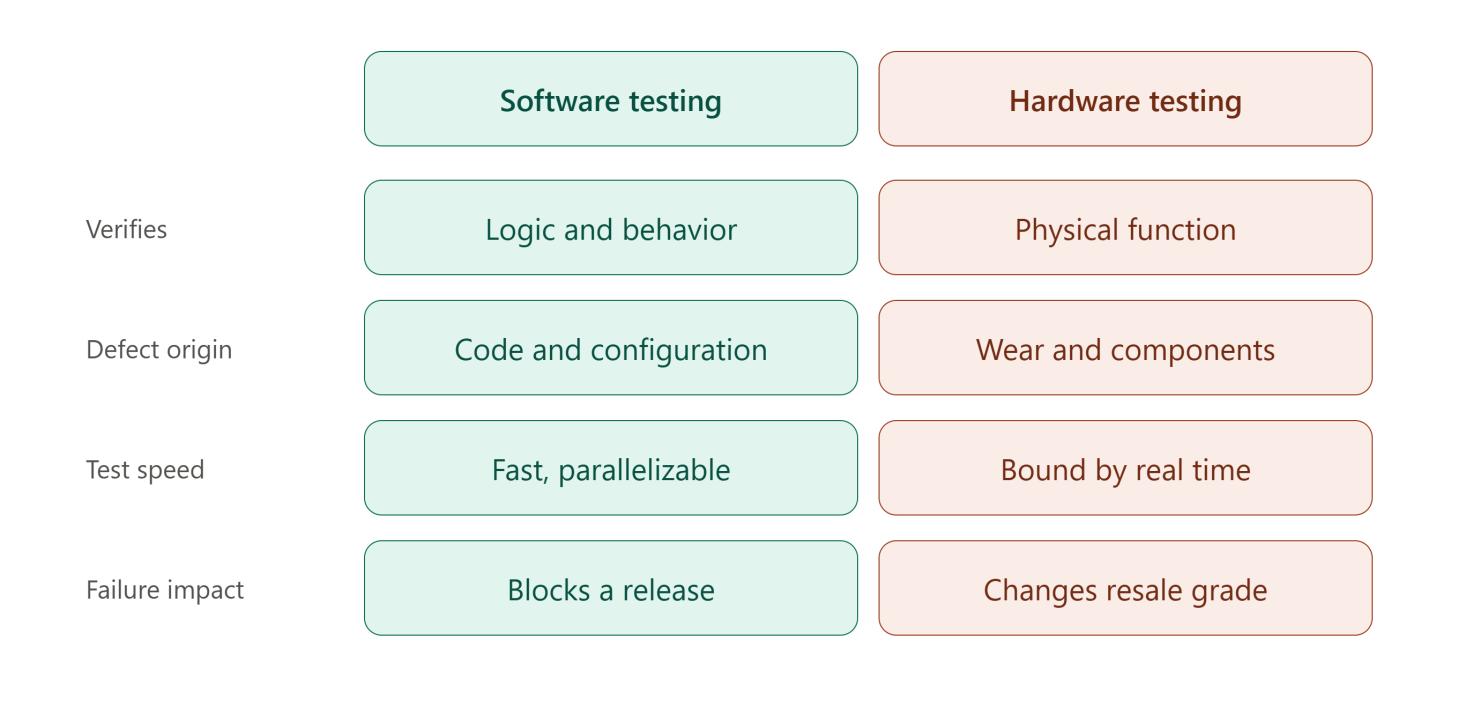
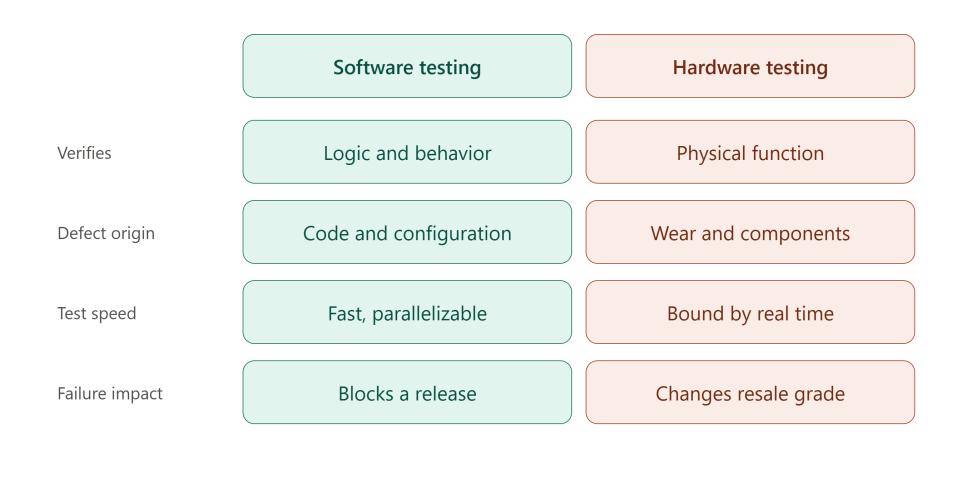
Software testing validates logic: does the application behave as expected given a set of inputs. Hardware testing validates physical function: does the component perform as expected given real-world conditions like temperature, vibration, wear, or electrical load.
A mobile device is a useful example. Its operating system and apps can pass every functional test while the physical unit still has a failing battery, a cracked digital-to-analog converter, or a camera sensor that no longer focuses correctly. These are not code defects. They are physical degradations that only show up when the actual hardware is exercised.
Typical categories covered by hardware testing include:
- Power and battery performance under load
- Display, touch response, and screen calibration
- Sensors (accelerometer, gyroscope, proximity, biometric)
- Connectivity modules (cellular, Wi-Fi, Bluetooth, NFC)
- Audio input and output components
- Physical buttons, ports, and connectors
Where the two disciplines overlap
Despite the differences, hardware and software testing share a common foundation. Both rely on repeatable test cases, both benefit from automation to reduce human error, and both depend on clear pass/fail criteria to be meaningful at scale.
The overlap becomes most visible in embedded and IoT contexts, where firmware sits directly on top of hardware. In these environments, a single defect report can originate from either layer, and distinguishing a firmware bug from a component failure requires testers who understand both worlds.
This is also where automation delivers the biggest return. A manual tester checking a device's speaker, microphone, and vibration motor one at a time introduces variability: fatigue, inconsistent judgment calls, and differing thresholds between shifts. Automated hardware test suites apply the same criteria every time, which is the same argument QA teams already use to justify automating regression suites in software.
Why the testing approach still diverges
Even with automation in place, a few structural differences keep hardware and software testing from being interchangeable disciplines.
- Hardware tests are constrained by physical time. A battery drain test or a thermal stress test cannot be sped up the way a unit test can; the component still needs real time to respond to real conditions.
- Hardware defects can be intermittent and condition-dependent. A charging port may test fine at room temperature and fail once a device has been in a warm environment, which pushes teams toward environmental and batch testing rather than a single pass/fail run.
- Hardware test results carry residual value implications. In software, a failed test blocks a release. In hardware, a failed test on a used or refurbished device changes its resale grade, warranty status, or eligibility for a marketplace listing, which adds a commercial layer that software QA rarely has to account for.
That last point is increasingly relevant as more industries process physical devices at scale, such as consumer electronics moving through refurbishment pipelines before resale. In these settings, defects can be easy to miss when units are processed in batches rather than one at a time, and charging faults on wearable devices are a good example of a defect that becomes visible only under bulk testing conditions, not single-unit spot checks. It is a useful illustration of why a hardware testing strategy needs to account for volume, not just accuracy on an individual device.
Building a testing strategy that accounts for both
Teams that manage both software and hardware quality tend to succeed when they stop trying to force one methodology onto the other and instead define where each applies.
A practical starting point:
- Map defects by origin. Before triaging an issue, confirm whether it is reproducible in isolation from the hardware (a software bug) or only when a specific physical component is engaged (a hardware bug).
- Separate test environments. Software regression suites can run continuously in virtual environments; hardware tests need dedicated device pools, environmental controls, or robotics for consistent, repeatable stress conditions.
- Standardize pass/fail thresholds for physical checks the same way functional tests use assertions. A vague threshold like "the screen looks fine" is not testable; a defined brightness range or response-time value is.
- Track hardware test history per unit, not just per release. Software testing usually resets with each build; hardware testing benefits from a persistent record tied to the individual device, since the same physical unit may be re-tested multiple times across its life cycle.
Conclusion
Hardware testing and software testing are not competing disciplines, but they are not the same one either. Software QA verifies logic and behavior in a controlled, repeatable digital environment, while hardware testing verifies physical performance under conditions that are harder to standardize and often tied to the commercial value of the unit itself. Teams that recognize this distinction — and build separate but coordinated testing strategies for each — catch defects that a purely software-oriented QA process would miss, whether that process is validating an app or validating the physical device it runs on.