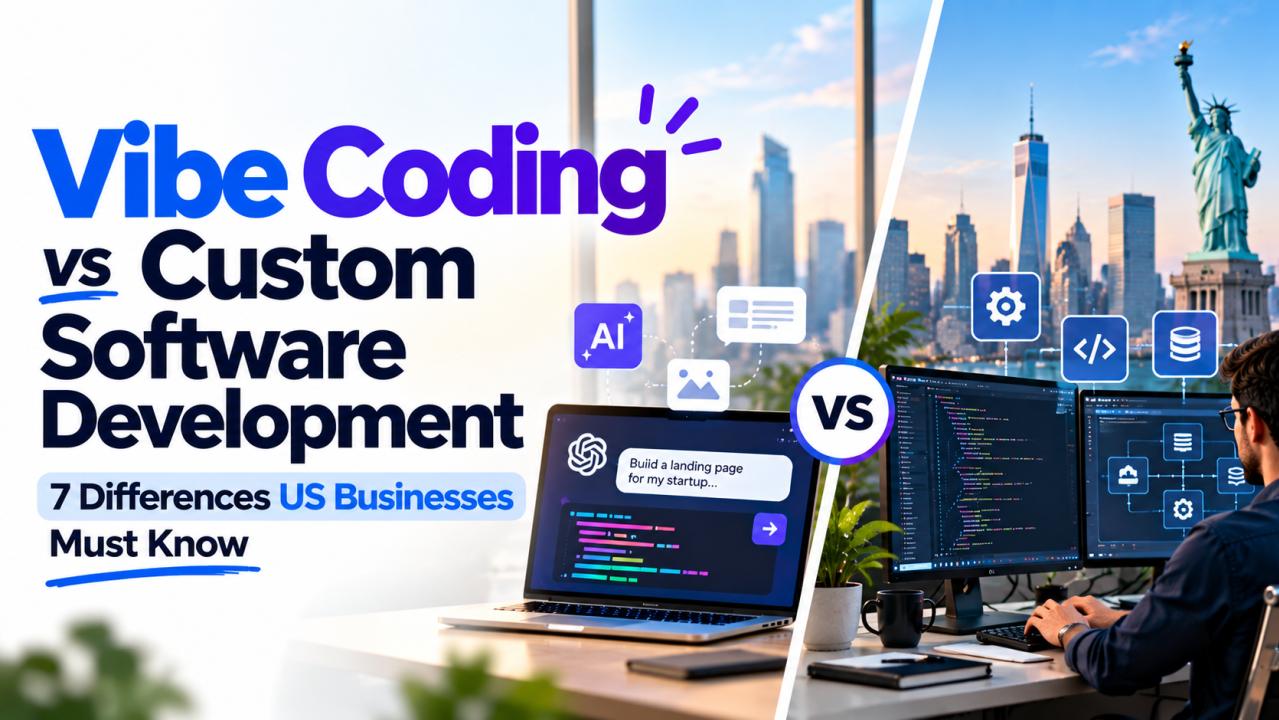
What if businesses stopped treating vibe coding and professional software development as competitors?
AI coding tools can now generate interfaces, APIs, and functional prototypes from natural language instructions. Meanwhile, experienced software engineers remain essential for solving complex architectural, security, and operational problems.
The opportunity isn't necessarily choosing one over the other. It's understanding where each approach delivers the most value.
According to GitHub's Octoverse 2025 report, more than 1.1 million public repositories used an LLM SDK, reflecting the growing adoption of AI technologies in software projects.
For American companies evaluating software development services in usa, this shift raises an important question: How can businesses benefit from AI generated code without compromising product quality?
Here are six practical ways to combine both approaches.
1. Use Vibe Coding to Validate Ideas Before Investing Heavily
Imagine a Texas based startup developing a platform connecting homeowners with local contractors.
Instead of spending months building a complete marketplace, the founders could use AI coding tools to create an early prototype featuring:
User registration and basic profiles
Contractor listings
Search and filtering
Simple booking requests
This prototype can help demonstrate the concept and collect initial feedback.
However, once real payments, personal information, and contractor verification enter the picture, professional engineering becomes increasingly important.
The practical approach: Use vibe coding to test whether customers want the product before investing in a complete production system.
2. Let AI Handle Repetitive Development Tasks
Professional developers spend considerable time writing routine code, creating test cases, and maintaining existing functionality.
AI tools can accelerate parts of that work.
For example, developers can use AI assistance for:
Generating boilerplate code
Creating basic user interfaces
Drafting API endpoints
Writing initial unit tests
Preparing technical documentation
However, generated output still needs validation.
A working code snippet doesn't guarantee compatibility with the overall application architecture.
Businesses investing in custom software development solutions should therefore evaluate how efficiently engineering teams use AI rather than assuming that manually written code is always superior.
The practical approach: Automate repetitive coding while keeping architectural decisions and technical reviews under experienced engineers.
3. Keep Security Critical Features Under Professional Supervision
Consider a California healthcare startup developing an appointment management application.
AI might generate the scheduling interface quickly. But protecting patient information requires additional planning.
Security sensitive components may include:
Authentication and authorization
Payment processing
Database permissions
Encryption and secrets management
Audit logs and access monitoring
The NIST Secure Software Development Framework recommends integrating security practices throughout software development rather than addressing vulnerabilities only after deployment.
Whether code comes from an AI assistant or an experienced developer, security controls must be implemented and tested.
The practical approach: Use AI to assist with implementation, but require qualified engineers to review sensitive workflows before release.
4. Build Custom Features Instead of Recreating Everything
One expensive mistake businesses make is developing functionality that existing platforms already provide effectively.
For example, a US ecommerce startup may need payment processing, customer notifications, inventory management, and personalized product recommendations.
Building every component internally may not make financial sense.
A hybrid strategy could involve:
Using established payment processing APIs
Buying existing customer communication services
Generating simple administrative interfaces with AI
Developing proprietary recommendation logic professionally
This allows engineering resources to focus on features that actually differentiate the business.
Experienced providers offering custom software application development services can help determine which components justify custom engineering.
The practical approach: Buy commodity features, accelerate simpler development with AI, and invest in proprietary functionality.
5. Introduce Professional Testing Before Scaling
A prototype may perform well with a handful of users but behave differently after attracting thousands of customers.
Problems can emerge from inefficient database queries, unstable integrations, inadequate infrastructure, or inconsistent error handling.
Before scaling, businesses should introduce:
Automated functional testing
Security and dependency scanning
Performance and load testing
Application monitoring
Backup and recovery procedures
For example, a logistics platform operating across multiple US states may require reliable synchronization between warehouses and delivery partners.
An attractive AI generated dashboard cannot compensate for inaccurate inventory transactions.
The practical approach: Treat production readiness as a separate milestone from completing the prototype.
6. Choose Development Partners Who Understand AI Assisted Workflows
Hiring a professional development team doesn't mean abandoning vibe coding.
In fact, the strongest workflow may combine AI assisted implementation with experienced human judgment.
When evaluating bespoke software development services, businesses should ask:
How does your team use AI coding tools?
Who reviews AI generated code?
How are security vulnerabilities identified?
What happens when generated code becomes difficult to maintain?
Will we retain access to source code and documentation?
These questions reveal more than simply asking whether a company uses AI.
A capable engineering partner should be able to explain when AI accelerates delivery and when traditional development practices remain necessary.
The practical approach: Choose teams based on engineering quality, transparency, and measurable outcomes rather than promises of extremely fast development.
Planning a Software Project Beyond the Prototype?
Before committing to a particular development approach, explore how custom software development services can support applications that need secure integrations, reliable performance, and room for future growth.
Final Thoughts
Vibe coding is changing how quickly businesses can experiment with software ideas. Professional engineering remains crucial when those ideas become products customers depend on.
For US startups and enterprises, combining both approaches can offer flexibility without sacrificing technical oversight.
The future of software development isn't simply AI versus developers. It's about using AI where it helps and human engineering expertise where it matters most.
Frequently Asked Questions
1. Can vibe coding and professional software development work together?
Yes. AI tools can assist with prototypes, interfaces, and routine coding, while professional developers manage architecture, integration, testing, and security.
2. Is vibe coding suitable for enterprise software?
It can support selected enterprise development tasks, but applications involving sensitive information, complex integrations, or critical operations require appropriate engineering oversight.
3. Does AI assisted development reduce software costs?
It can reduce time spent on certain tasks. However, total costs also depend on testing, infrastructure, maintenance, and the effort needed to correct generated code.
4. Should US startups use AI tools to build their MVP?
AI tools can be useful for validating early concepts, provided founders understand the limitations and review applications before exposing real users or sensitive data.
5. How can businesses choose between vibe coding and custom development?
Evaluate product complexity, security requirements, integration needs, expected traffic, and available technical expertise. A hybrid approach may offer the best balance.