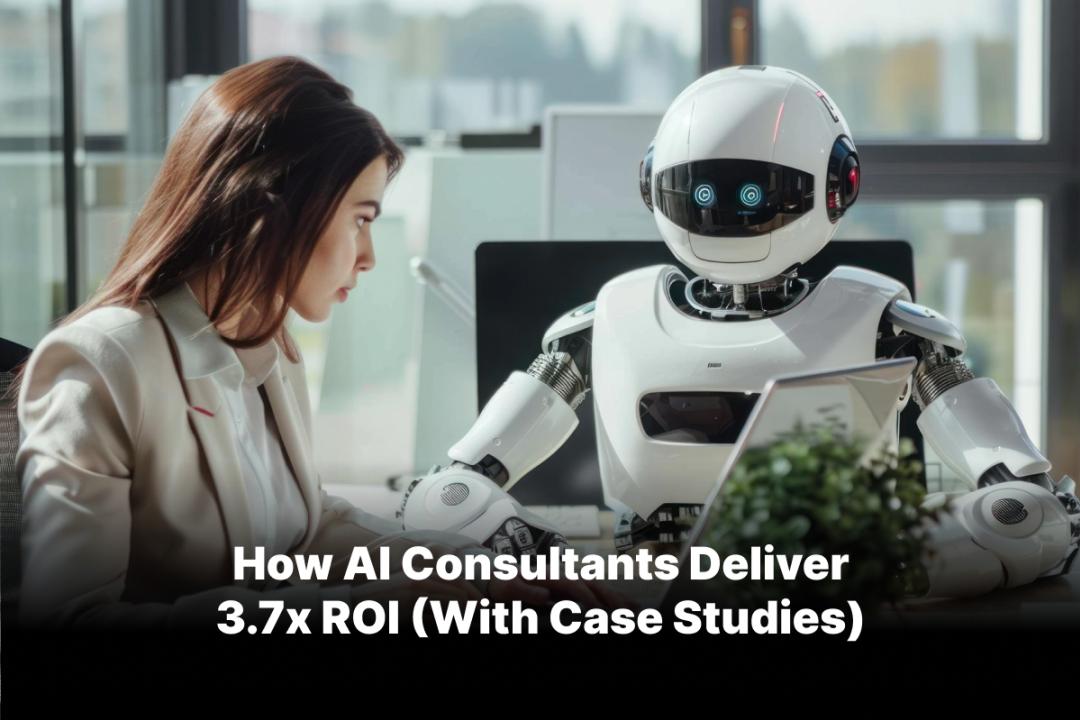

Most companies that hire an AI consulting partner are not asking whether AI works. It is already known to them. The more telling questions are: Where does the money come back and how soon? In studies published up to 2025 and early 2026, the organisations that clearly present AI services as an answer to a business problem report a median 3.7-times return on their investment in AI in the first 18 months. It is not a marketing figure; that's the number. It's a habit that is afoot in deployments and it's worthwhile to understand before signing a statement of work.
In this guide, we’ll dissect how that return is achieved, what sets the projects that are successful apart, and the trends driving the decision in 2026.
What Does an AI Consulting Company Actually Do?
An AI consulting company assists a business in determining, creating and running AI techniques that can tackle a particular business challenge. Typically, the work follows a four-step process: opportunity assessment, data readiness review, model or system development, and deployment and continuous measurement. Good consultants invest more time in the first two phases than people realize, since the majority of failed AI projects never get to a single model trained.
It's not just a single chatbot. These AI consulting services include process automation, demand forecasting, document intelligence, customer service routing, fraud detection, and retrieval of internal knowledge. The common denominator is that each engagement begins with an existing metric that the business cares about and drills back to the smallest system that moves it.
Why ROI Reaches 3.7x
The Return isn't magic. It is due to three cumulative effects:
- Labor reallocation. Routine work is automated, allowing skilled workers to handle more valuable tasks. This alone is often enough to make up for the project cost.
- Error reduction. AI systems in the structured decision-making process eliminate rework and compliance penalties, which have hidden but very high costs.
- Speed of decision. When forecasts are made in a shorter time and customers respond in a shorter time, cash cycles are shortened, and that is reflected in revenue.
- When all three are placed on a process that is executed thousands of times per month, a small increase per transaction adds up to a big increase per year. That's how the 3.7x number is math.
Three Short Case Studies
Case 1: Mid-Size Insurer, Claims Triage
One regional insurance carrier had 40% of its adjuster time devoted to reading and sorting incoming claim documentation. Document Intelligence solution based on custom AI and machine learning consulting services resulted in automatic classification and routing of claims. The adjusters took over the final judgment and avoided the sorting. Processing time was reduced by 58% and the additional capacity was used to process an additional 30% volume with no additional hires. Payback arrived in just under eleven months.
Case 2: E-Commerce Retailer, Demand Forecasting
An online retailer had an excessive number of slow-moving items and ran out of fast-moving items. A forecasting model developed using sales, seasonality and supplier lead times had reduced stockouts by 22% and inventory holding in excess of requirements by 19%. The total working-capital improvement was able to finance the entire project many times over in the first year.
Case 3: B2B Software Firm, Support Automation
As the software company continued to grow, they were experiencing an increasing number of support tickets. An AI project was implemented for a retrieval system to link with the existing help desk and to write accurate first responses based on the internal documentation. Agents were creating replies, but editing and approving them. First-response time dropped 64% while there was an improvement in customer satisfaction due to answers being faster and more consistent. The team has been able to avoid the three support hires that were planned.
In all three, the trend is the same: a limited problem, a quantifiable starting point, and a system that enhances rather than replaces humans.
2026 Trends Shaping AI Consulting
- Agentic workflows go mainstream. By 2026, a higher proportion of engagements with AI agents will involve multi-step actions in software systems, not single-prompt responses. This leads to guardrail design and consulting with an orchestral approach.
- Small, specialized models gain ground. Companies now more often deploy small models optimized for one domain, rather than always going for the big general model. The outcome is decreased running costs and quicker response, enhancing ROI mathematics.
- Full-Stack AI Development becomes the standard ask. Today, buyers want a single partner to manage data pipelines, model work, application code, and deployment, instead of cobbling together different vendors.
- Governance moves from afterthought to requirement. As AI regulation is developing on a regional level, audit trails, bias testing and data lineage are no longer add-ons but rather part of the build.
- Retrieval over retraining. For many use cases, costly periodic retraining is being replaced with connecting models to live governed company data via retrieval systems.
How to Choose AI Consulting Services
When you're looking at selection, the difference is typically between a 3.7x return and a stalled pilot. Evaluate partners against these decision factors:
- Problem framing first. A good partner insists on discussing the metric and baseline first, before technology. Beware of any person who starts with the tools.
- Data honesty. Good consultants let you know when your data is not ready and what to do about it, even if that means delaying the sale.
- Full-stack capability. Ensure they can take a project from data to a deployed application, thereby maintaining accountability in one place.
- Measurement built in. Inquire about measures of success following launch. If ROI is not measured, it's lost.
- Knowledge transfer. The best engagements result in a team that is able to sustain and expand the system, not rely on the vendor.
Build, Buy, or Blend?
Not all of the issues require custom work. Common, low-differentiation tasks are addressed by off-the-shelf tools. The custom AI and machine learning consulting services are effective when the issue is unique to your business, your data is a valuable resource, or integration with your internal systems is challenging. Ultimately, most of the programs that grow to maturity find themselves doing a blend of both: purchasing the commodity tool and building the custom parts where they see true value.
If you are considering these choices, engaging with an AI consulting company can help accelerate the journey from conception to tangible outcomes, as the framing and data questions represent the greatest value and risk.
The Role of AI Integration Services
If a model only functions on a notebook computer and never gets to your daily systems, it is not creating any return. AI Integration Services fill that void. They integrate models into your CRM, ERP, support desk or internal applications, making predictions and responses present where people currently work. The real challenge for integration begins when projects are experiencing success, or when they just quietly die: Does the AI fit into the current workflow, or does the staff need to visit a new screen?
In 2026, it's also a reason why Full-Stack AI Development will play a crucial role. If it is the same team that owns the model and the integration, there is no handoff place where accountability and momentum are lost.
Frequently Asked Questions
- When does an AI consulting project pay off? The majority of well-scoped projects demonstrate measurable return in 9-18 months. High-volume process problems with narrow ROI will see the quickest returns, sometimes within a year since the per-transaction benefits will add up rapidly.
- What is the difference between AI consulting and AI development?
AI consulting involves determining the appropriate issues, evaluating data, and setting up a strategy for the application of AI. AI development is the creation of the systems themselves. Full-Stack AI Development partners manage both, ensuring strategy and execution go hand in hand. - Do small businesses benefit from AI consulting services? Yes. Smaller companies may experience quicker returns due to the less complex processes they have, and because one automated workflow may impact a significant portion of operations. The secret is to pick one clear issue and to not try to roll it all out at once.
- What is custom AI and machine learning consulting? It's not building with a generic off-the-shelf tool, but designing and building AI systems that would be specific to your business problem and data. It is a good fit for situations where your data, workflow or integration requirements are unique enough that common products don't fit the bill.
- How much does AI integration cost?
- Cost is based on the number of systems and the complexity of data. One workflow integration is much more affordable than a company-wide program. Having a clear objective and a success measure helps to maintain budgets and connect them to returns.
Bringing It Together
That 3.7x is attainable, but it's not a given. It's about choosing a genuine problem, being transparent with data, creating a complete solution, embedding it into your workflow, and quantifying the impact. The successful companies are those that take AI as a well-specified business project instead of an unquantifiable initiative.
When you are prepared to map your highest-return use case, a structured discussion with an experienced AI consulting company is a clear way to get started, where the focus remains on the metric you are looking to move and the quickest path to doing so.