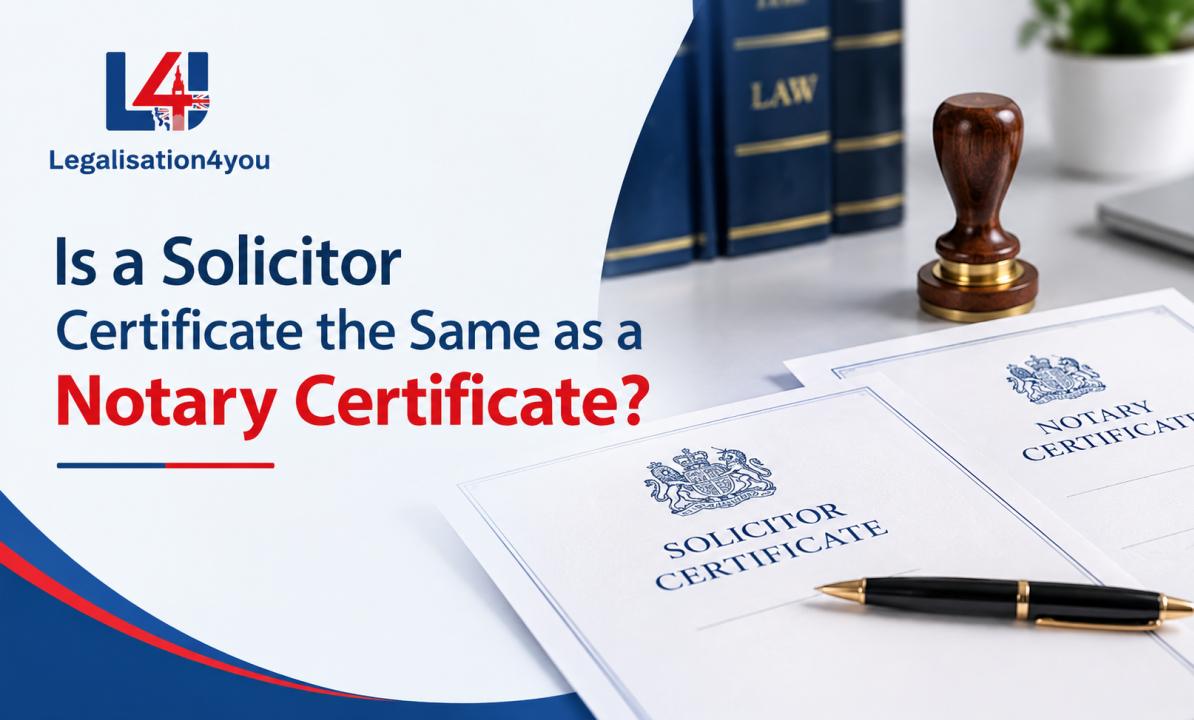
When preparing official documents for legal, financial, immigration, or international purposes, you may be asked to obtain certification from a qualified professional. Two terms that often cause confusion are a solicitor certificate and a notary certificate. Although both relate to verifying documents or signatures, they are not always interchangeable.
Understanding the difference can help you avoid delays, unnecessary expenses, and rejected paperwork. The correct option depends on the type of document you have, the country where it will be used, and the requirements of the organisation requesting it.
In the UK, solicitors can certify copies of documents in appropriate circumstances, while notaries public have a specialised role in authenticating documents and signatures, particularly for use overseas. The UK government's guidance also explains that certain documents may need further legalisation through an apostille before they can be accepted abroad.
This FAQ guide answers common questions about certification, notarisation, apostilles, costs, and international document requirements.
1. What Is a Solicitor Certificate?
A solicitor certificate generally refers to a document or certification provided by a qualified solicitor to confirm a particular fact, certify a copy, or witness a signature, depending on the service requested.
One common example is a certified copy of an original document. A solicitor examines the original and its photocopy before confirming that the copy is a true representation of the original seen.
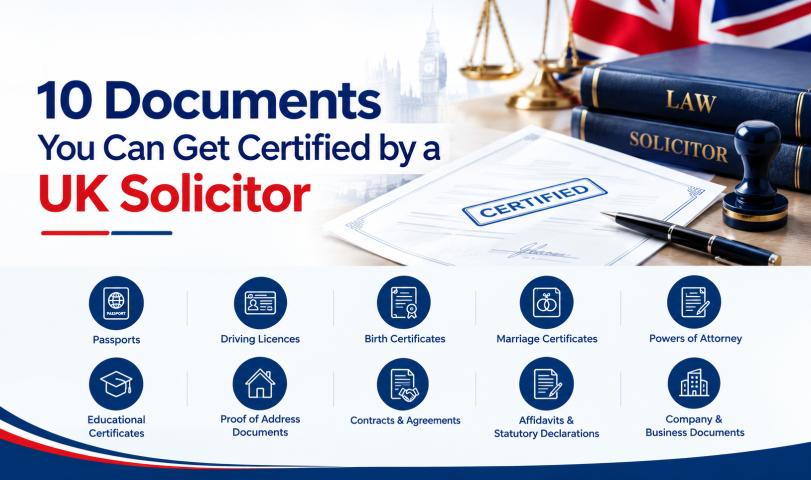
Documents that may require this type of certification include:
- Passport copies and driving licences
- Bank statements and utility bills
- Educational certificates and qualifications
- Certain legal documents and declarations
- Supporting paperwork for financial or administrative applications
The exact wording and procedure depend on the purpose of the certification. Some organisations may also specify who must certify the document and what information must appear on it.
A solicitor certificate is often suitable for domestic administrative requirements, but you should not automatically assume that it will satisfy an overseas authority.
2. What Is a Notary Certificate?
A notary certificate is a formal certification issued by a notary public. In England and Wales, notaries are specialist legal professionals with a separate qualification and regulatory framework.
A notary public may verify a person's identity, witness a signature, examine relevant supporting documents, or confirm matters within the scope of the notarial service being provided.
A notary certificate may be required for documents intended for use in another country, particularly when a foreign authority, bank, court, or business requests notarisation.
Common examples include:
- Powers of attorney for overseas transactions
- Company documents for international business
- Declarations and affidavits for foreign authorities
- Documents relating to property held abroad
- Educational or professional documents requiring notarisation
- Certain agreements and authorisations for international use
The notary's certification and seal help establish the authenticity of the notarial act. However, the certificate does not automatically guarantee acceptance in every country. Additional legalisation or embassy attestation may still be required.
3. Is a Solicitor Certificate the Same as a Notary Certificate?
No. A solicitor certificate and a notary certificate serve related but different purposes.
A solicitor can certify documents where appropriate, confirm copies against originals, and provide other legal services within their authority. A notary public performs specialised notarial acts, often for documents that need to be recognised outside the UK.
The main differences are:
| ||||||||||||||||||||
4. When Should You Choose a Solicitor Certificate?
A solicitor certificate may be appropriate when an organisation requires a certified copy of a document or a solicitor's signature for a specific legal or administrative purpose.
For example, a bank might request a certified passport copy as part of an identity-verification process. A solicitor may be able to provide the certification if the bank accepts that professional's certification.
You may also be asked for certified copies of supporting documents during certain applications involving financial institutions, employers, or other organisations.
However, requirements vary. Some institutions accept certification from several types of professionals, while others specify a solicitor, notary, or another authorised person.
Before booking an appointment, confirm the wording required, whether the original document must be presented, and whether the certifier needs to include their professional details.
If your document is intended for use abroad, ask the receiving authority whether solicitor certification is sufficient or whether notarisation is necessary.
5. When Do You Need a Notary Certificate?
A notary certificate is commonly required when documents must be authenticated for use in a foreign country.
For example, if you are authorising someone to act on your behalf in an overseas property transaction, the receiving authority may require your signature to be witnessed by a notary public.
Similarly, an overseas company, bank, or government department might require a notarised declaration or corporate document before processing an application.
A notary may check your identity, establish your authority to sign where relevant, witness the execution of a document, and prepare the appropriate notarial certificate.
Not every international document requires notarisation. Some official UK documents can be submitted directly for an apostille, while others must first be certified or notarised.
The safest approach is to obtain written instructions from the organisation receiving the paperwork. This helps establish whether a notary certificate is required and whether additional legalisation steps apply.
6. Can a Solicitor Certificate Be Used Abroad?
Yes, in some circumstances. However, acceptance depends on the country, the receiving organisation, and the type of document.
A solicitor's certification may be sufficient when the overseas authority specifically accepts it. In other situations, the authority may insist on notarisation by a UK notary public.
If an apostille is required, the document must also meet the UK Legalisation Office's requirements. The UK government explains that certain documents can be legalised when they have been certified by an eligible UK public official, including a solicitor or notary, where the applicable requirements are satisfied.
This does not mean every solicitor-certified document can automatically receive an apostille. The document's format, signature, certification, and eligibility all matter.
Before obtaining a solicitor certificate, check the exact requirements for your destination country. Confirm whether the document needs notarisation, an apostille, embassy attestation, or a combination of these services.
7. Does a Notary Certificate Need an Apostille?
Sometimes. An apostille is an official certificate issued by the UK's Legalisation Office to authenticate a qualifying public official's signature, seal, or stamp for international use.
If a foreign authority requires an apostille, a document may need to be notarised before it can be submitted for legalisation. This is common for certain private documents, including powers of attorney, declarations, and agreements.
Other documents, such as eligible public registry certificates, may follow a different process and might not require notarisation first.
An apostille does not certify that the contents of a document are true or that the document will automatically be accepted by every foreign institution. It confirms the authenticity of the relevant signature, seal, or stamp within the legalisation process.
You should also check whether the destination country requires further embassy or consular legalisation after the apostille.
8. What Is the Difference Between a Notary Certificate and an Apostille?
Although these terms are sometimes confused, a notary certificate and an apostille are different things.
A notary certificate is prepared by a notary public as part of a notarial act. An apostille is issued by the competent authority to authenticate the relevant official signature, seal, or stamp for use abroad.
Consider an example involving a power of attorney intended for use overseas:
- The receiving authority specifies that the power of attorney must be notarised.
- A UK notary checks the relevant details and completes the notarial act.
- If required, the document is submitted for a UK apostille.
- The document may then need further embassy legalisation, depending on the destination country's rules.
This is an illustrative process rather than a universal requirement. The correct steps depend on the document and destination.
Understanding this distinction helps you avoid paying for certification that does not meet the receiving authority's requirements.
9. How Much Does a Solicitor Certificate or Notary Certificate Cost?
The cost varies according to the document, the professional's fees, the complexity of the work, and the urgency of the request.
A straightforward certified copy may cost less than a notarial service involving identity checks, company records, multiple documents, or an overseas transaction.
Additional costs may apply if your paperwork requires an apostille, courier delivery, certified translation, or embassy attestation.
When requesting a quote, provide the following information:
- The type and number of documents
- The country where the documents will be used
- The certification wording requested
- Whether notarisation or an apostille is required
- Your preferred completion date
Do not choose a service based on price alone. A lower-cost certification can become more expensive if the receiving authority rejects it and you have to repeat the process.
Request a clear breakdown of the services included and confirm whether additional legalisation fees are payable.
10. How Long Does It Take to Obtain Certification?
The timeframe depends on the type of certification and the professional's availability.
A straightforward certified copy may be completed relatively quickly, sometimes during an appointment. Notarial work can take longer if the notary needs to review supporting evidence, verify signing authority, prepare a formal certificate, or arrange additional documents.
If an apostille or embassy attestation is required, you should allow extra time for processing and delivery.
To help prevent delays, prepare your original documents, valid identification, and any instructions received from the overseas authority. Check whether translations or additional supporting evidence are needed before arranging an appointment.
If you have a deadline for a visa, property transaction, business registration, or other application, explain it when requesting the service. Confirm the expected completion date rather than assuming that all certification and legalisation stages can be completed immediately.
11. Can You Get a Solicitor Certificate and Notary Certificate for the Same Document?
Yes, where the requirements and circumstances make both appropriate. However, obtaining both is not always necessary.
For example, a document may need to be certified or prepared in a particular way before a notary completes a separate notarial act. In other situations, the receiving authority may require only notarisation.
The correct sequence depends on the document and the instructions provided. Getting multiple certifications without checking the requirements can increase costs and cause avoidable delays.
Before proceeding, ask the receiving organisation to confirm exactly which professional must certify or notarise the document. If an apostille is also required, verify that the proposed certification will meet the Legalisation Office's requirements.
A document-by-document assessment can help determine the most appropriate route.
12. How Can You Avoid Having Your Certified Documents Rejected?
The best way to reduce the risk of rejection is to confirm the receiving authority's requirements before starting the process.
Use this checklist:
1. Confirm the destination: Identify the country and the organisation receiving the document.
2. Check the certification type: Establish whether a solicitor, notary public, or another professional is required.
3. Verify the document format: Ask whether an original, certified copy, or electronically signed document is acceptable.
4. Check legalisation requirements: Confirm whether an apostille or embassy attestation is needed.
5. Review translation requirements: Find out whether an approved or certified translation is required.
6. Check deadlines: Allow time for certification, legalisation, delivery, and any corrections.
Do not assume that a document accepted by one bank, embassy, or government department will automatically be accepted by another.
Careful preparation can make the process more straightforward and reduce the chance of repeating the same steps.
Need Help Preparing Your Documents?
Choosing between a solicitor certificate and a notary certificate depends on what your documents are for and where they will be submitted. The right certification can help you prepare your paperwork correctly and avoid unnecessary delays during the legalisation process.
Legalisation4you can help you understand the document legalisation route for your requirements, including certification, apostille services, and further legalisation where applicable.
Visit to explore the available services and find out what steps may be required for your documents.
Before proceeding, make sure you have checked the requirements of the receiving authority and the destination country so that the service you choose matches their instructions.