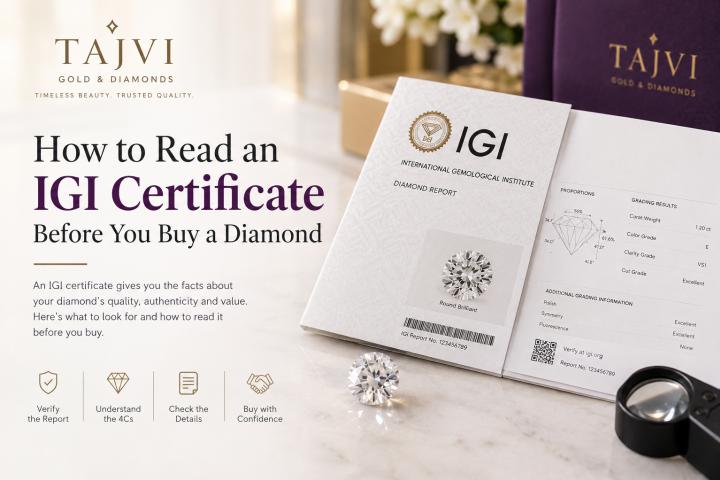
A diamond certificate is the single most useful document you receive when buying a diamond. It tells you exactly what the stone is, how it was graded and how it compares with others. Yet many buyers glance at the first page, see a few letters and numbers, and move on. That can cost you money or leave you with a stone that is not what you expected. This guide explains how to read an IGI certificate step by step, so you can buy with confidence. If you are still deciding what to buy, take a look at the full diamond jewellery collection at Tajvi Gold & Diamonds.
What Is an IGI Certificate?
IGI stands for the International Gemological Institute, one of the best-known independent gem grading labs in the world. An IGI report is a grading document. It describes the stone's characteristics, but it does not give a price or a valuation. It is also not a guarantee of beauty, since two stones with the same grades can still look slightly different.
IGI issues separate reports for natural diamonds and laboratory-grown diamonds, and the report title makes this clear. Always check the title first, because it tells you what kind of stone you are buying.
Step 1: Check the Report Number and Date
Every certificate has a unique report number. This number links the paper report to the stone and to IGI's online records. Write it down. You will use it later to verify the report. The report date is also useful, since it shows when the stone was last graded.
Step 2: Confirm Shape and Cutting Style
This section names the diamond's shape, such as round brilliant, oval, pear, emerald or cushion. It also describes the cutting >
Step 3: Look at the Measurements
Measurements show the diamond's length, width and depth in millimetres. They help you understand how big the stone will look on the finger. Two diamonds of the same carat weight can have different face-up sizes, depending on how the stone is cut. A well-proportioned stone usually looks larger than a deep, heavy one of the same weight.
Step 4: Understand the 4Cs
The core of the certificate is the 4Cs. Here is what each one means.
- Carat weight: the weight of the diamond, shown to two decimal places. One carat equals 0.20 grams.
- Colour grade: graded on a scale from D (colourless) to Z (light yellow or brown). D to F are colourless, G to J are near colourless, and most buyers find G to H a good balance of value and appearance.
- Clarity grade: measures tiny internal and surface marks. The scale runs from Flawless and Internally Flawless through VVS, VS and SI, down to I grades. VS and SI stones often look clean to the naked eye and cost much less than top grades.
- Cut grade: shows how well the diamond reflects light. Excellent and Ideal grades are the best. Cut has the biggest effect on sparkle, so avoid compromising here.
Cut grades are mainly shown for round brilliant stones. For some fancy shapes you may see only polish and symmetry, so ask the jeweller how the stone's proportions were judged.
Step 5: Check Polish and Symmetry
Polish describes the surface finish of the facets. Symmetry describes how evenly the facets are shaped and aligned. Both are graded from Excellent down to Poor. Look for Very Good or Excellent in both, as lower grades can reduce brilliance.
Step 6: Read the Fluorescence Grade
Fluorescence is the glow a diamond may show under ultraviolet light. It is graded as None, Faint, Medium, Strong or Very Strong. Most diamonds with faint or no fluorescence look normal in daily light. Strong fluorescence can make some stones look slightly hazy. It can also lower the price, so it is worth asking about.
Step 7: Study the Clarity Plot and Proportions
Many reports include a clarity plot, a small diagram that marks where the inclusions are. Check how many marks there are, where they sit and what type they are. Marks near the edge are usually less visible than ones in the centre. The proportions diagram shows table size, depth and other cut details, which help explain the cut grade.
Step 8: Look at the Comments and Laser Inscription
The comments section may list extra details, such as the clarity characteristics or whether the stone has been treated. For laboratory-grown diamonds, the report also states how the stone was produced. Many IGI stones carry a tiny laser inscription on the edge, which holds the report number. Ask the jeweller to show it under magnification and confirm it matches the certificate.
Step 9: Verify the Report Online
Never rely on paper alone. Enter the report number on IGI's official website to confirm that the details match. If anything differs, ask the seller to explain before you buy. This takes only a minute and protects you from errors or fake reports.
Match the Certificate to the Piece
Once the certificate checks out, think about how you will wear the stone. A solitaire looks best when the cut grade is strong, which makes it worth the extra care when you compare diamond rings. For pendants, the clarity and colour matter slightly less, so you can often save money by choosing a diamond necklace with a slightly lower grade. If you are shopping for someone else, see our ranges of diamond jewellery for women and diamond jewellery for men for ideas.
Quick Checklist Before You Pay
- The report title matches the type of diamond you are buying.
- The report number verifies on IGI's website.
- Shape, measurements and carat weight match the stone in front of you.
- Colour, clarity and cut suit your budget and your taste.
- Polish and symmetry are Very Good or better.
- Fluorescence has been explained to you.
- The laser inscription matches the report number.
Final Thoughts
An IGI certificate gives you the facts, but you still need to read them carefully. Verify the report, compare the grades, and look at the stone in person. A jeweller who is happy to walk you through the certificate is usually one you can trust.
Tajvi Gold & Diamonds is a fine jewellery brand in the Gold Souq, Deira, Dubai, offering certified diamonds and handcrafted gold designs.