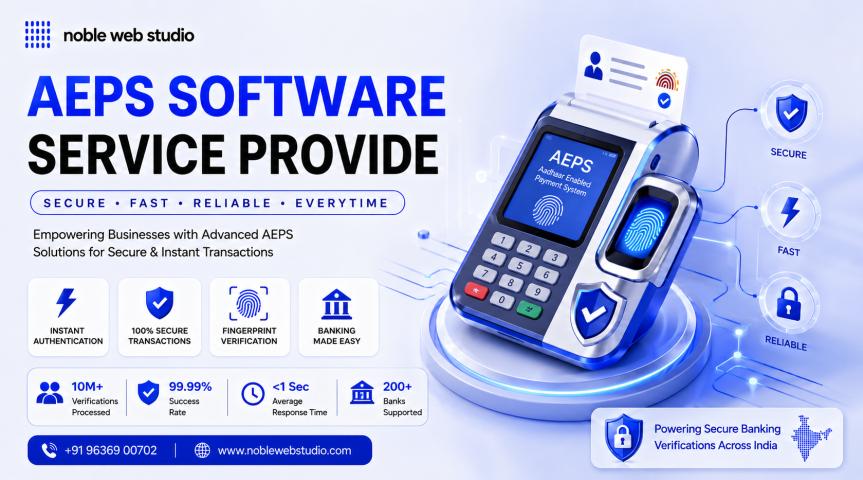
As digital payment systems rapidly transform India’s financial landscape, AEPS software development has become an essential tool for providing real-time payment solutions, particularly in rural and underserved areas. The Aadhaar Enabled Payment System (AEPS) leverages Aadhaar-based biometric authentication to allow secure and seamless financial transactions. In rural India, where access to traditional banking infrastructure is often limited, AEPS B2C (Business to Customer) software has emerged as a key enabler of cashless transactions, offering fast and reliable payment solutions.
AEPS B2C software allows retailers, small businesses, and local agents to offer various banking services like cash withdrawals, balance inquiries, and fund transfers using biometric authentication. This software has helped bridge the financial divide in India, making banking services accessible to the rural population, which otherwise faces challenges such as distance from banks, lack of ATMs, and inadequate financial literacy. AEPS B2C software ensures that rural customers can benefit from the convenience of real-time transactions, contributing to financial inclusion in the country.
What is AEPS B2C Software?
AEPS B2C software is designed to provide secure and real-time banking services through Aadhaar-based authentication. It allows retail agents and service providers to offer banking services at the local level, directly to consumers. The software enables users to conduct essential banking functions such as cash withdrawals, balance inquiries, and money transfers, all by authenticating transactions through their Aadhaar number and biometric details.
For digital payment service providers, integrating AEPS software into their platforms opens up a world of opportunities. AEPS B2C software ensures that rural customers have access to banking services without the need to travel long distances to a bank branch or ATM. By offering a cashless solution, AEPS B2C software supports the government’s push towards a digital India and promotes greater financial inclusion.
How AEPS B2C Software Benefits Rural India
-
Real-Time Transactions
One of the biggest advantages of AEPS B2C software is the ability to process real-time transactions. This is especially important in rural India, where access to traditional banking systems may be limited. Whether it’s withdrawing cash from a Micro ATM or transferring funds to a family member, AEPS B2C software facilitates instant, hassle-free payments. Rural customers no longer need to wait for banking hours or travel long distances to access their funds, making daily financial transactions much more efficient. -
Increased Financial Inclusion
AEPS B2C software plays a vital role in promoting financial inclusion in rural India. By providing a cashless payment system, AEPS ensures that even those in remote areas can participate in the digital economy. This software allows individuals to access basic banking services without needing a physical bank branch, helping bridge the gap between urban and rural financial systems. -
Easy Access to Banking Services
In rural India, many people do not have access to formal banking facilities due to geographical barriers. AEPS B2C software enables local retailers, agents, and entrepreneurs to offer banking services, thereby reducing the dependency on traditional banking infrastructure. Customers can now perform essential banking functions at local retailers equipped with AEPS-enabled devices, making banking accessible in even the most remote areas. -
Secure and Biometric Authentication
AEPS B2C software relies on biometric authentication to ensure the security and accuracy of transactions. This prevents fraud and ensures that only authorized individuals can access their accounts. For rural customers, who may have limited access to technology or financial knowledge, biometric authentication is a simple and secure method of verifying their identity. This adds a layer of trust and confidence to the payment system. -
Cost-Effective and Scalable Solution
For digital payment service providers and local retailers, AEPS B2C software offers a cost-effective solution to serve the financially underserved. The setup costs for AEPS-enabled retail outlets are lower than setting up traditional bank branches or ATMs. Additionally, AEPS software can be easily scaled across multiple locations, making it a viable solution for providers looking to expand their reach in rural areas.
The Impact on Rural Retailers and Service Providers
Rural retailers and service providers who integrate AEPS B2C software into their operations stand to gain significantly. Not only do they become Aadhaar-enabled banking agents, but they also have the opportunity to earn a commission on every transaction they process. This provides an additional revenue stream, while also helping to boost the digital financial ecosystem in their communities.
Conclusion
In rural India, AEPS software development has proven to be a game-changer by providing real-time payment solutions that empower rural customers and drive financial inclusion. AEPS B2C software has made banking services more accessible, secure, and efficient, allowing retailers and service providers to bridge the digital divide. The adoption of AEPS software is not just about convenience; it’s about creating a more inclusive, cashless economy that benefits everyone, regardless of their location or financial background.
For digital payment service providers looking to expand their services in rural India, partnering with an AEPS software development company is essential. By offering AEPS-enabled services, they can help ensure that even the most remote corners of India are part of the growing digital financial ecosystem.