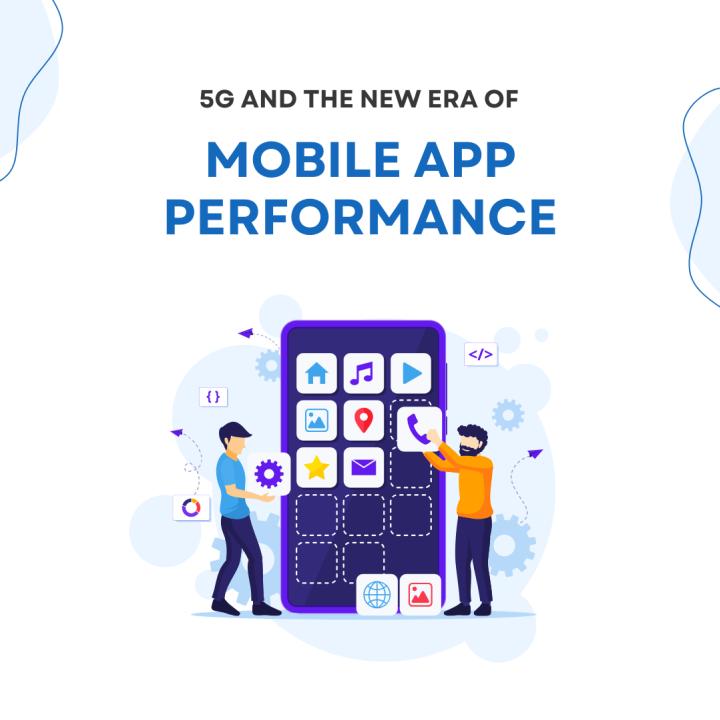
Integration of 5G technology will transform the digital landscape, particularly for sectors dependent on mobile applications. 5G is revolutionising faster connectivity to low-latency provision. The latest performance standards set by 5G are changing the approach to mobile app development services with developers globally. In this environment, end users are demanding faster, smoother, more compelling experiences, and businesses and development organisations need to rethink their approach to remain competitive.
The 5G Impact: Faster and More Reliable Than Ever
5G is supposed to be so fast that it will make speeds up to 100 times faster than with 4G, with theoretical download speeds reaching up to 20 Gbps and latency down to 1 millisecond. This technological advance makes mobile apps load up instantly, allows buffer-free high-definition streaming and perfectly timed, interactive content.
For these vendors that provide mobile app development, this means a chance for apps that can support more advanced capabilities - such as real-time data processing, AR and VR, and high-quality media streaming.
According to recent research, 74% of users will likely uninstall an app after waiting five seconds for it to load, and a two-second increase in load time increases app access by 74%. 5G accelerates time to market and easy access to these user requirements that have implications for ROI and user engagement for developers.
5G and Its Impact on App Architecture
For 5G opportunities to be fully exploited, development architectures are evolving significantly. Monolithic architectures are being replaced with microservices and serverless computing, which are allowing providers of mobile app development services to create applications that are scalable, modular and efficient.
In addition, edge computing, or processing data closer to the source instead of in centralised cloud servers, is increasingly common. This minimises latency by as much as 75%, crucial for use-cases such as autonomous driving, telemedicine and smart city infrastructure.
For mobile companies who are in search of Android app development or iOS development, these architectural changes will be necessary in order to produce the kinds of high-performance apps users will expect in the 5G era.
Improving Cross-Platform User Experiences
The introduction of 5G is affecting not just mobile applications but wider digital services such as web design services or chatbot development services.
1. Web Design Services: Now developers can unlock the full power of the website experience across mobile, and more user-centric, visually strong, dynamic and interactive websites with integrated rich streaming media, stunning interface and continuous content to disseminate across image-rich and innovative solutions with minimal website and CMS.
2. Chatbot Development Services: Thanks to the speed of 5G, chatbots can understand and act on natural language queries while accessing cloud-based AI models with no delay, reducing response times and providing a better user experience.
And then there's the bigger that will see a lot of apps that do AR and VR, get a lot better. And in retail, for instance, consumers can place clothes on themselves virtually, the same way they would try something on, or see 3D models of products in real time. This is only possible due to the increased bandwidth and almost no latency of 5 G.
What Role Does 5G Play in Test Automation Services?
As the app ecosystem evolves, quality and performance are more important than ever. Here Test Automation Services are very much in demand.
Automated testing tools simulate 5G network conditions to test how an app behaves with different bandwidth and latency. This allows apps to be performant and reliable even when real-world networks are unpredictable. Test Automation Services can also be used to identify bottlenecks, speed up load times and test functionality across various devices and operating systems, which is crucial for cross-platform products, such as Android app development services and iOS development services.
Five 5G Mobile App Innovations Leading the Way in Industries
Several sectors are using 5G to unlock new mobile experiences.
1. Gaming & Entertainment: From zero lag or buffering, console-quality experiences can be played on handheld devices instantly.
2. Healthcare & Telemedicine: Real–time video Doctor consultations and monitoring patients remotely is now a reality with 5G’s extremely low latency.
3. Retail & E-Commerce: AR apps let users look at products in their environment – increasing conversions by 40%.
4. 5G: You already know 5G will enable 1 million devices per square kilometre, which can improve smart traffic systems, public safety networks and energy management.
5. Education & E-Learning High definition video streaming and real-time collaboration tools are improving the quality of virtual classrooms and remote education platforms.
5G’s Impact on the Top 10 App Development Companies
5G is testing very political and one of those things that is becoming a differentiator among the Top 10 App Development Companies. These decision-makers are quickly moving past new development frameworks, serverless computing and AI-driven automation to build next-generation apps powered to take full advantage of 5 G.
For young companies providing mobile app development services, taking cues from them is necessary. Keeping ahead means also investing in skills like cloud integration, machine learning, and advanced test Automation Solutions.
Global 5G Adoption by the Numbers
The number of 5G subscriptions worldwide had reached over 1.6 billion by 2024, and this figure is anticipated to break the 5 billion mark by 2030 which would equate to 56% of all mobile subscriptions worldwide, as stated in Ericsson's 5G subscription forecast.
The second biggest smartphone market in the world, India, has its telecom giants, i.e Reliance Jio and Bharti Airtel, investing in expanding their 5G networks, leading to the massive demand for 5G android app development and iOS development services.
At the same time, the chatbot development services and real-time collaboration tools developed by North American, South Korean and European markets leverage 5G, becoming innovative with real-time data transfer speed.
Challenges to Overcome
5G has its own challenges, despite the promises. The technology depends on a tight network of small cells — expensive and time-consuming to deploy, particularly in rural areas. In addition, it will be important to secure the 5G infrastructure to protect user data.
These gaps have to be closed by an App developer too by having a strong network with network providers, as well as by testing with advanced Test Automation Services.
Final Thought: New Standard for Mobile App Development Services
The 5G revolution is transforming the rules for mobile applications. Quicker speeds, ultra-low latency, and a huge number of connections are establishing new standards for what users demand and hanker for in their apps. For the mobile app development service providers, now is the time to proceed by making use of the latest development framework, the test automation services, and proper integration with web design services, chatbot development services, iOS development services, and Android app development.
But the Leading App Development Companies are already ahead of the curve, making moves to invest in edge computing, advance in AI and immerse themselves in cloud-based technologies that are needed to make a 5G future possible. To remain competitive, every development company will have to follow suit — or risk getting left in the dust in the world’s most rapidly changing technology scene.