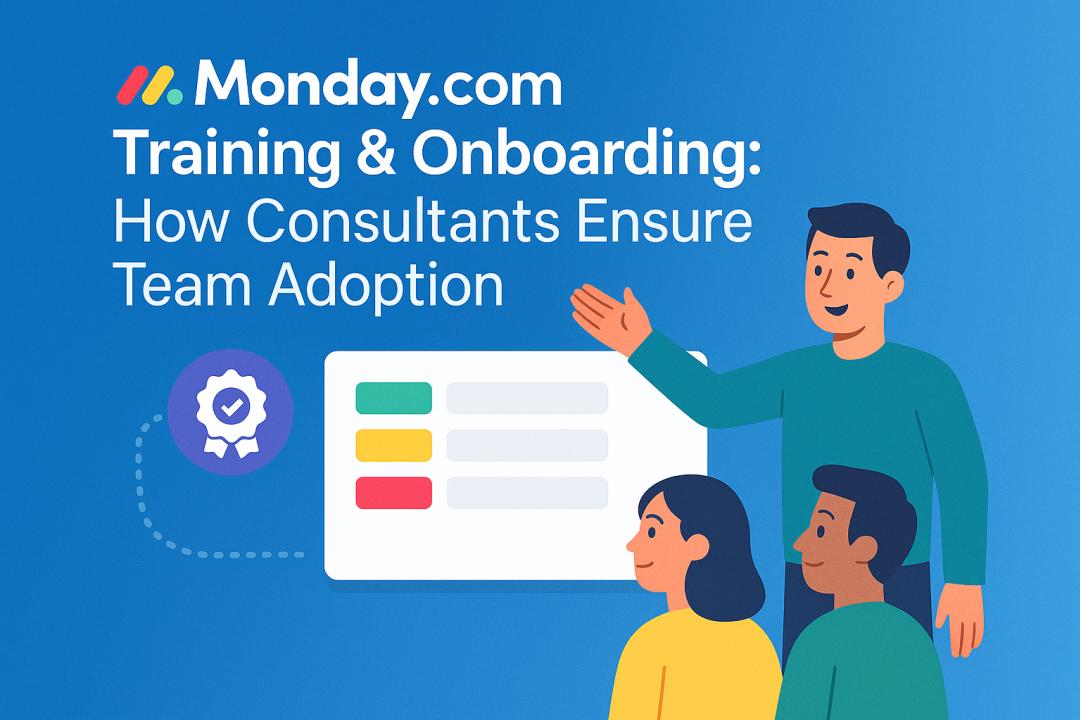
Successful project execution hinges on your team’s ability to fully utilize the tools at hand. That’s where expert-led onboarding makes the difference—especially when deploying a platform as versatile as Monday.com. With the right Monday.com consulting services, teams move beyond basic usage and start achieving real business outcomes. From system setup to in-depth training, consultants make sure that adoption isn’t just a checkbox—it’s a competitive advantage.
1 . Understanding the Importance of Structured Training
Consultants don’t just install software—they enable change. Structured training ensures users understand how to apply Monday.com features to real business processes, reducing friction from day one.
Key benefits of structured training include:
Faster onboarding: Teams get up to speed quickly with guided walkthroughs.
Minimized confusion: Fewer support tickets and errors due to knowledge gaps.
Increased platform ROI: Teams use more features, driving greater value.
Consistent processes: Everyone follows best practices, reducing chaos.
Stronger collaboration: Unified understanding boosts teamwork across departments.
2 . Tailored Onboarding for Different Teams and Roles
Every team works differently, and consultants understand that. A marketing team needs workflows that differ from finance or HR, and onboarding reflects those distinctions.
How consultants customize onboarding:
Role-specific use cases: Training is aligned with each department’s tasks.
Persona-based dashboards: Views and boards are configured per user type.
Permission clarity: Role-based access control is explained in context.
Examples from the same industry: Demonstrations use relatable templates.
Custom training agendas: Each session fits the team’s day-to-day needs.
3 . Setting Up the Monday.com Environment for Learning
A clean and accessible setup lays the foundation for smooth adoption. Before users even log in, consultants configure the platform to match company goals.
Typical setup elements include:
Workspace structure: Organized by department, function, or project.
Template selection: Prebuilt workflows tailored for rapid adoption.
Naming conventions: Uniform board/task labels aid in user understanding.
Automations for repetition: Routine work is simplified to show impact.
Demo boards: Sandboxes where users can safely practice.
4 . Live Sessions vs. On-Demand Training Options
Consultants provide hybrid learning formats to suit all types of learners. This ensures flexibility and reinforces retention of key platform concepts.
Training formats usually offered:
Live virtual workshops: Real-time learning with Q&A sessions.
Pre-recorded videos: For self-paced education and reference.
Interactive playbooks: Downloadable guides with step-by-step instructions.
Office hours: Open Q&A to troubleshoot real scenarios.
Onboarding certifications: Validation of platform skills for power users.
5 . Building Adoption Through Change Management
Adoption is not just about features—it’s about habits. Change management strategies help teams embrace new workflows, not resist them.
How consultants build adoption momentum:
Stakeholder alignment: Managers are briefed first to model behavior.
Success metrics: Clear KPIs to track adoption across teams.
Feedback loops: End-user input is used to fine-tune workflows.
Champion programs: Internal power users are empowered to guide others.
Celebrating milestones: Recognize wins to keep morale high.
6 . Monitoring Usage and Providing Iterative Coaching
Once onboarding is complete, consultants continue to support progress. Adoption is monitored through platform data and supplemented with periodic check-ins.
Post-launch support activities:
Dashboard usage tracking: Identify drop-offs and friction points.
Customized tips: Continuous improvement based on real usage.
Refresher training: Quarterly reviews to reinforce workflows.
Workflow optimization: Fine-tune boards as teams grow.
Feature updates: Keep teams informed of new tools.
7 . Case Studies: What Effective Training Looks Like
Seeing successful adoption in action proves the value of consultant-led training. Real-life case studies highlight how teams transformed their work.
Common results from case studies:
90% faster onboarding: Time-to-productivity drastically reduced.
Reduced support requests: Teams solve issues on their own.
Cross-team collaboration: Silos broken using shared boards.
Revenue-linked improvements: ROI measured in outcomes.
High satisfaction scores: Teams rate training as “easy and valuable.”
Conclusion
Project success depends on more than just having the right tool—it’s about knowing how to use it. With the right support, onboarding becomes an engine for long-term efficiency and engagement. Working with a Monday.com Solution Partner ensures that your team doesn’t just adopt the platform—they thrive on it.