
Introduction
In today’s fast‑moving business landscape, companies across the Middle East are embracing digital transformation with greater urgency, and one of the key instruments making waves is SAP S/4HANA. As organizations increasingly look to streamline operations, enhance agility, and gain real‑time insights, they’re turning to specialized ERP Consulting Services to guide their modernization journey. This trend reflects not just a desire to upgrade technology, but to fundamentally transform the way businesses operate, innovate, and compete—within nations and across the region.
Framing the Need
Regional organizations are recognizing that enterprise resource planning is more than just software—it’s a business‑critical ERP Utility that powers everything from supply chains to financial reporting, human capital, manufacturing, and beyond. For businesses in the Middle East, where complexity meets rapid growth, this utility ensures seamless connectivity, enhanced accuracy, and reliable performance in an increasingly volatile global environment.
The Core Drivers: Why Move to SAP S/4HANA?
1. Real‑Time Analytics and Insights
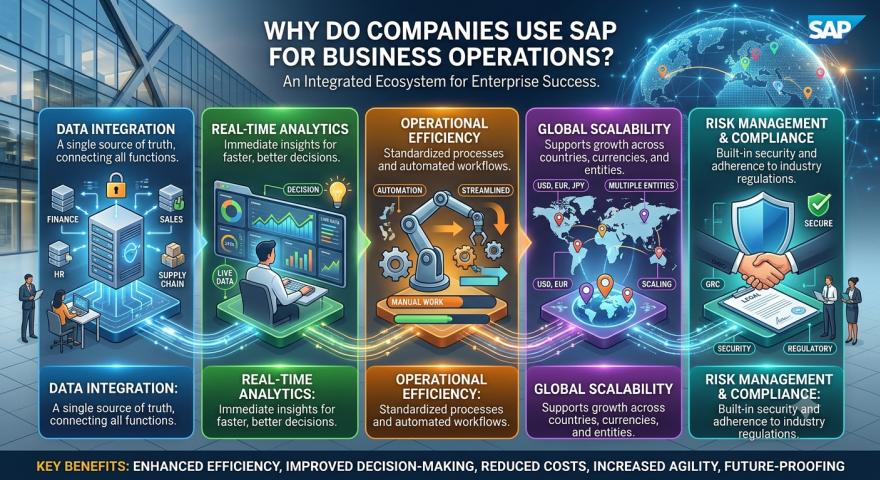
S/4HANA’s in‑memory database enables real‑time data processing and analytics. In markets where rapid decision‑making is essential—such as oil & gas forecasting, retail market shifts, or logistics planning—this capability allows for quick, data‑driven responses and predictive foresight.
2. Simplified, Integrated Architecture
S/4HANA consolidates formerly siloed legacy modules into one streamlined platform. This simplification benefits Middle Eastern firms contending with fragmented IT structures—spanning multiple legacy systems, regional offices, and acquisitions—by reducing complexity and enhancing interoperability.
3. Cloud Flexibility and Scalability
Many Middle Eastern businesses are leveraging cloud‑based S/4HANA deployments on platforms like SAP’s RISE with SAP or hyperscalers (AWS, Azure). This cloud push offers scalability, cost predictability, and easier updates—ideally aligned with regional digital transformation initiatives and national economic diversification goals.
4. Regulatory Compliance and Localization
Operating across GCC countries and beyond means navigating varying VAT regimes, labor laws, and audit requirements. S/4HANA provides built‑in localization tools, rapid support for changing regulations, and compliance tracking—critical for businesses operating across multiple jurisdictions.
5. AI, Automation, and Intelligent Enterprise Capabilities
S/4HANA paves the way for SAP’s Intelligent Enterprise vision—embracing machine learning, robotic process automation, and advanced analytics. Whether optimizing procurement, forecasting demand, or automating finance workflows, these capabilities empower firms to be smarter and more responsive.
6. Enhanced User Experience via Fiori
SAP Fiori offers a modern, role‑based user interface that enhances adoption, productivity, and user satisfaction. Middle Eastern companies—with diverse, multilingual user bases—benefit from intuitive designs, streamlined processes, and mobile accessibility.
Regional Imperatives Fueling Adoption
1. Economic Diversification and Vision 2030
Initiatives such as Saudi Arabia’s Vision 2030, UAE’s Centennial Plan 2071, and Qatar National Vision 2030 are pushing public and private sectors toward innovation, efficiency, and digitalization. S/4HANA aligns seamlessly with these national strategies, enabling modernization, improved governance, and data‑driven economic planning.
2. Rapid Growth in Key Sectors
Industries like oil & gas, petrochemicals, construction, tourism, logistics, and retail are experiencing dynamic growth in the region. S/4HANA equips these sectors with integrated planning, asset management, customer engagement, and supply‑chain capabilities essential for maintaining pace in fast‑moving markets.
3. Regional IT Talent and Ecosystem Expansion
The Middle East is witnessing a growing ecosystem of SAP partners, system integrators, and local consultancies. This aligns with government mandates focused on localization and knowledge transfer, enabling the deployment of S/4HANA with regional expertise and long‑term support.
4. Operational Resilience and Business Continuity
Global disruptions—from pandemics to supply‑chain shocks—have underscored the need for resilience. S/4HANA’s unified system architecture, combined with cloud deployment, reinforces uptime, enables disaster recovery strategies, and supports business continuity across dispersed operations.
Migration Strategies: How Businesses Are Making the Shift
1. Greenfield Implementation
Some organizations, particularly those with tangled legacy systems, are opting for a fresh start with greenfield implementations—designing a clean, optimized S/4HANA landscape and adopting best practices from the ground up.
2. Brownfield (System Conversion)
Others are minimizing disruption by converting existing SAP ECC environments into S/4HANA, preserving customizations and historical data while upgrading to the latest, more efficient architecture.
3. Selective Data Transition (Hybrid Approaches)
For businesses moving at a measured pace, hybrid approaches enable staged data migration—retaining core legacy operations while progressively adopting S/4HANA modules aligned with business priorities.
4. Value‑Driven Phased Rollouts
Strategic phased deployments—such as starting with finance, procurement, or supply chain—help firms build momentum, validate benefits early, and manage change across stakeholder groups sensitively.
Key Benefits Realized by Regional Businesses
1. Accelerated Reporting & Planning
Faster month‑end closes, real‑time dashboards, and scenario modeling empower finance and operations teams—especially critical in volatile sectors like energy and trading.
2. Increased Efficiency & Cost Savings
By streamlining processes and automating repetitive tasks, companies cut operational costs and free up talent for strategic initiatives, contributing to enhanced ROI.
3. Enhanced Customer Engagement
Retailers and consumer‑focused firms leverage integrated CRM, e‑commerce platforms, and real‑time inventory management to deliver omnichannel experiences and personalized services—boosting loyalty and retention.
4. Smarter Asset and Project Management
In infrastructure and energy, S/4HANA’s asset lifecycle tools support predictive maintenance, energy forecasting, and project controls—improving uptime and capital efficiency.
5. Regulatory Control & Audit Readiness
Built‑in compliance features, audit trails, and localization modules simplify navigating evolving regulations across jurisdictions—critical for cross‑border operations.
6. Future‑Ready Positioning
S/4HANA creates a foundation for the future—supporting integrations with IoT, blockchain, and industry 4.0 technologies, giving companies an innovation edge.
Overcoming Challenges: What Middle Eastern Firms Must Address
1. Change Management Complexity
Training users across multiple languages and cultures demands thoughtful communication strategies, clear governance, and localized learning materials to ensure widespread adoption.
2. Managing Legacy and Customizations
Balancing legacy custom code and integrations with modern S/4HANA demands careful planning—and often, refactoring or simplification to adhere to standard best practices.
3. Cost and ROI Considerations
While the long‑term benefits of S/4HANA are compelling, initial investments for licensing, infrastructure, and consulting can be substantial. Firms must align projects with business cases—ensuring CFO and executive alignment upfront.
4. Skilled Talent Scarcity
Despite a growing ecosystem, the region still faces talent gaps—particularly in S/4HANA technical roles, Fiori design, and data migration. Partnering with trained system integrators and upskilling in-house teams is essential.
5. Integration with Legacy & Partner Systems
Companies often rely on regional partners, logistics providers, or government platforms requiring interfaces to unified S/4HANA environments; designing scalable, secure integrations is a necessity.
Spotlight: Success Stories in the Region
-
Leading GCC Retailer
A major retail chain implemented S/4HANA on a phased basis—from finance to inventory to omnichannel retail operations—achieving a 40% reduction in reporting time and a 25% boost in order accuracy. Mobile Fiori-enabled apps enhanced frontline productivity and customer experience. -
Construction and Infrastructure Giant
By migrating to S/4HANA with a focus on project systems and operational control, one of the region’s top construction firms improved project delivery timelines by 15% and slashed material wastage by 20%—aligning closely with Vision‑driven productivity goals. -
Energy Sector Leader
A national energy company implemented S/4HANA Central Finance to unify diverse subsidiaries’ ledgers. The result: consolidated financial visibility with half the previous month‑end close time, plus improved compliance and data auditability.
Best Practices for a Smooth Transition
1. Establish Clear Governance Structures
Define steering committees, project sponsors, and clear stakeholders from finance, IT, operations, and compliance to align roles and decisions.
2. Align Transformation with Business Strategies
Link every S/4HANA module deployment to clear, measurable business outcomes—be it cost savings, faster decision cycles, or better customer experiences.
3. Invest in Local Capacity Building
Partner with regional SAP-certified firms and build internal skills through training, mentoring, and certifications—securing long-term support and ownership.
4. Adopt Agile & Iterative Rollouts
Rather than “big bang” launches, use agile deployment methods and smaller sprints to deliver value early, adapt based on feedback, and reduce risk.
5. Focus on Data Quality and Migration Planning
Ensure data is cleansed, harmonized, and enriched before migration. The garbage‑in, garbage‑out adage holds—poor data undermines reporting, automation, and user confidence.
6. Prioritize Change Management
Communicate benefits, involve power users early, localize training, and celebrate milestones. A motivated workforce is the best agent of digital transformation.
What’s Next: The Road Ahead in S/4HANA Adoption
1. Embedded AI, Machine Learning, and IoT
As adoption grows, expect deployments to include more intelligent automation—in areas such as predictive maintenance, AI‑driven demand forecasting, and IoT‑powered monitoring across industries like manufacturing, logistics, and energy.
2. Data‑Driven Regulatory Compliance
Cloud‑based S/4HANA releases with embedded tax engines and compliance tools will help organizations stay ahead of shifting VAT, sustainability reporting, and regional economic mandates.
3. Regional Cloud and Data Sovereignty
With growing adoption of local cloud data centers and sovereign cloud mandates, we’ll likely see more on‑premise + cloud hybrid deployments—balancing regulatory control with the flexibility of hyperscaler platforms.
4. Ecosystem Expansion and Partner Innovation
Local consultancies are already building pre‑packaged regional accelerators, localization packages, and value‑added vertical extensions—streamlining deployment for retail, energy, healthcare, and government sectors.
Conclusion – Embracing Transformation with Purpose
As Middle Eastern businesses confront the convergence of digital expectations, economic diversification, and evolving regulatory landscapes, SAP S/4HANA emerges not just as a modern ERP system—but as a strategic enabler of agility, insight, and growth. Its real‑time capabilities, integrated design, cloud maturity, and intelligent potential make it uniquely suited for industries in transition—from traditional energy to cutting‑edge retail and construction. With the right migration strategy, governance, and commitment to change management, organizations can unlock substantial business value, operational resilience, and future readiness.
Ultimately, for many leaders in the region, S/4HANA isn’t just an IT upgrade—it’s the next chapter in their journey toward becoming agile, data‑driven, and forward‑looking enterprises in a rapidly evolving world.