
Public Key Infrastructure (PKI) Market Size
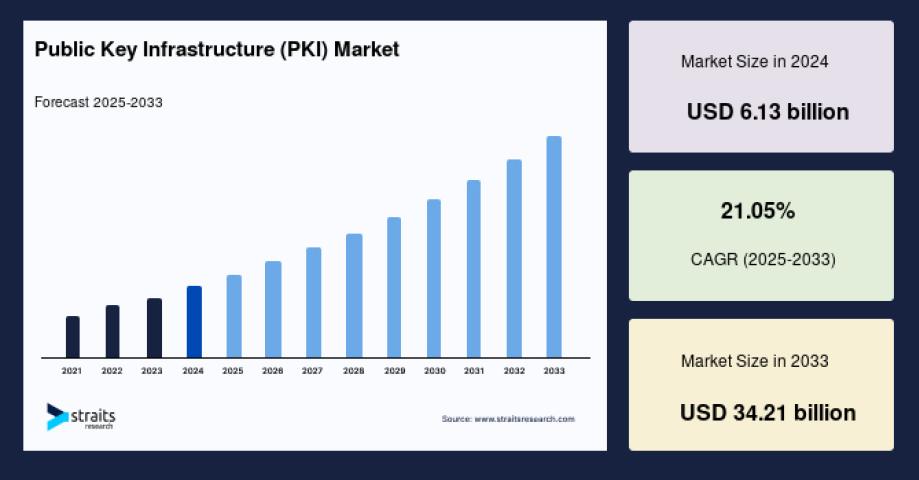
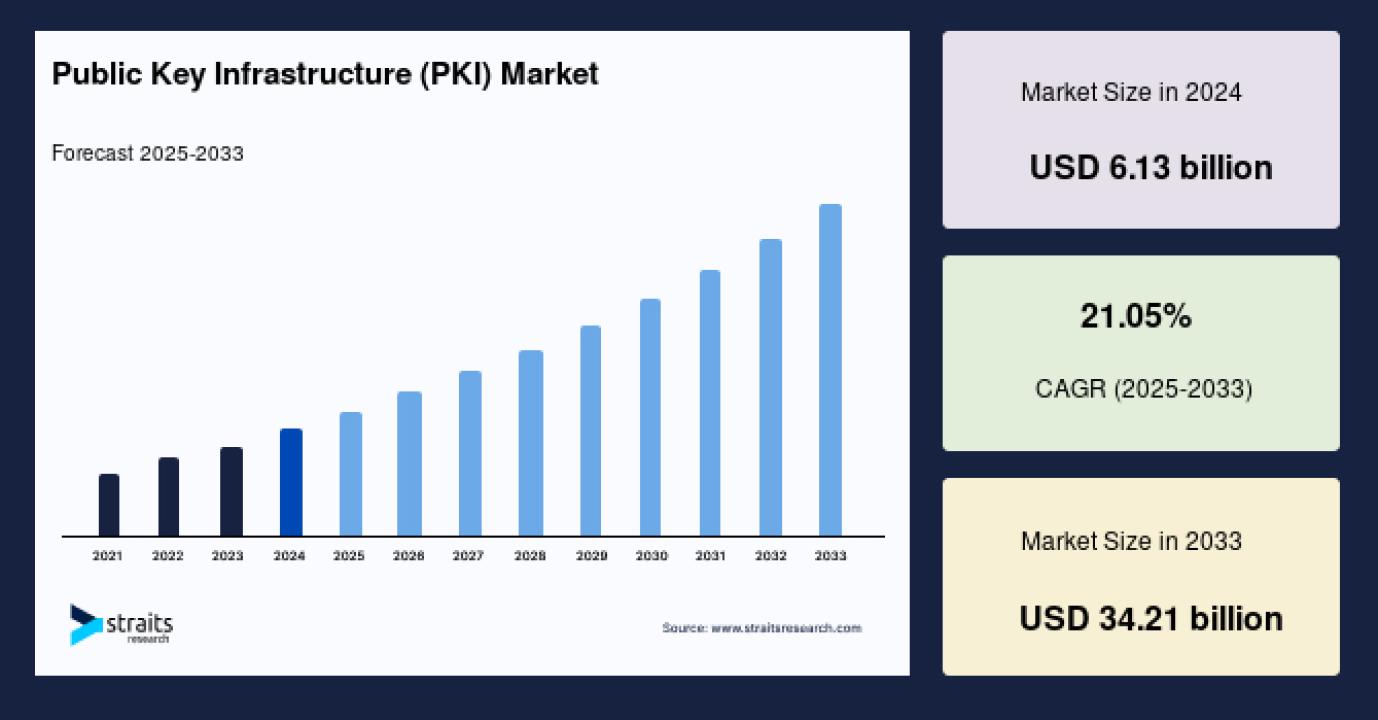
The global public key infrastructure (PKI) market is witnessing unprecedented growth driven by accelerating digital transformation and escalating cybersecurity threats. Valued at USD 6.13 billion in 2024, the market is projected to grow from USD 7.42 billion in 2025 to reach USD 34.21 billion by 2033, exhibiting a CAGR of 21.05% during the forecast period.
For comprehensive market insights and detailed analysis, access the full report at https://straitsresearch.com/report/public-key-infrastructure-pki-market/request-sample.
Market Drivers
The PKI market is propelled by several transformative factors. The surge in digital transformation across sectors such as banking, healthcare, education, and government is the primary driver, as organizations increasingly shift to digital operations requiring secure online identities, transactions, and communications. This makes PKI an essential security component for modern digital ecosystems.
The extensive adoption of remote and hybrid work models has intensified the need for secure access to enterprise networks and resources. PKI enables strong authentication and encrypted data exchange, ensuring secure connectivity in distributed environments where traditional perimeter-based security is insufficient. The rising adoption of Zero Trust architecture further amplifies demand, as enterprises shift from traditional security models to identity-centric frameworks where PKI plays a vital role in secure authentication, encryption, and digital identity management.
The proliferation of digital documents and e-signatures, especially in regulatory, legal, and financial sectors, has heightened the need for digital certificate-based authentication and non-repudiation. Additionally, increasing emphasis on securing DevOps environments through code signing and software integrity checks has reinforced PKI's role in enterprise IT security strategies, with companies requiring robust verification mechanisms for software deployment and updates.
Market Challenges
Despite robust growth prospects, the market faces significant obstacles. The complex implementation process and high initial costs pose the most substantial challenge, as establishing a PKI system requires significant technical expertise for configuring secure certificate authorities (CAs), managing certificate lifecycles, and integrating with existing IT infrastructure. Small and medium-sized enterprises (SMEs) often lack the resources or dedicated IT teams to handle such complexities.
The upfront investment in hardware security modules (HSMs), software licenses, and ongoing maintenance can be substantial, creating barriers particularly for cost-sensitive markets. These challenges can discourage organizations from adopting PKI solutions when balancing security needs against budget constraints, thereby hindering widespread market penetration in developing regions.
Impact of War on Current Market: Geopolitical tensions and regional conflicts have created both challenges and opportunities in the PKI market. Military conflicts drive increased defense spending and cybersecurity investments, boosting demand for advanced encryption and authentication solutions in defense and critical infrastructure sectors. However, supply chain disruptions, cyber warfare threats, and economic uncertainties can impact PKI implementation timelines and vendor relationships, requiring organizations to reassess security priorities and compliance frameworks.
Market Segments
According to Straits Research analysis, the market is segmented across multiple dimensions:
By Component:
Solutions (dominant segment due to growing demand for secure digital identity management)
Services
By Deployment:
On-Premise (leading segment for security-critical applications)
Cloud
By Organization Size:
Large Enterprises (dominant segment with expansive digital ecosystems)
Small and Medium Enterprises
By Application:
Web Browsing Security (leading segment driven by HTTPS adoption)
Email Security
Code Signing
User Authentication
By Industry:
BFSI (dominant sector due to regulatory compliance requirements)
Healthcare
Government
IT and Telecommunications
The solutions segment dominates due to growing demand for secure digital identity management and certificate lifecycle automation. Organizations increasingly rely on PKI software solutions for seamless integration with IT infrastructure, enabling encryption, authentication, and data integrity across systems. Web browsing security leads applications, driven by widespread HTTPS adoption and increasing threats of phishing, spoofing, and man-in-the-middle attacks.
Purchase the complete study at https://straitsresearch.com/buy-now/public-key-infrastructure-pki-market.
Regional Analysis
North America maintains the largest market share at approximately 35% of global revenue, driven by rapid digitalization of government services, financial institutions, and healthcare systems. High awareness of cyber threats and mature cybersecurity frameworks have prompted widespread PKI adoption. The U.S. government's Federal PKI (FPKI) program supports identity verification across agencies, while companies like DigiCert and Entrust lead innovation in cloud-based PKI solutions.
Asia Pacific represents the fastest-growing region, experiencing robust expansion due to digital economies and rising cyberattack incidents. Rapid advancements in fintech, e-commerce, and government e-services necessitate strong encryption and identity verification solutions. China's market grows rapidly driven by government-led digital transformation and cybersecurity regulations like MLPS 2.0, while India witnesses strong growth through Digital India initiatives and Aadhaar-enabled services.
Europe captures around 28% market share, expanding due to stringent data privacy laws and cross-border digital identity initiatives. Regulations such as eIDAS have created harmonized frameworks for electronic signatures and trust services, fostering PKI adoption across member states.
Top Players Analysis
The PKI market features several leading players implementing diverse strategies. Major companies include DigiCert Inc., Entrust Corporation, GlobalSign, Sectigo, IBM Corporation, Microsoft Corporation, Thales Group, and Venafi, Inc..
DigiCert Inc. leads as a U.S.-based provider of scalable PKI solutions and digital certificates, serving enterprises, governments, and IoT device manufacturers globally. The company strengthened its position through acquisitions, including Symantec's website security business in 2017, and focuses on post-quantum cryptography research.
Entrust Corporation maintains strong market presence through comprehensive identity and security solutions, offering PKI platforms for certificate lifecycle management and digital identity verification across multiple industries.
Thales Group provides enterprise-grade PKI solutions with emphasis on hardware security modules (HSMs) for secure key generation, storage, and backup, targeting high-security applications in government and defense sectors.
These companies collectively invest in R&D to develop cloud-based solutions, automation tools for certificate lifecycle management, and enhanced interoperability features while integrating PKI with IoT, 5G, and Zero Trust security frameworks.
Market Outlook
The PKI market is positioned for sustained growth, driven by expansion of smart cities and 5G infrastructure creating significant opportunities for scalable PKI solutions capable of handling large volumes of digital certificates. Despite implementation challenges, continuous innovation in post-quantum cryptography and automated certificate management positions the market for long-term expansion.
Frequently Asked Questions
What is Public Key Infrastructure (PKI)?
PKI is a framework of software, hardware, processes, policies, and procedures required to manage, generate, distribute, use, and store digital certificates and public keys, enabling secure authentication, encryption, and digital identity management.
How big is the PKI market?
The market was valued at USD 6.13 billion in 2024 and is projected to reach USD 34.21 billion by 2033, growing at 21.05% CAGR during the forecast period.
What drives PKI market growth?
Key drivers include digital transformation initiatives, remote work adoption, Zero Trust architecture implementation, e-signature proliferation, and increasing emphasis on DevOps security through code signing.
Which region dominates the PKI market?
North America holds the largest market share at 35%, while Asia Pacific is the fastest-growing region due to expanding digital economies and cybersecurity investments.
What are the main challenges?
Primary challenges include complex implementation processes, high initial costs, technical expertise requirements, and integration complexities with existing IT infrastructure.
Who are the key players?
Major companies include DigiCert Inc., Entrust Corporation, GlobalSign, Sectigo, IBM Corporation, Microsoft Corporation, Thales Group, and Venafi, Inc., focusing on cloud-based solutions and certificate lifecycle automation.