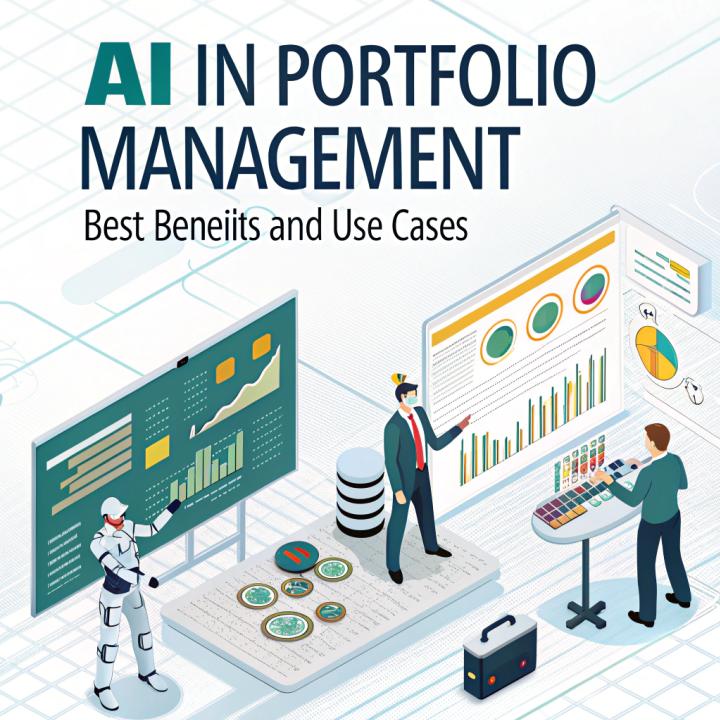

In the lightning-fast changing financial industries, portfolio management has become more convoluted than ever before. With myriad investment opportunities, volatile markets, and growing investor expectations, traditional strategies are no longer enough to assure long-term stability and profitability. This is where AI in portfolio management comes into play.
If we say AI is transforming every industry, from banking and finance to real estate, healthcare and fitness to education, and social networking to gaming, and if we talk about portfolio management, AI is boosting this platform also. With the help of AI, we can manage easily analyzing large datasets in few seconds to predicting market trends with impressive accuracy
This article explores the top benefits and use cases of AI in portfolio management and why financial firms and AI app development companies are increasingly adopting this powerful technology.
What is AI in portfolio management?
AI portfolio management indicates the AI app development, machine learning, and advanced tech stake to monitor trends in the digital market, optimize risk, and manage investment portfolios. for the purpose of investment decision-making. In contrast to conventional practices where millions of people's intuition and manual analysis are used, AI-based portfolio management uses big data and predictive analytics to standardize patterns, make predictions, and suggest appropriate investment plans.
Key features of AI for portfolio management include:
Real-time monitoring of market fluctuations.
Predictive modeling for better risk management.
Automated portfolio adjustments based on investor goals.
Enhanced personalization tailored to risk appetite and investment horizon.
Benefits of AI in Portfolio Management
1. Data-Driven Investment Decisions
Traditional portfolio managers often rely on historical data, reports, and personal expertise. However, these methods can be limited in scope and prone to bias. With AI portfolio management, large volumes of structured and unstructured data (such as market news, social media sentiment, and economic reports) are analyzed within seconds. This enables investors to make decisions based on accurate and up-to-date insights.
2. Predictive Market Analysis
One of the most significant advantages of AI-driven portfolio management is its predictive capability. Machine learning models analyze past trends, market cycles, and real-time data to predict possible market movements. This empowers investors to anticipate risks and opportunities before they occur.
3. Personalized Investment Strategies
Every investor has unique goals, whether it’s wealth preservation, aggressive growth, or retirement planning. AI-based portfolio management uses algorithms to create highly personalized portfolios by considering risk tolerance, financial goals, and investment preferences. This level of personalization ensures that strategies are aligned with individual needs.
4. Enhanced Risk Management
Managing risk is one of the most critical aspects of portfolio management. AI in portfolio management evaluates multiple risk factors simultaneously, including market volatility, geopolitical events, and sector-specific risks. By doing so, it minimizes exposure and ensures that the portfolio remains resilient even in uncertain times.
5. Efficiency and Automation
Manual portfolio management requires hours of analysis and rebalancing. In contrast, AI-driven portfolio management automates these tasks, saving time and reducing human error. Automated trading strategies can rebalance portfolios instantly in response to market movements, ensuring portfolios remain optimized at all times.
6. Improved Returns
The combination of predictive analysis, real-time monitoring, and risk mitigation helps investors achieve better returns. By seizing opportunities early and avoiding potential pitfalls, AI portfolio management significantly enhances overall profitability.
Best Use Cases of AI in Portfolio Management
1. Robo-Advisors
Traditional portfolio managers depend primarily on past data, reports, and individual experience. Such approaches are limited in nature and can be subject to bias. In AI portfolio management, massive amounts of structured and unstructured data (like market news, social media opinion, and economic reports) are processed in seconds. This allows investors to make investment decisions based on precise and real-time insights.
2. Predictive Market Analysis
Among the most important benefits of portfolio management using AI is its predictive nature. Machine learning algorithms study historical trends, market cycles, and current data to forecast potential movements in the market. This allows investors to make educated guesses about potential risks and opportunities ahead of time.
3. Personalized Investment Strategies
Each investor has distinct objectives, whether it is wealth preservation, growth at a high rate, or retirement planning. Portfolio management based on AI employs algorithms to develop extremely customized portfolios by taking into account risk tolerance, financial objectives, and investment choices. Such customization helps ensure that approaches are customized to meet individual requirements.
4. Improved Risk Management
Risk management is one of the most important practices of portfolio management. AI portfolio management considers several factors of risk at one time, such as market volatility, geopolitical news, and sectoral risks. By doing so, it reduces exposure and maintains the portfolio robust even in uncertain situations.
5. Efficiency and Automation
Manual portfolio rebalancing and analysis take several hours. With AI-based portfolio management, these processes are automated, which means less time is wasted and fewer errors are made. Automated trading systems can rebalance portfolios immediately in reaction to market fluctuations, keeping portfolios optimized at all times.
6. Custom Financial Advisory
Wealth management firms leverage AI portfolio management tools to provide personalized recommendations to high-net-worth individuals. These recommendations are based on real-time data, ensuring clients receive up-to-date and relevant advice.
Challenges of AI in Portfolio Management
While the benefits are impressive, there are also challenges to consider:
Data Quality: Poor-quality or biased data can lead to inaccurate predictions.
Over-Reliance on Automation: Excessive reliance on AI may overlook external factors such as political events or natural disasters.
Ethical and Privacy Concerns: Managing sensitive financial data requires strict adherence to privacy laws and ethical practices.
High Initial Investment: Developing robust AI portfolio management systems can be costly, though the long-term ROI often justifies the expense.
The Future of AI in Portfolio Management
The adoption of AI in portfolio management is expected to grow exponentially in the coming years. In the growing market, upcoming latest technologies and algorithms become more sophisticated, and data accessibility improves. AI in portfolio management has proven to be a game-changer role in shaping investment strategies.
We can expect to see:
More advanced robo-advisors for retail investors.
AI systems integrating ESG (Environmental, Social, and Governance) factors into portfolios.
Smarter predictive models to forecast global economic shifts.
Seamless integration of AI with blockchain and fintech solutions.
The future points to a world where AI-driven portfolio management not only enhances returns but also democratizes access to professional investment strategies.