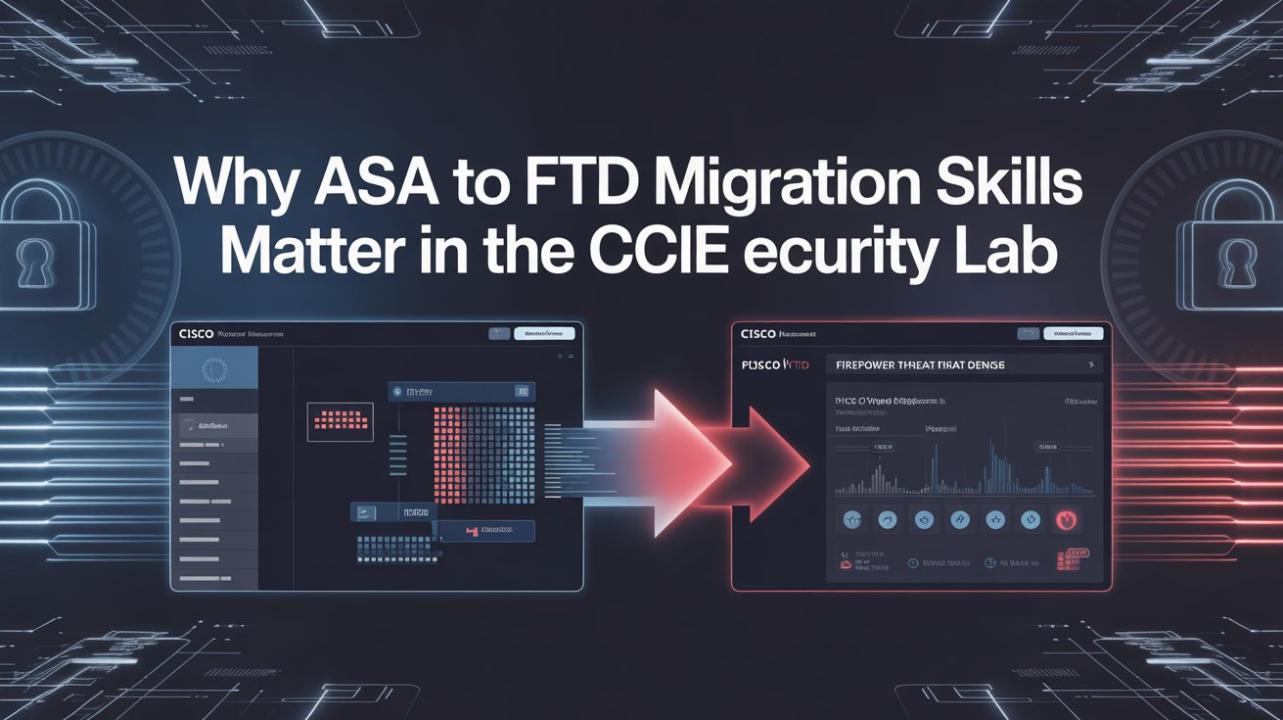
The cybersecurity ecosystem is experiencing unprecedented transformation, and Cisco’s transition from Adaptive Security Appliance (ASA) to Firepower Threat Defense (FTD) represents one of the most pivotal architectural overhauls in enterprise network security. As organizations modernize their security posture, the ability to manage ASA-to-FTD migration workflows has moved from a niche competency to a mission-critical expertise. For CCIE Security aspirants—particularly those preparing in competitive, technology-driven markets like Virginia—mastering this migration process is no longer optional. It is a strategic differentiator that directly impacts lab performance, professional credibility, and long-term career acceleration.
Within the foundational stages of CCIE Security Training in Virginia, learners gain structured, scenario-based exposure to both ASA and FTD technologies. This exposure ensures they develop the technical acumen required to navigate modern threat-defense systems deployed across enterprises and federal environments. Virginia’s cybersecurity landscape, influenced heavily by defense, intelligence, and regulated industries, demands engineers who can operate confidently in hybrid, complex architecture environments. ASA-to-FTD migration expertise sits at the center of this expectation.
Understanding the Enterprise Shift from ASA to FTD
Today’s enterprises operate in a high-stakes threat environment where visibility, automation, and predictive intelligence are no longer aspirational—they are essential. Cisco Firepower Threat Defense brings these capabilities into a unified platform, delivering next-generation firewall services integrated with advanced intrusion prevention, dynamic analytics, and automated threat detection.
As more organizations modernize their infrastructures, legacy ASA deployments are steadily being replaced with holistic FTD solutions. This migration introduces intricate workflows that require engineers to understand both architectures thoroughly. The expectation is simple: optimize the migration without disrupting service availability, performance, or compliance.
For CCIE candidates, this real-world expectation becomes a testing ground inside the lab environment.
Why ASA-to-FTD Migration Skills Are Essential for CCIE Security Lab Success
The CCIE Security Lab exam is meticulously crafted to evaluate an engineer’s ability to deliver end-to-end, enterprise-grade security solutions. Cisco assesses not just theoretical understanding but the capacity to implement, troubleshoot, and optimize diverse security architectures—including both legacy and modern platforms.
1. Aligned Directly with CCIE Blueprint Requirements
The CCIE Security blueprint incorporates core components of ASA, Firepower Management Center (FMC), NAT policies, Access Control rules, VPN services, and advanced IPS features. ASA-to-FTD migration touches all these domains, making it one of the most high-impact skills for lab success.
2. Dominant Enterprise Adoption Across Virginia
From federal agencies to defense contractors and financial institutions, the migration toward FTD is accelerating across Virginia. Organizations expect professionals to manage hybrid deployments and transition plans with operational rigor.
3. Lab Troubleshooting Frequently Includes Hybrid Environments
Candidates often encounter mixed ASA and FTD environments in the lab. These scenarios mirror enterprise realities, where full migration is phased and legacy systems coexist with next-generation solutions.
4. Enables Stronger Decision-Making and Root-Cause Analysis
Understanding both architectures empowers CCIE aspirants to make precise troubleshooting decisions and resolve configuration conflicts efficiently. This competence is especially valuable when addressing complex NAT, VPN, and policy translation issues.
Critical ASA-to-FTD Migration Skills for CCIE Candidates in Virginia
Developing migration proficiency requires a structured, outcome-driven approach. Training programs in Virginia integrate practical simulation labs that mirror real enterprise conditions, empowering candidates with the following core skills:
1. Pre-Migration Assessment
A successful migration begins with evaluating the ASA’s existing state. Aspirants must be adept at:
Reviewing and backing up current configurations
Assessing NAT structures and ACL dependencies
Identifying unsupported ASA features that require redesign
This assessment establishes a stable foundation for error-free migration.
2. Using the Firepower Migration Tool (FMT)
The FMT automates configuration and policy conversion; however, its outputs often require manual refinement. CCIE candidates must understand:
Which ASA rules convert cleanly
Which features require redesign
How to validate policy logic post-conversion
This knowledge ensures efficient and accurate migration workflows.
3. NAT and Access Policy Mapping
ASA uses Access Control Lists (ACLs), while FTD relies on Access Control Policies (ACP). The translation process changes rule precedence, behavior, and implementation. Candidates must grasp how policies evolve when transitioning between these platforms.
4. Object and Service Conversion
Network objects, port groups, and service definitions translate differently in Firepower. Understanding object inheritance, nested groups, and FMC-driven logic is crucial to avoiding misconfiguration.
5. Post-Migration Validation and Troubleshooting
After deployment, engineers need to verify traffic flow, ensure policy enforcement, validate VPN operations, and troubleshoot unexpected behaviors. This mirrors the troubleshooting section of the CCIE Lab exam—making validation a core competency.
Why Virginia Is an Ideal Environment for Building Migration Expertise
Virginia’s cybersecurity ecosystem is robust, future-focused, and heavily influenced by public-sector and defense-grade security requirements. This environment creates a steady demand for professionals who can architect, execute, and optimize ASA-to-FTD migration projects with precision.
Training institutes across Virginia differentiate themselves by offering:
Real-world migration case studies
Scenario-based simulation labs
Mentor-guided troubleshooting frameworks
Hybrid ASA+FTD environment practice modules
This ecosystem empowers aspirants with hands-on proficiency and decision-making agility—skills that translate directly into CCIE Lab success.
Conclusion
ASA-to-FTD migration expertise has evolved into a cornerstone competency for CCIE Security aspirants preparing in Virginia’s dynamic cybersecurity landscape. By mastering migration planning, policy translation, validation processes, and hybrid architecture troubleshooting, learners position themselves to excel in lab scenarios modeled after real-world enterprise environments. As candidates accelerate their competency across modern threat-defense frameworks, they elevate their readiness for advanced certification and bolster their professional trajectory with CCIE Security Lab Training USA—ultimately strengthening their long-term impact in high-demand cybersecurity roles.