
Introduction – Understanding Contact Center Management
The way customers interact with your company can influence their attitude towards your brand when they contact it. That is where contact center management comes in. It is the platform behind all smooth calls, chat and emails that can assist your team to provide a consistent service.
Contact center management isn’t just about answering calls. It is all about people, technology and customer expectations. It is what businesses use to maintain the structure of communication, track performance, and ensure their customers receive the help promptly.
Imagine it to be the linkage between the workflow of your team and the experience of your customers. It can be used to create trust, increase efficiency and make customers loyal when managed properly and this is the reason why we are going to dive in today and find out all that you need to know!
What Does Contact Center Management Involve?
Contact center management goes beyond handling calls. It includes the managing of teams, monitoring performance, using call management systems and utilizing technology to enhance communication and customer satisfaction on all channels.
Core Responsibilities of Contact Center Managers
Running a contact center takes more than scheduling shifts and tracking calls. The managers have the role of balancing performance, people and processes. Their day to day work usually involves:
Overseeing inbound and outbound operations
Measuring such indicators as the number of calls, the duration to respond, and customer satisfaction.
Leading staff members by coaching and providing feedback.
Compliance with company rules and regulations of data protection.
Determining areas where workflows or costs should be better.
Types of Contact Centers
Not all contact centers serve the same purpose. These are the primary categories that businesses count on:
Inbound centers: Product enquiries, complaints and support calls.
Outbound centers: Specialize in telemarketing, lead follow-up and survey.
Blended centers: Incorporate inbound and outbound work, which is flexible.
Omnichannel hubs: Integrate voice, chat, email, and social applications, which will provide a clean customer experience.
Key Skills Every Contact Center Manager Should Have
A good contact center manager is an empathetic leader whose communication abilities, sound decision-making, and adaptability (form a balance between human skills and technical skills to maintain the operations flowing and customers satisfied) allow this person to keep the contact center functioning smoothly and the customers satisfied.
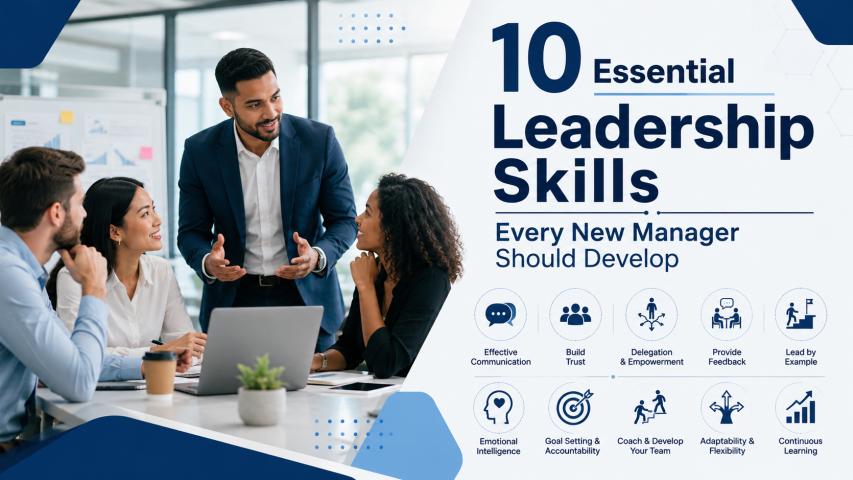
Leadership and Team Motivation
The best contact center managers are great coaches, not just supervisors. They make specific objectives and appreciate victories, large or small. A motivated team doesn’t just perform better it stays longer.
Open communication, feedback listening and maintaining high morale are very significant in a high pressure environment. A good leader knows when to be aggressive to achieve results and when to be supportive on bad days to the agents.
Data-Driven Decision Making
Contemporary call centers operate on digits. Managers can use data to identify patterns, correct bottlenecks, and make smarter schedules.
Common metrics include:
First Call Resolution (FCR): The number of times an issue of the customer is resolved during a call.
Average Handling Time (AHT): The period of time used by agents on an interaction.
Customer Satisfaction (CSAT): The level of satisfaction of customers, after a conversation with your team.
Net Promoter Score (NPS): The loyalty is the extent to which a person is likely to refer to your brand.
Communication and Emotional Intelligence
Every conversation matters. Whether calming an angry customer or guiding a confused one, emotional intelligence is a must. This skill must be modelled by managers to their teams.
Good communication is not just what is said but how one listens, empathizes and the tone. The agents take the lead of the managers who are patient and understanding.
Technical and Process Knowledge
A contact center manager doesn’t need to be a tech genius, but they should understand how the systems work. That includes:
Customer data management CRM.
IVR (interactive Voice Response) to call routing.
Scheduling and forecasting workforce management tools.
Live performance tracking reporting dashboards.
Benefits of Effective Contact Center Management
Good management of contact centers enhances the speed of response, customer satisfaction and performance of the team. It minimizes mistakes, enhances productivity and improves customer relationships that leads to sustainable business development.
Better Customer Experience
Customers feel that they are listened to and their opinions matter when your contact center operates effectively. They do not wait forever or repeat their issue several times.Call recording also helps maintain quality across channels.
A proper call center provides them with timely and uniform assistance, regardless of the medium: phone, chat, or e-mails. The reliability makes people come back repeatedly and creates long term trust.
Higher Agent Productivity
Agents work best when they are aware of the expectations and are encouraged. When they are adequately managed, their workload remains manageable, and they find it easy to use the available tools, and training keeps their skills up-to-date.
When managers work on the growth rather than micromanaging, employees work quicker, smarter, and more confidently.
Improved Business Efficiency
Lean center management reduces wastage of time and expenses. The workflows are clear, resulting in fewer handoffs and automation allows routine work to be done, allowing the agents to work on complex problems.
By having better teams, the businesses are able to save money without reducing the quality of their services, which is a win to the business, and to the customers.
Proven Strategies for Successful Contact Center Management
Effective contact center management depends on appropriate objectives and training, intelligent automation, and continuous enhancement to maintain high levels of efficiency of teams and customer satisfaction.
Focus on Omnichannel Support
The customers will demand the same level of attention regardless of the point at which they reach you, be it on the phone, chat or even through social media. By coordinating all these channels, your team will be able to see the journey of every customer in full.
Omnichannel management will prevent a repetition of information and will result in an easier and more individualized interaction.
Leverage Technology and Automation
Technology is your friend, but not when it is used foolishly. Routine questions can be answered by AI chatbots, auto-dialers, and call routing systems and serve to expedite response.
Nevertheless, human touch must never be substituted with automation. The most effective ones incorporate technology to assist an agent, and not marginalize it. Intelligent automation saves time and work and allows teams to spend time on meaningful dialogues.
Common Challenges in Contact Center Management
Contact center managers face challenges like high call volumes, agent stress, and outdated tools. Balancing speed with quality service requires smart systems and strong team support.
High Agent Turnover
Agent burnout is one of the toughest challenges in this industry. Working long hours, receiving a lot of calls and having set targets may exhaust individuals.
Managers can minimize the turnover by providing environmentally friendly schedules, recognition programs as well as well defined career paths. A motivated agent stays longer and delivers better service.
Managing Peak Call Volumes
Even experienced teams are prone to busy seasons. The ability to predict call surges using past data is useful in planning.
The load can also be lightened with the help of self-service tools such as FAQs or AI chatbots. Customers will not have to wait long queues even during rush periods as a result of good forecasting and intelligent routing.
Future Trends in Contact Center Management
AI-driven data: It is now possible to propose solutions even before the call is picked up by the agents because of predictive tools.
Remote teams: Cloud-based systems enable managers to manage teams across the world anywhere.
Sentiment tracking in real-time: AI is able to read tone and emotion and thus can be adjusted accordingly, in real-time.
Customer self-service: Chatbots and knowledge bases will continue to grow, and customers will be able to find fast answers independently.
Conclusion
Contact center management isn’t just about handling calls, it's about creating connections. Companies that consider it as an important aspect of developing the company experience more loyal customers, happier employees and easier business.
A combination of effective leadership, the appropriate equipment and a sincere orientation towards service will not merely make you manage a contact center but will create a unique experience that customers can depend on.
That’s the real power of great contact center management.