Have you ever tried uploading a large file, sharing your screen on Zoom, or backing up photos to the cloud, only to find that everything takes forever? You might have fast download speeds, but what happens when you upload? It can feel like your internet has turned into a dial-up connection.
If this sounds familiar, you’re facing a common issue: upload speed versus download speed. This is why more people are moving to the Symmetrical Internet. But what is it? How does it work? And is it really better than traditional home internet?
Let’s break it down in a simple, friendly, Web 2.0 >
What Is Symmetrical Internet?
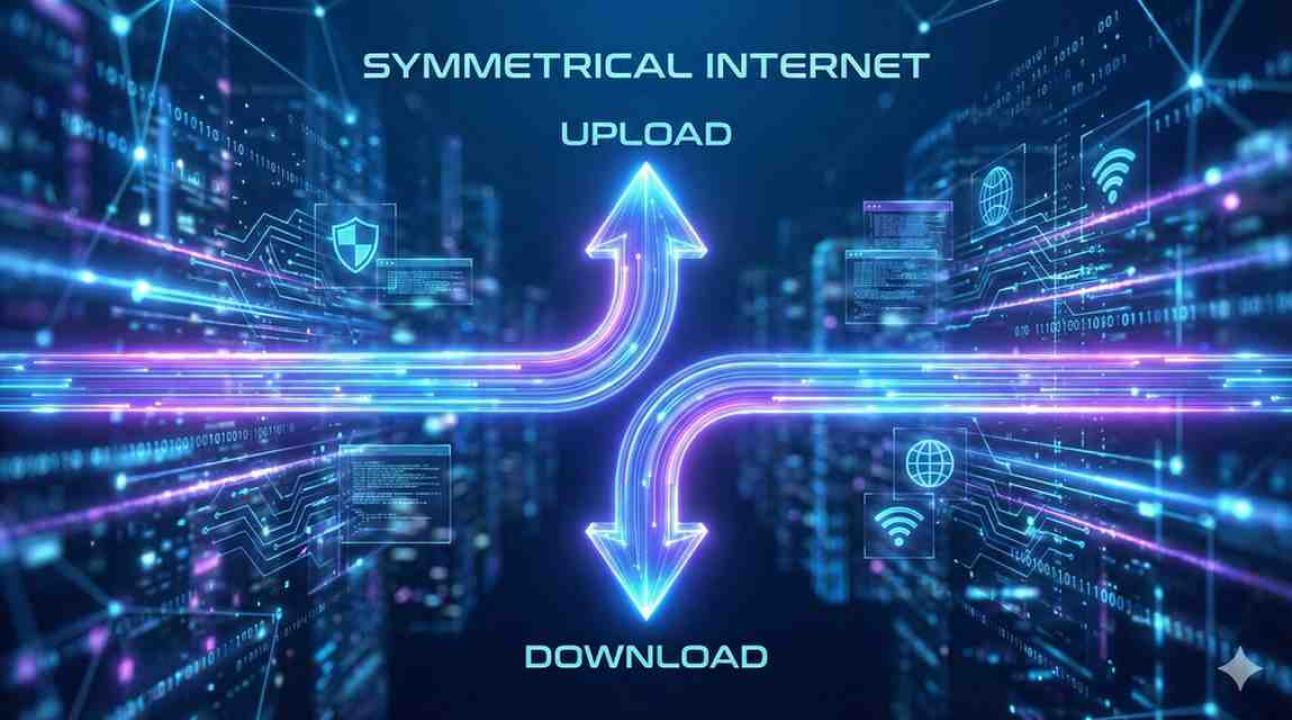
Symmetrical Internet means you get equal upload and download speeds.
For example, a 300 Mbps symmetrical plan gives you:
- 300 Mbps download
- 300 Mbps upload
By comparison, most common household plans might offer something like:
200 Mbps download
10 Mbps upload
This imbalance is why your streaming and browsing feel fast, but your video calls or uploads sometimes struggle.
Why Upload Speeds Matter Much More Today
For years, the internet was built for consuming content:
Watching Netflix
Browsing websites
Scrolling social media
Downloading apps
But in 2025, that’s no longer how most people use the internet.
Now we’re constantly sending data:
Joining video meetings
Uploading content
Sharing files
Syncing cloud storage
Livestreaming
Gaming
Running smart home cameras
We’re uploading more than ever, and slow uploads can affect everything, sometimes even more than slow downloads. That’s why symmetrical internet speeds are gaining popularity, especially with fiber internet and better connectivity options.
How Symmetrical Internet Works
To understand how symmetrical speeds are possible, we need to look at how different types of internet transmit data.
1. Fiber Internet (The Technology Behind Symmetry)
Most symmetrical internet plans use fiber optic cables, which send data with pulses of light. Because fiber can handle large amounts of data in both directions simultaneously, it naturally supports equal upload and download speeds.
Fiber = true symmetrical speeds.
2. Cable Internet (Asymmetrical by Design)
Traditional cable internet relies on coaxial cables that were originally made for TV broadcasts. This system tends to focus on download speeds, giving uploads much less bandwidth. This is why cable plans rarely offer balanced speeds.
3. Fixed Wireless & Other Technologies
Some high-end wireless internet providers offer near-symmetrical speeds, but it depends heavily on the network, distance, and equipment.
4. Why Fiber Easily Supports Symmetrical Internet
Fiber networks are:
Faster
More reliable
Less congested
Better for two-way data traffic
This is why fiber companies can deliver equal speeds while DSL, cable, and satellite typically cannot.
Key Benefits of Symmetrical Internet
Not everyone needs symmetrical internet speeds but for the people who do, it’s a total game-changer. Here are the biggest benefits.
1. Better Video Calls & Online Meetings
Video calls rely heavily on upload speeds.
With symmetrical internet:
Your video is clearer
You freeze less
Audio stays stable
Screen-sharing is smoother
If you work from home or attend online classes, symmetrical speeds make a huge difference.
2. Faster File Uploads
Uploading anything becomes dramatically faster, including:
YouTube videos
Photos
Large documents
Software updates
Client files
School assignments
Social media content
If uploading takes too long, symmetrical internet fixes that instantly.
3. Cloud-Based Work Becomes Seamless
Many tools today run completely online:
Google Drive
OneDrive
Dropbox
Notion
Adobe Cloud
CRM tools
These tools constantly sync data in the background. Balanced speeds keep everything fast and smooth.
4. Better Online Gaming & Livestreaming
Gamers often think download speed matters most, but in reality:
Latency
Ping
Packet loss
…are all affected by upload performance.
With symmetrical speeds, you get:
Lower lag
Better responsiveness
Smoother Twitch/YouTube streaming
5. Perfect for Homes With Many Devices
Modern homes have:
Smartphones
Laptops
Smart TVs
Tablets
Security cameras
Smart appliances
Many of these devices send data constantly, not just receive it. Balanced speeds prevent network slowdowns when multiple devices upload at once.
6. Ideal for Small Businesses & Home Offices
Businesses benefit most from symmetrical speeds because they rely heavily on:
VoIP calling
File transfers
Cloud backups
Data syncing
Remote work tools
Even small home-based businesses can see massive improvements.
7. More Reliable for Smart Home Security Systems
Many devices constantly send data, not just receive it. Balanced speeds prevent network slowdowns when multiple devices upload at once. Security cameras upload footage all day. Doorbells send alerts. Baby monitors stream live video. All of this needs strong upload bandwidth. Symmetrical speeds ensure your cameras won’t slow down your network.
Who Actually Needs Symmetrical Internet?
Let’s break it down.
You Need Symmetrical Internet If You:
Work from home
Upload videos or content
Livestream
Play competitive online games
Use cloud-based software
Have a smart home with multiple devices
Run a business from home
Back up files frequently
You May Not Need It If You:
Mostly watch Netflix or YouTube
Browse casually
Live alone with minimal devices
Don’t upload large files
Just use light social media
It all comes down to how much upload bandwidth your daily life actually requires.
How Symmetrical Internet Speeds Compare to Asymmetrical Speeds
Let’s simplify the difference.
Asymmetrical Speeds:
Download: fast
Upload: slow
Good for streaming and browsing
Struggles with video calls, uploads, and cloud tools
Symmetrical Speeds:
Download = upload
Great for work, gaming, cloud storage, and multi-device homes
More balanced and modern experience
In simple terms:
Asymmetrical speeds are built for the past.
Symmetrical internet speeds are built for the future.
Is the Symmetrical Internet Always Faster?
Not necessarily.
It depends on your life>
If you upload a lot → Yes, it’s absolutely faster.
If you mostly download → You might not notice much difference.
But one thing is certain: symmetrical plans are more future-proof as our digital lives continue shifting toward two-way data.
Conclusion
Symmetrical Internet isn’t just a trendy term, it's a smarter, more modern way to stay connected. With equal upload and download speeds, you get a balanced and powerful internet experience that supports remote work, content creation, gaming, smart home devices, and almost every cloud-based tool we rely on today.
While not everyone needs symmetrical speeds, those who rely on uploads, video calls, cloud storage, or have many devices at home will notice an immediate improvement. As the internet becomes more two-directional, symmetrical speeds are becoming more of a necessity than a luxury.
FAQs About Symmetrical Internet
1. What is symmetrical internet?
Symmetrical Internet provides equal upload and download speeds, giving you balanced performance for both sending and receiving data.
2. Do symmetrical speeds make video calls better?
Yes. Video calls rely heavily on upload bandwidth, so symmetrical speeds improve clarity, reduce lag, and prevent freezing.
3. Is symmetrical internet faster than cable?
Usually, yes, especially for uploads. Cable internet has very limited upload bandwidth, while fiber-based symmetrical plans perform well in both directions.
4. Who benefits most from symmetrical internet?
Remote workers, gamers, livestreamers, creators, and households with many devices benefit the most due to high upload needs.
5. Is fiber the only way to get symmetrical internet?
Fiber is the main technology that supports true symmetrical speeds, though some fixed wireless providers offer near-symmetrical performance depending on their network.