Generative AI has matured from experimental innovation into a strategic business capability. Enterprises and high-growth startups are no longer asking whether to adopt AI. They are asking how to build systems that deliver secure, scalable, and measurable business outcomes. This is where enterprise-ready model development becomes the defining factor between pilot success and long-term transformation.
While public foundation models offer a starting point, real enterprise value emerges when organizations build proprietary intelligence that reflects internal knowledge, workflows, compliance requirements, and customer expectations. Achieving this level of maturity requires disciplined architecture, governance planning, and operational alignment.
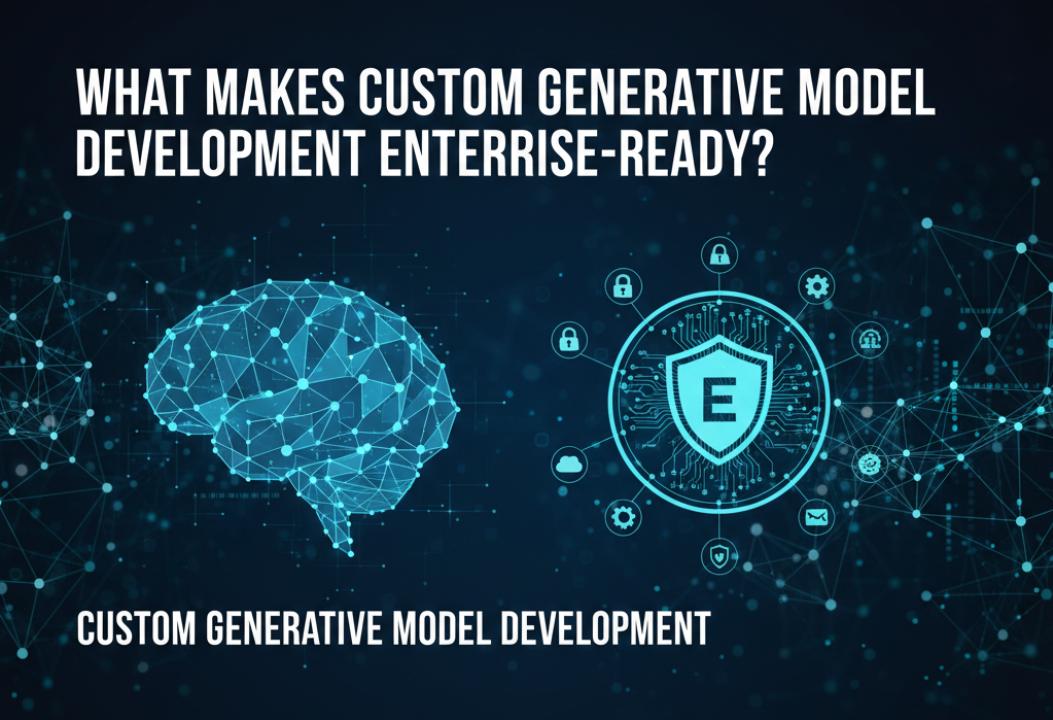
This article explains the practical foundations that make Custom Generative Model Development ready for enterprise deployment and why leadership teams should approach investment with a long-term operational mindset.
1. Moving Beyond General Intelligence to Business Context
Public models are trained on broad internet data. Enterprises operate on proprietary knowledge. The difference determines output relevance, trust, and usability.
When organizations develop internal models trained on company data, domain documentation, process records, and historical interactions, AI becomes context-aware rather than generic. This enables:
- Accurate internal knowledge retrieval
- Business-specific language understanding
- Domain-aligned recommendations
- Consistent brand communication
A logistics enterprise can embed routing logic. A financial institution can integrate internal compliance frameworks. A manufacturing firm can connect technical manuals to automated assistance. These capabilities drive measurable productivity gains that public models cannot deliver alone.
A qualified Generative AI development company provides data engineering, model architecture design, and domain adaptation pipelines required to convert enterprise knowledge into intelligent systems.
2. Governance and Data Security as the Starting Line
No enterprise deploys AI without addressing data risk. Generative systems interact with sensitive customer information, intellectual property, and internal operations. Enterprise readiness begins with strong governance.
A secure generative AI foundation includes:
- Encrypted data storage and transmission
- Role-based access management
- Controlled data ingestion pipelines
- Private cloud or on-premise deployment options
- Full audit logs for model interactions
Industry studies report that over 60 percent of enterprises delay AI adoption due to security and compliance concerns. Organizations that build governance into architecture planning accelerate internal approvals and regulatory confidence.
Strategic planning support through Generative AI Consulting ensures policies, accountability structures, and compliance mapping are defined before technical development begins.
3. Infrastructure Designed for Real Enterprise Load
A model that performs well in a pilot environment may fail under enterprise traffic volumes. Enterprise readiness means designing for scale from day one.
Scalable deployment architecture includes:
- Optimized model inference pipelines
- Load balancing for high request volumes
- Cloud resource orchestration
- Latency control for real-time responses
- Continuous uptime monitoring
AI must integrate with existing business platforms such as CRM tools, ERP systems, data warehouses, and workflow engines. This is where Generative AI Integration Services play a critical role by embedding intelligence directly into operational systems instead of creating standalone tools.
Many organizations begin structured deployment planning through professional Generative AI Development Services that combine infrastructure design, system integration, and model engineering.
4. Output Reliability and Continuous Model Improvement
Enterprise users expect consistent accuracy. Unpredictable or hallucinated responses reduce trust and slow adoption. Enterprise-ready AI requires continuous evaluation and optimization.
Best practices include:
- Real-world scenario testing
- Human review loops for critical workflows
- Automated accuracy scoring
- Version-controlled model updates
- Performance drift detection
Research shows enterprises that implement continuous monitoring achieve significantly higher long-term model stability. Continuous improvement transforms AI from a one-time deployment into a living knowledge system that evolves with business needs.
5. Compliance, Transparency, and Explainability
Regulators increasingly require visibility into automated decision systems. Enterprises deploying generative AI must prove how outputs are generated and what data influences responses.
Compliance-ready model frameworks include:
- Explainable response tracing
- Bias detection and fairness audits
- Documented data lineage
- Clear responsibility ownership
Industries such as finance, healthcare, legal services, and government demand audit-ready systems. Building transparency into model design avoids costly reengineering later and strengthens stakeholder trust.
6. Business Alignment and ROI Accountability
Enterprise investment decisions require defined return metrics. AI initiatives succeed when they solve real operational challenges.
High-value enterprise applications include:
- Internal knowledge discovery
- Customer support automation
- Sales proposal generation
- Technical documentation assistance
- Employee productivity enablement
Success metrics typically measure reduced handling time, lower operational costs, faster knowledge access, and improved service quality. Enterprise adoption studies indicate organizations with defined ROI frameworks are twice as likely to scale AI initiatives.
These measurable outcomes are delivered through structured Generative AI solutions that convert repetitive knowledge work into efficient digital operations.
7. User Adoption and Organizational Enablement
Even the strongest technology fails without user trust. Enterprise readiness includes training, onboarding, and cultural integration.
Effective enablement programs include:
- Leadership alignment workshops
- Role-based training sessions
- AI usage guidelines
- Feedback-driven refinement cycles
- Embedded interfaces in existing tools
When employees interact with AI inside familiar platforms, adoption accelerates and resistance decreases. Enterprise-grade AI should feel like a natural extension of daily workflows.
8. Long-Term Partnership and Operational Support
Enterprise AI is not a short-term project. Models evolve, data grows, and compliance requirements change. Sustainable success depends on long-term technical partnership.
Key partner evaluation factors include:
- Experience with enterprise-scale deployments
- Cross-industry implementation expertise
- Ongoing optimization and maintenance support
- Roadmap planning for future model enhancements
This is where investing in structured Generative AI Development Services creates long-term operational continuity rather than fragmented implementations.
9. Building Proprietary Intelligence for Competitive Advantage
Organizations that build internal generative capabilities gain strategic defensibility. Instead of relying on shared public intelligence, they develop proprietary knowledge engines that compound in value over time.
Enterprise benefits include:
- Faster internal decision-making
- Higher workforce productivity
- Improved knowledge sharing
- Stronger customer experience
- Durable competitive positioning
This is the strategic outcome of enterprise-grade Custom Generative Model Development executed with a long-term vision.
Final Thoughts
Enterprise-ready generative AI is not defined by model complexity alone. It is defined by governance, scalability, compliance, reliability, integration, and business accountability. Organizations that approach development with structure and clarity move faster from proof of concept to operational maturity.
For global enterprises and high-growth startups preparing to scale intelligent systems, selecting the right Generative AI development company becomes a foundational decision that determines long-term success.