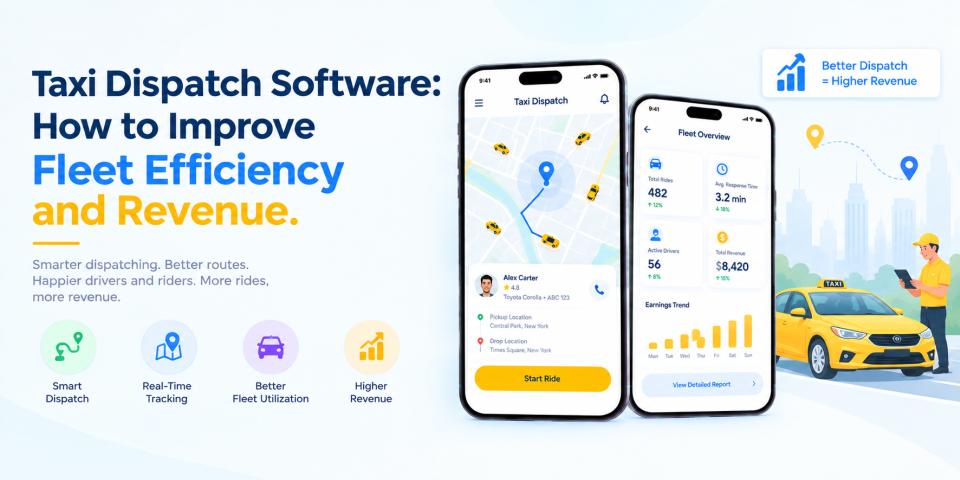
Taxi booking has shifted almost entirely to mobile. Customers expect instant rides, real-time tracking, digital payments, and smooth app experiences. For businesses, Android and iOS taxi app development is no longer just about building an app. It’s about creating a scalable ride-hailing platform that can compete with Uber, Ola, and regional players while controlling costs and ownership. Understanding platforms, features, development models, and costs is critical before you invest.
What Is Android and iOS Taxi App Development?
Android and iOS taxi app development refers to building a complete ride-hailing ecosystem that runs on both major mobile platforms. This ecosystem typically includes three core components:
- A passenger mobile app
- A driver mobile app
- A web-based admin panel
Mobile taxi app development goes beyond booking rides. It handles real-time GPS tracking, dynamic pricing, driver allocation, secure payments, notifications, and analytics. Ride-hailing app development also requires a strong backend to manage thousands of concurrent users, trips, and transactions without downtime.
Android vs iOS Taxi App Development for Businesses
Android Taxi App Development
Android dominates global market share, especially in emerging markets. For businesses aiming at mass adoption, Android taxi app development offers broader reach and device flexibility.
Key points:
- Built using Kotlin or Java
- Supports a wide range of devices and price segments
- Faster market penetration in developing regions
- More customization at OS and hardware level
iOS Taxi App Development
iOS users generally expect premium performance and design. iOS taxi app development is preferred when targeting high-value customers and urban markets.
Key points:
- Built using Swift
- Strong security and data privacy standards
- Better performance consistency across devices
- Higher average revenue per user
Android vs iOS Taxi App Development Cost
When businesses compare Android and iOS taxi app development cost, the difference is not just about hourly rates or coding language. The real cost gap comes from device coverage, testing effort, user expectations, and long-term maintenance.
Android Taxi App Development Cost Explained
Android apps usually require more development and testing time. The reason is fragmentation.
Android runs on thousands of devices across different brands, screen sizes, OS versions, and hardware capabilities. For a taxi booking app, this directly impacts:
- GPS accuracy and location permissions
- App performance on low-end devices
- Battery optimization for driver apps
- Compatibility with older Android versions
Because of this, Android taxi app development involves:
- Extra UI testing
- More QA cycles
- Additional bug-fixing rounds
What this means for cost:
- Higher testing and quality assurance effort
- Slightly longer development timeline
- More ongoing maintenance updates
iOS Taxi App Development Cost Explained
iOS taxi app development is generally more predictable.
Apple controls hardware and software tightly. There are fewer devices, fewer OS variations, and more consistent performance. This reduces development uncertainty.
Cost advantages of iOS:
- Faster testing cycles
- Fewer device-specific bugs
- More stable app behavior
- Lower short-term maintenance cost
But there’s a trade-off.
Apple has strict App Store guidelines, especially around:
- Location tracking
- Payment methods
- Data privacy
- Background processes
Meeting these requirements adds time during review and compliance phases. While coding may be faster, approval delays can affect launch timelines.
From a revenue perspective, iOS users typically:
- Book rides more frequently
- Spend more per transaction
- Show higher loyalty
Cost Comparison: Android vs iOS Taxi App Development
At a high level:
Android taxi app
- Higher development and QA cost
- Broader market reach
- Better suited for scale
iOS taxi app
- Lower testing cost
- Faster development cycles
- Higher revenue per user
Native vs Cross-Platform Taxi App Development
Native Taxi App Development
Native apps are built separately for Android and iOS using platform-specific languages.
Advantages:
Best performance
Smooth GPS and real-time tracking
Better integration with device hardware
Higher long-term scalability
Cross-Platform Taxi App Development
Cross-platform taxi app development uses a single codebase to deploy apps on both platforms.
Popular frameworks:
- Flutter taxi app development
- React Native taxi app
Advantages:
- Lower initial development cost
- Faster launch
- Easier maintenance
Core Features of a Taxi Booking App for Android and iOS
Passenger App Features
The passenger app defines customer experience.
Essential features:
- User registration via mobile, email, or social login
- GPS-based taxi app with live location detection
- Real-time ride tracking app
- Fare estimation before booking
- In-app payment integration for taxi apps
- Ride history and invoices
- Ratings and reviews
Driver App Features
Driver efficiency determines supply reliability.
Key features:
- Driver onboarding and document verification
- Ride request notifications
- Navigation with optimized routes
- Earnings dashboard
- Availability toggle
- Trip history and payout tracking
Admin Panel Features
The admin panel is the control center of the platform.
Capabilities include:
- Admin panel for taxi app with real-time dashboards
- Driver and user management
- Commission and pricing rules
- Dispute and refund handling
- Analytics and reports
Advanced Features in Modern Ride-Hailing App Development
Modern taxi platforms rely on intelligence, not just booking flows.
Advanced features include:
- AI features in taxi app development for driver allocation
- Dynamic pricing based on demand and traffic
- Predictive analytics for peak hours
- Fraud detection systems
- Cloud-based taxi app development for high availability
- Multi-city and multi-language support
Taxi App Development Process: Step-by-Step
Step 1: Business Requirement Analysis
Define your target market, pricing model, and expansion strategy.
Step 2: UI/UX Design
Design intuitive interfaces for Android and iOS users.
Step 3: Backend for Taxi Booking App
Build a scalable backend to handle real-time data, payments, and notifications.
Step 4: App Development
Develop passenger app, driver app, and admin panel.
Step 5: Testing and QA
Test performance, security, GPS accuracy, and payment flows.
Step 6: Deployment and Launch
Publish apps on Google Play Store and Apple App Store.
Cost to Develop a Taxi App for Android and iOS
The cost to develop a taxi app for Android and iOS depends on how far you want to go from day one. A simple MVP to test the market costs very differently from a full-scale Uber-like platform built for multi-city operations. What matters most is not just the initial build, but how well the app can scale without needing a rebuild.
Taxi App Development Cost Breakdown
MVP Taxi App Development Cost
An MVP taxi app is designed to launch fast and validate the idea with minimum risk. It focuses only on core ride-booking functionality.
Typical features included
- Passenger app with ride booking
- Driver app with ride accept and navigation
- GPS-based location tracking
- Basic fare calculation
- One payment gateway
- Simple admin panel
Estimated cost
- Android or iOS only: USD 15,000 to 25,000
- Android + iOS (cross-platform): USD 20,000 to 30,000
Best suited for
- Startups testing a city or niche
- Local taxi operators going digital
- Pilot projects before fundraising
Advanced Taxi App Development Cost
An advanced taxi app is built for growth and competition. It includes features that improve efficiency, retention, and revenue.
Additional features
- AI-based driver allocation
- Dynamic or surge pricing
- Real-time analytics dashboard
- Multi-city support
- Promotions and referral system
- Enhanced admin controls
- Better performance optimization
Estimated cost
- Single platform (Android or iOS): USD 30,000 to 45,000
- Android and iOS (native or optimized cross-platform): USD 40,000 to 60,000
Best suited for
- Funded startups
- Regional ride-hailing businesses
- Companies competing with established platforms
Factors Affecting Taxi App Development Cost
Understanding cost drivers helps businesses avoid surprise expenses later.
Features and Complexity
The more real-time and intelligent the app, the higher the cost. Features like AI pricing, predictive analytics, fraud detection, and multi-language support significantly increase development and testing effort.
Future Trends in Android and iOS Taxi App Development
Taxi apps are no longer just about booking rides. The next phase of Android and iOS taxi app development is focused on efficiency, sustainability, platform expansion, and smarter decision-making. Businesses that plan for these trends early will have a clear advantage over late adopters.
Electric Vehicle Integrations
Electric vehicles are becoming a core part of modern ride-hailing strategies, especially in cities pushing sustainability policies. Taxi apps are now being designed to support EV-specific operations rather than treating them like regular vehicles.
- EV driver onboarding and vehicle tagging
- Battery level monitoring inside the driver app
- Smart ride assignment based on remaining charge
- Charging station discovery and route planning
- EV-focused incentives and pricing rules
Final Thoughts: Is Taxi App Development Worth the Investment?
Android and iOS taxi app development is worth the investment when it’s built with scale and long-term growth in mind. Owning your taxi platform gives you full control over customers, pricing, and data, instead of relying on third-party aggregators.
With the right strategy and technology partner like Comfygen, businesses can launch secure, scalable taxi apps that grow across cities without constant rebuilds. From MVPs to enterprise ride-hailing platforms, a well-planned taxi app becomes a revenue-generating asset, not just a booking tool.
If mobility is central to your business, investing in a custom taxi app is no longer optional. It’s how modern transport companies stay competitive.