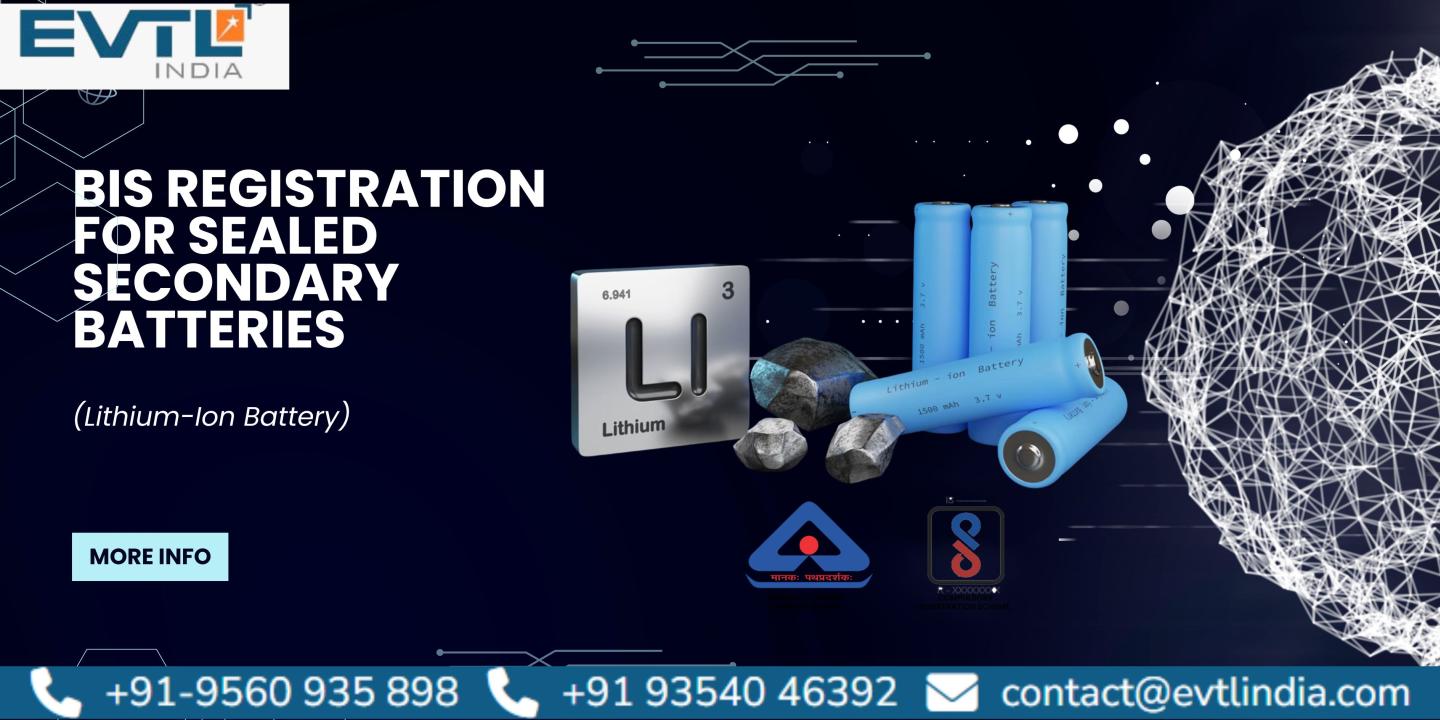
The use of sealed secondary lithium-ion batteries and cells has become essential across sectors such as electric vehicles, consumer electronics, telecom equipment, medical devices, and renewable energy storage. Due to safety risks associated with lithium-ion technology, the Indian government has mandated BIS Certification for Sealed Secondary Batteries/Cells (Lithium-Ion Battery) as per IS 16046 .
Manufacturers and importers must obtain BIS Registration, CRS Certification, and BIS License to legally sell or import lithium-ion batteries in India.
What Is IS 16046 (Part 2): 2018?
IS 16046 (Part 2): 2018 is the Indian Standard that specifies safety requirements for secondary lithium-ion cells and batteries. This standard is harmonized with international safety norms and focuses on preventing electrical, thermal, and mechanical hazards.
The standard covers:
-
Protection against over-charging and forced discharge
-
Short-circuit and thermal abuse safety
-
Mechanical shock, vibration, and drop resistance
-
Fire, explosion, and leakage prevention
Compliance with this standard is compulsory under the BIS Compulsory Registration Scheme (CRS).
Why BIS Certification for Lithium-Ion Batteries Is Mandatory
BIS Certification for Sealed Secondary Batteries/Cells (Lithium-Ion Battery) is mandatory to ensure public safety and product quality. Lithium-ion batteries without BIS approval are strictly prohibited from sale or import in India.
Key Reasons to Obtain BIS Registration:
-
Mandatory compliance with Indian regulations
-
Legal approval for manufacturing and imports
-
Reduced safety and liability risks
-
Improved acceptance by OEMs and government buyers
-
Authorization to use the BIS CRS Standard Mark
Products must carry the BIS logo along with a valid CRS registration number.
BIS Registration and CRS Certification Procedure
The BIS Registration for Sealed Secondary Batteries/Cells (Lithium-Ion Battery) follows a defined CRS approval process.
BIS CRS Registration Steps:
-
Identify product applicability under IS 16046 (Part 2): 2018
-
Conduct testing at a BIS-recognized laboratory
-
Prepare Construction Data Form (CDF)
-
Compile Critical Component List (CCL)
-
Submit online CRS application on the BIS portal
-
Technical evaluation by BIS authorities
-
Grant of BIS CRS Registration
The registration is typically issued for two years and must be renewed before expiry.
BIS QCO for Sealed Secondary Lithium-Ion Batteries
The BIS Quality Control Order (QCO) mandates that only BIS-certified lithium-ion batteries and cells can be manufactured, imported, or sold in India.
Non-Compliance Risks:
-
Rejection of imports at Indian ports
-
Monetary penalties and prosecution
-
Product recalls and business suspension
Adhering to BIS QCO for Sealed Secondary Batteries/Cells (Lithium-Ion Battery) is essential for uninterrupted market access.
Documents Required for BIS License
To obtain a BIS License for Sealed Secondary Batteries/Cells (Lithium-Ion Battery), applicants must submit:
-
CRS application form
-
Test report as per IS 16046 (Part 2): 2018
-
Construction Data Form (CDF)
-
Critical Component List (CCL)
-
Product datasheet and specifications
-
User manual and labeling details
-
Trademark registration certificate
-
Manufacturing license
-
Authorized Indian Representative (AIR) details for foreign manufacturers
Role of a BIS Consultant, CRS Consultant, and BIS Agent
Due to the technical complexity of lithium-ion battery certification, working with a professional BIS Consultant for Sealed Secondary Batteries/Cells (Lithium-Ion Battery) is highly recommended.
How a BIS Agent Adds Value:
-
Correct standard identification and scope analysis
-
Coordination with BIS-approved testing labs
-
Accurate CRS application filing
-
Acting as AIR for overseas manufacturers
-
Renewal, amendment, and compliance support
A dedicated CRS Consultant for Sealed Secondary Batteries/Cells (Lithium-Ion Battery) significantly reduces delays and rejection risks.
Who Must Obtain BIS Certification?
-
Indian manufacturers of lithium-ion batteries and cells
-
Foreign manufacturers exporting batteries to India
-
Importers and brand owners selling lithium-ion battery products
Without valid BIS Registration, lithium-ion batteries cannot be legally sold in India.
Conclusion
EVTL India is one of the leading BIS Consultant in India, helping manufacturers obtain their BIS licences hassle-free.Obtaining BIS Certification, BIS Registration, and CRS Certification for Sealed Secondary Batteries/Cells (Lithium-Ion Battery) under IS 16046 (Part 2): 2018 is a mandatory regulatory requirement for ensuring safety, compliance, and business continuity in India. With strict BIS QCO enforcement, professional assistance from an experienced BIS Consultant or BIS Agent ensures smooth approvals and long-term compliance.