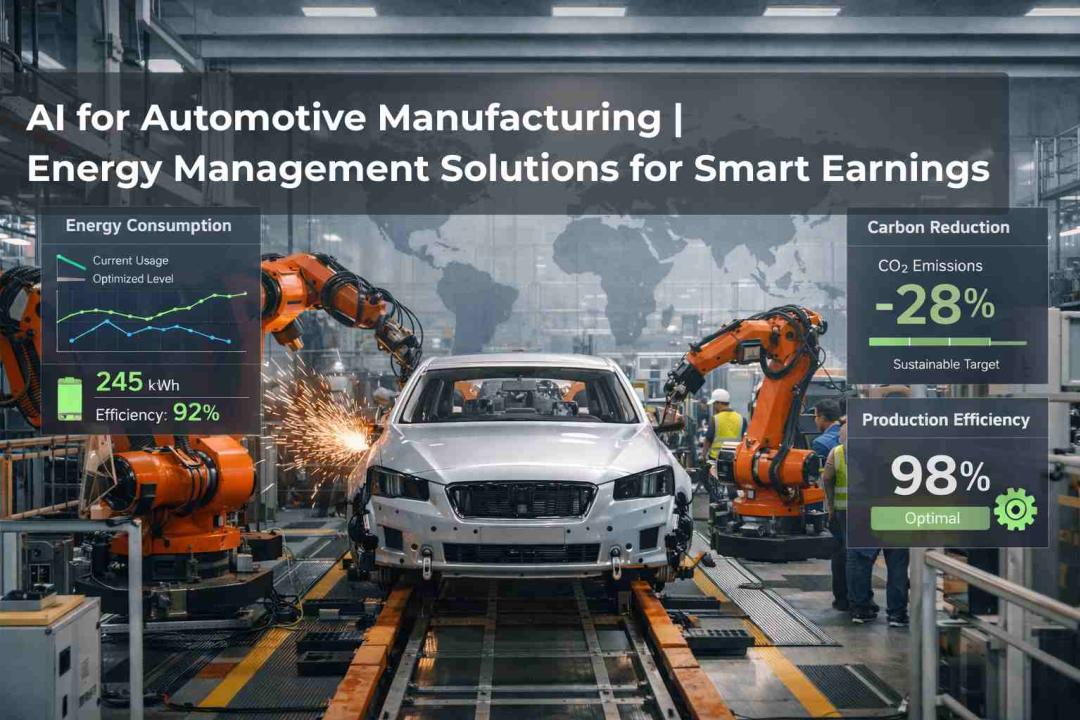
The automotive industry in India and globally is going through a strong transformation. Rising energy costs, strict carbon regulations, water scarcity, and pressure for operational excellence are pushing manufacturers to rethink how plants are managed. Today, automotive manufacturing is not just about production speed. It is about energy efficiency, sustainability, and enterprise-level intelligence.
Understanding
the Challenge in Automotive Manufacturing
Automotive
plants are highly energy-intensive. From paint shops and welding lines to
compressed air systems and HVAC utilities, every process consumes significant
power and water. However, many factories still operate with fragmented data
systems. Energy usage is tracked separately from production KPIs. Water
balancing is managed manually. Sustainability reporting is often reactive
instead of predictive.
This
creates three major problems:
- Difficulty in identifying
which process or utility is driving higher energy consumption
- Limited visibility of plant-wise
carbon emissions
- Delayed decision-making due to
scattered data
Without
integrated insights, cost reduction becomes difficult, and sustainability goals
remain on paper.
Why
Enterprise AI and Smart Energy Management Matter
To reduce
manufacturing cost per unit and improve EBITDA margins, automotive companies
must move from reactive monitoring to predictive and prescriptive intelligence.
This is
where AI for automotive manufacturing
becomes a strategic enabler.
A modern
energy management platform connects utilities, production lines, assets, and
sustainability systems into one unified intelligence layer. Instead of viewing
data in silos, plant leaders get real-time visibility across:
- Energy consumption by process
and utility
- Water balancing across supply
and demand
- Asset performance efficiency
- Carbon footprint per plant and
per product line
When data
is structured under a common framework, benchmarking becomes easy. One plant’s
best practice can be replicated across 10 others within weeks. Energy leakages,
compressed air inefficiencies, and abnormal power loads can be detected
automatically.
For
example, in the automotive component industry, energy balancing complexity
often prevents accurate cost allocation. With enterprise AI integration,
manufacturers can distinguish between utility consumption and process loads
clearly. This improves cost transparency and supports smarter capital
allocation decisions.
Similarly,
water balancing challenges in automotive facilities can be resolved through
intelligent tracking of inflow, outflow, and losses. Leak detection, recycling
optimisation, and demand forecasting reduce operational waste significant
Achieving
Measurable Impact with EMS
At this
stage, decision-makers usually ask: how do we scale this across multiple plants
without disrupting operations?
This is
where Energy Management enables enterprise-wide impact.
Instead of
deploying isolated analytics tools, Greenovative AI-led EMS builds a unified
operational intelligence architecture. The platform integrates energy, water,
asset, and carbon data into one enterprise view. This ensures:
- Standardised KPIs across all
plants
- Transparent and explainable AI
logic
- Faster replication of
optimisation strategies
- Unified ROI and carbon
visibility for CXOs
Automotive
manufacturers adopting such enterprise AI solutions typically achieve:
- 8–12% reduction in energy
costs
- Faster sustainability
reporting compliance
- Improved plant benchmarking
- Better decision governance
More
importantly, leadership gains clarity. Instead of multiple dashboards, they get
one version of operational truth.
The future
of automotive manufacturing will not be defined only by production capacity. It
will be defined by how intelligently energy, water, and assets are managed at
scale.
AI-driven
energy management systems are no longer optional. They are becoming
foundational infrastructure for profitability and sustainability. Companies
that move beyond pilot projects and build enterprise-level intelligence will
gain long-term competitive advantage.
If your
automotive facilities are struggling with energy balancing, carbon tracking, or
cross-plant benchmarking, it is time to rethink your approach.