
Introduction: The Overhead Problem No One Talks About Enough
Ask any business owner what keeps them up at night, and rising operational costs will almost always make the list. Rent. Salaries. Raw materials. And sitting quietly at the bottom of every monthly expense report — electricity.
For most commercial businesses, electricity is one of the largest and fastest-growing overhead costs. Industrial units, retail outlets, hotels, cold storage facilities, and offices across India are watching their power bills climb year after year, with no end in sight.
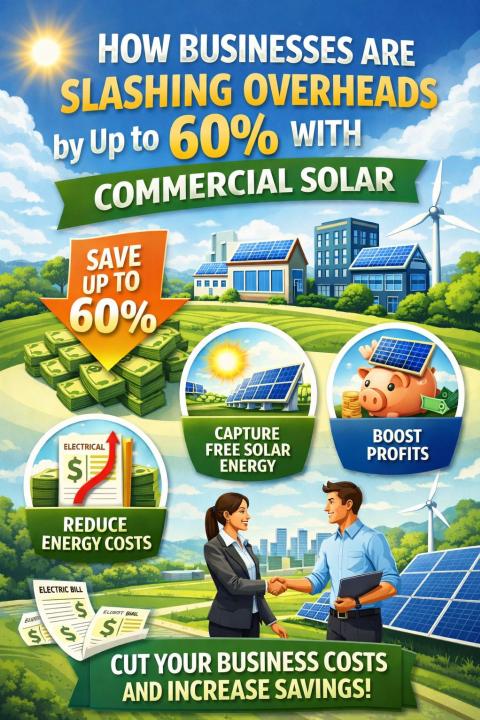
But a growing number of businesses have found a way to fight back — and the results are striking. By switching to commercial solar, many are cutting their electricity overheads by 40%, 50%, even 60%. Not over decades. Within the first few years of installation.
This article breaks down exactly how that is happening, who is benefiting most, and what it means for your business.
1. Why Electricity Costs Are Eating Into Business Profits
Before we talk about the solution, it helps to understand the scale of the problem.
Commercial electricity tariffs in India have risen steadily over the past decade. Industrial and commercial consumers typically pay between ₹7 and ₹12 per unit depending on the state and consumption slab — and these rates are expected to continue rising as demand grows and grid infrastructure costs increase.
For a mid-sized manufacturing unit consuming 50,000 units per month, that translates to electricity bills of ₹3.5 lakh to ₹6 lakh every single month. For a hotel running round-the-clock air conditioning, lighting, and kitchen equipment, the numbers are similarly punishing.
These are not small line items. For many businesses, electricity is the second or third largest cost after salaries. And unlike salaries, it delivers no productivity, no innovation, and no loyalty. It is pure overhead.
2. How Commercial Solar Delivers Savings of Up to 60%
The mathematics of commercial solar is straightforward — and compelling.
A rooftop solar system generates electricity from sunlight at an effective cost of ₹2 to ₹3.5 per unit over the system's lifetime, once you account for installation costs spread across 25 years of operation. Compare that to the ₹7–₹12 per unit you currently pay to the grid, and the savings become obvious.
Here is a simplified example:
| Metric | Without Solar | With Solar | |
|---|---|---|---|
| Monthly consumption | 30,000 units | 30,000 units | |
| Grid rate per unit | ₹9 | ₹9 | |
| Solar generation | 0 units | 20,000 units | |
| Units purchased from grid | 30,000 | 10,000 | |
| Monthly electricity bill | ₹2,70,000 | ₹90,000 | |
| Monthly saving | — | ₹1,80,000 | |
| Annual saving | — | ₹21,60,000 |
In this example, the business has reduced its electricity bill by 67% — right in line with the "up to 60%" savings that commercial solar users regularly report.
The exact percentage depends on your roof area, your daily consumption pattern, your current tariff rate, and how much of your usage falls during daylight hours. But across industries, the savings are real, consistent, and significant.
3. The Industries Seeing the Biggest Impact
Commercial solar works for virtually any business with a roof and a substantial electricity bill. But certain industries are seeing particularly dramatic results:
Manufacturing and industrial units are among the biggest winners. Heavy machinery, continuous operations, and high connected loads mean massive electricity consumption — and massive savings potential. Many manufacturing businesses in India are achieving payback periods of just 3–4 years.
Hotels and hospitality businesses run high loads around the clock — air conditioning, lighting, water heating, laundry, kitchen equipment. Solar dramatically reduces the daytime portion of this load, and solar water heating systems can further cut energy costs.
Retail and commercial complexes benefit from the strong alignment between peak solar generation hours (10am–4pm) and peak business activity hours. The electricity your panels generate during the day is used exactly when you need it most.
Cold storage and food processing facilities operate continuously and are extremely sensitive to electricity costs. Solar can make the difference between a profitable and an unprofitable operation in this sector.
Educational institutions and hospitals have large campus footprints with significant roof space, predictable daytime energy needs, and — in the case of hospitals — a critical need for energy security. Solar with battery backup is increasingly common in this segment.
4. Government Incentives Make It Even More Attractive
The savings from commercial solar are compelling on their own. Government incentives make the case even stronger.
Accelerated depreciation is one of the most powerful incentives available to commercial solar adopters. Businesses can claim up to 40% accelerated depreciation on solar assets in the first year under the Income Tax Act, significantly reducing their tax liability in the year of installation.
GST benefits apply to solar equipment, with reduced GST rates on solar panels and related components making the upfront investment more manageable.
Net metering allows businesses to feed surplus solar electricity back to the grid and receive credits on their bill, further improving the economics of solar — especially on weekends or during periods of lower production activity.
State-level subsidies and incentives vary across India, but many states offer additional support for commercial and industrial solar adoption. In Kerala, for instance, the KSEB net metering policy allows commercial consumers to offset their grid consumption with solar generation effectively.
When you combine operational savings with tax benefits and incentives, the effective return on investment for commercial solar is exceptional by almost any standard.
5. The Payback Period: When Does Solar Start Paying You Back?
One of the most common questions business owners ask is: how long before I recover my investment?
For commercial solar in India, the typical payback period ranges from 3 to 6 years, depending on system size, electricity tariff, available incentives, and financing structure. After payback, the system continues generating electricity — and savings — for another 19 to 22 years with minimal maintenance.
Think of it this way: you are essentially pre-purchasing 25 years of electricity at today's prices — or lower. Every year that electricity tariffs rise after your installation, your savings grow larger.
A business that installs a ₹50 lakh solar system today and achieves ₹15 lakh in annual savings recovers its investment in under 4 years. Over 25 years, the total savings could exceed ₹3.5 crore — after accounting for the initial investment.
This is not a cost. It is an investment with one of the most predictable and attractive returns available to any business.
6. Financing Options: You Do Not Need to Pay Upfront
A common misconception is that commercial solar requires a large upfront capital outlay that many businesses cannot afford. In reality, there are several financing models that make solar accessible regardless of cash flow position.
CAPEX model: The business owns the system outright, pays upfront (or through a business loan), and enjoys 100% of the savings and tax benefits. Best for businesses with available capital or access to low-interest financing.
OPEX / solar leasing model: A third-party developer installs and owns the system on your roof. You purchase the electricity generated at a fixed rate — typically lower than your current grid tariff. No upfront investment required. Savings begin from day one.
Power Purchase Agreement (PPA): Similar to the OPEX model, where you agree to buy solar power at a pre-agreed rate for a fixed term. The developer handles installation, maintenance, and operations.
Bank financing: Most nationalised and private banks in India offer dedicated green energy loans for commercial solar, with competitive interest rates and loan tenures of up to 7 years.
The right model depends on your business's financial situation, tax position, and long-term plans. A good solar advisor will help you evaluate which structure delivers the best outcome for your specific circumstances.
7. Beyond Savings: The Strategic Benefits of Commercial Solar
The financial case for commercial solar is strong enough on its own. But forward-thinking business owners are also recognising the strategic advantages that go beyond the electricity bill.
Energy independence: With solar and battery storage, your business is less vulnerable to grid outages, load shedding, and tariff hikes. This is especially valuable for businesses where downtime is costly.
Fixed cost certainty: Solar locks in a significant portion of your energy cost for 25 years. In an environment of rising tariffs and input cost volatility, this predictability is genuinely valuable for financial planning.
Brand and reputation: As discussed elsewhere, businesses that operate on clean energy build stronger brands. This is increasingly relevant for businesses seeking enterprise clients, export markets, or ESG-conscious investors.
Talent attraction: Employees — especially younger professionals — prefer working for businesses that demonstrate environmental responsibility. Solar is a visible, tangible signal of that commitment.
Conclusion: The Cost of Waiting Is Going Up Every Year
Every month your business runs without solar, you are paying full commercial tariff rates that are likely to be higher next year than they are today. The savings you could be making are being paid to the electricity utility instead.
The businesses that switched to commercial solar three years ago are now well past their payback period. They are operating with dramatically lower overheads, reinvesting their savings into growth, and building energy-resilient businesses that are harder to disrupt.
The opportunity to do the same is available to you right now — with financing options that require no upfront capital, government incentives that improve the economics further, and a technology that is proven, reliable, and built to last.
The question is not whether commercial solar makes financial sense. The numbers make that clear.
The question is how much longer you can afford to wait.
Ready to find out how much your business could save with commercial solar? Get a free assessment from our team today.