Market Overview:
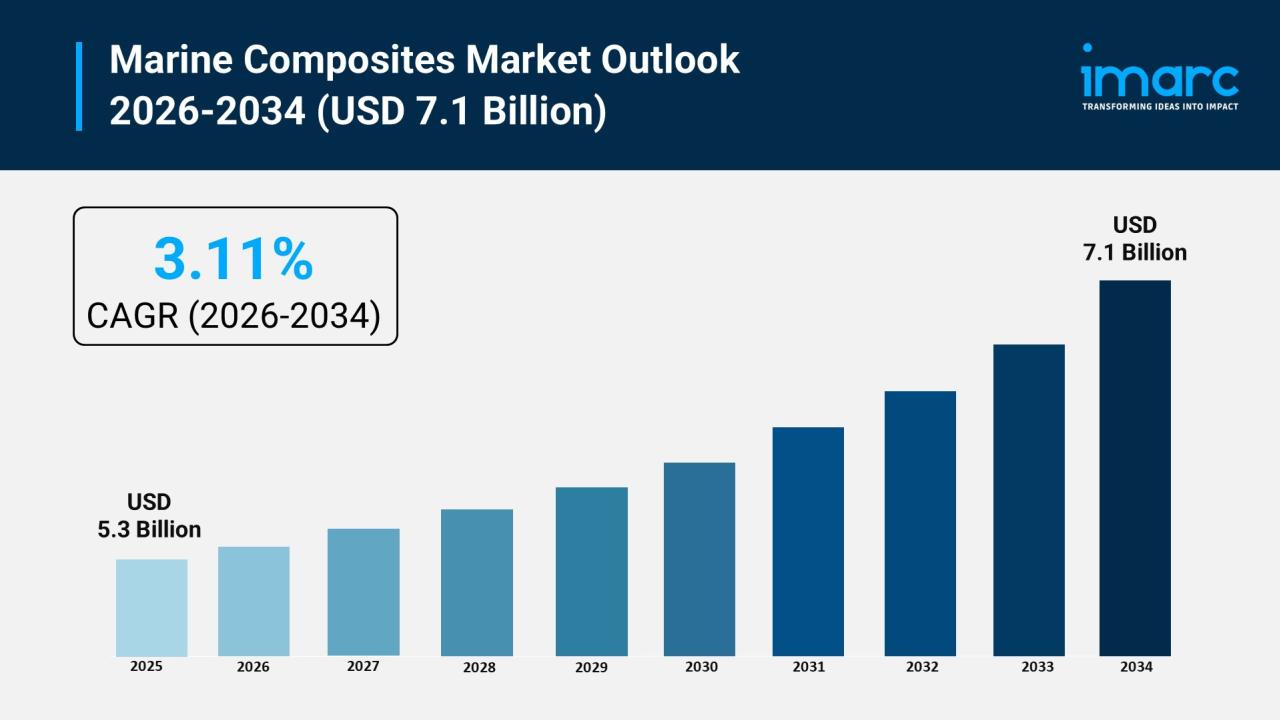
The marine composites market is experiencing rapid growth, driven by increasing production of leisure and luxury vessels, stringent environmental regulations and decarbonization, and expansion of offshore renewable energy infrastructure. According to IMARC Group’s latest research publication, “Marine Composites Market: Global Industry Trends, Share, Size, Growth, Opportunity and Forecast 2026-2034”, The global marine composites market size reached USD 5.3 Billion in 2025. Looking forward, IMARC Group expects the market to reach USD 7.1 Billion by 2034, exhibiting a growth rate (CAGR) of 3.11% during 2026-2034.
This detailed analysis primarily encompasses industry size, business trends, market share, key growth factors, and regional forecasts. The report offers a comprehensive overview and integrates research findings, market assessments, and data from different sources. It also includes pivotal market dynamics like drivers and challenges, while also highlighting growth opportunities, financial insights, technological improvements, emerging trends, and innovations. Besides this, the report provides regional market evaluation, along with a competitive landscape analysis.
Download a sample PDF of this report: https://www.imarcgroup.com/marine-composites-market/requestsample
Our report includes:
- Market Dynamics
- Market Trends And Market Outlook
- Competitive Analysis
- Industry Segmentation
- Strategic Recommendations
Growth Factors in the Marine Composites Market
- Increasing Production of Leisure and Luxury Vessels
The global surge in recreational boating and luxury yacht ownership is a primary engine for the marine composites market. In 2026, the leisure boat segment remains a dominant consumer, with powerboats alone accounting for a significant portion of the total market revenue. Modern consumers increasingly demand high-performance vessels that offer superior speed and fuel economy, which can only be achieved by replacing traditional heavy steel or aluminum hulls with lightweight carbon fiber and glass fiber reinforcements. For example, luxury catamaran manufacturers like Cure Marine have successfully launched 55-foot models utilizing full-hull infusion techniques to meet aggressive weight targets. This shift is supported by high-income growth in North America and Europe, where the aftermarket for composite retrofits, such as swim platforms and hardtops, is also expanding. As boat builders scale production to meet backlogged orders, the reliance on polymer-matrix laminates continues to grow.
- Stringent Environmental Regulations and Decarbonization
Global maritime authorities and regional governments are implementing rigorous emission standards that mandate a reduction in the carbon footprint of the shipping industry. To comply with these net-zero pathways, shipbuilders are turning to composite materials to significantly lower the overall weight of vessels, thereby improving hydrodynamics and reducing fuel consumption. In 2026, the European market leads this transition, supported by policies that incentivize the use of "green" vessels and sustainable manufacturing processes. Lighter hulls are particularly critical for the burgeoning electric and hybrid propulsion segment, as weight reduction directly extends the battery range and operational efficiency of zero-emission ferries and commercial craft. Furthermore, government initiatives like India's Maritime India Vision 2030 are providing financial assistance of 20% to 30% for the construction and retrofitting of green vessels, further accelerating the adoption of corrosion-resistant and fuel-efficient composite structures across the global merchant and commercial fleets.
- Expansion of Offshore Renewable Energy Infrastructure
The rapid global expansion of offshore wind energy projects has created a substantial and steady demand for marine-grade composite materials. Composite resins and fibers are indispensable in the manufacturing of massive wind turbine blades and floating offshore platforms due to their exceptional fatigue life and resistance to the harsh, corrosive saltwater environment. In 2026, major energy companies are investing billions in offshore infrastructure, particularly in the Asia-Pacific region and the North Sea, where composites provide a lower lifecycle cost compared to traditional materials. Beyond turbine blades, composites are being utilized for secondary structures like cable protection systems and access platforms. The offshore and marine structures segment is currently growing at a faster rate than many traditional maritime sectors, driven by the global transition toward renewable power. This industrial demand ensures a stable market for specialized epoxy resins and high-strength glass fibers, shielding the composites industry from the volatility of discretionary consumer spending.
Key Trends in the Marine Composites Market
- Adoption of Bio-based Resins and Natural Fibers
A significant shift toward sustainability is driving the development and integration of bio-based resins and natural fiber reinforcements in marine construction. Builders are increasingly experimenting with hybrid ply schedules that combine traditional glass fibers with basalt, flax, or hemp to reduce the environmental impact of vessel production without compromising structural integrity. Real-world applications of this trend are visible in the production of "eco-friendly" sailboats and small recreational craft, where manufacturers aim to appeal to environmentally conscious sailors. These bio-composites offer additional benefits such as improved vibration damping and lower energy consumption during the manufacturing phase compared to synthetic alternatives. Leading resin suppliers are now offering epoxy systems with over 30% bio-renewable content, allowing shipyards to lower their Scope 3 emissions. This trend marks a transition from niche experimental projects to mainstream manufacturing as certification bottlenecks for novel green resins are gradually being resolved.
- Integration of Smart Composites for Structural Health Monitoring
The marine industry is increasingly adopting "smart" composites that feature embedded sensors to monitor the structural health of a vessel in real-time. By integrating fiber-optic sensors or piezoelectric elements directly into the laminate layers during the infusion process, operators can detect delamination, moisture ingress, or stress fractures long before they become visible to the naked eye. This technology is particularly prevalent in high-value assets such as naval frigates and large cruise ships, like the Queen Mary 2, which utilizes composite partitions and structural components. These sensors feed data into digital twin models, enabling predictive maintenance schedules that maximize vessel uptime and reduce the frequency of expensive dry-dock inspections. This trend not only enhances safety for crew and passengers but also extends the total operational lifespan of the vessel by providing hard data on material fatigue in diverse sea states, representing a move toward lifecycle optimization.
- Growth of 3D-Printed Composite Components
Large-scale additive manufacturing, or 3D printing, is revolutionizing how complex marine parts are designed and produced. By using automated fiber placement and 3D printing with carbon-reinforced thermoplastics, shipyards can create intricate geometries that were previously impossible or too costly to manufacture using traditional molds. This trend is gaining significant traction in the production of custom hull sections, rudders, and internal structural brackets, as it drastically reduces material waste and labor intensity. For instance, the use of 3D-printed composite tools and parts allows for rapid prototyping and shorter lead times for bespoke yacht components. In 2026, naval modernization programs in the United States and Asia are leveraging this technology to quickly produce replacement parts for aging fleets, ensuring higher readiness levels. The ability to print one-piece, complex structures also reduces the number of joints and fasteners required, resulting in a stiffer and more reliable final product.
Leading Companies Operating in the Global Marine Composites Industry:
- ACP Composites, Inc
- Advanced Custom Manufacturing
- Airborne
- DuPont de Nemours, Inc.
- Gurit AG
- Marine Concepts
- Owens Corning
- Piran Advanced Composites
- Teijin Limited
- Zoltek Corporation (Toray Industries)
Marine Composites Market Report Segmentation:
By Composite Type:
- Metal Matrix Composite (MMC)
- Ceramic Matrix Composite (CMC)
- Polymer Matrix Composite (PMC)
Polymer Matrix Composite (PMC) is dominating the market due to its strength, lightweight properties, and corrosion resistance, PMC is widely used in marine applications like boat hulls and decks.
By Fiber Type:
- Glass Fiber
- Carbon Fiber
- Aramid Fiber
- Natural Fiber
- Others
Glass Fiber is holding the largest market share, glass fiber is favored for its affordability, high strength-to-weight ratio, and excellent corrosion resistance in marine applications.
By Resin Type:
- Polyester
- Vinyl Ester
- Epoxy
- Thermoplastic
- Phenolic
- Acrylic
- Others
Polyester is representing the leading segment, polyester resin is popular for its cost-effectiveness and compatibility with glass fiber, making it ideal for boat hulls and marine structures.
By Vessel Type:
- Power Boats
- Sailboats
- Cruise Ships
- Others
Power Boats is exhibiting clear market dominance, power boats are in high demand for recreational boating and sports, benefiting from lightweight composite materials that enhance performance.
Regional Insights:
- North America (United States, Canada)
- Asia Pacific (China, Japan, India, South Korea, Australia, Indonesia, Others)
- Europe (Germany, France, United Kingdom, Italy, Spain, Russia, Others)
- Latin America (Brazil, Mexico, Others)
- Middle East and Africa
North America is leading the market, North America accounts for the largest share in marine composites, driven by strong demand and advanced manufacturing capabilities in the region.
Note: If you require specific details, data, or insights that are not currently included in the scope of this report, we are happy to accommodate your request. As part of our customization service, we will gather and provide the additional information you need, tailored to your specific requirements. Please let us know your exact needs, and we will ensure the report is updated accordingly to meet your expectations.
About Us:
IMARC Group is a global management consulting firm that helps the world’s most ambitious changemakers to create a lasting impact. The company provide a comprehensive suite of market entry and expansion services. IMARC offerings include thorough market assessment, feasibility studies, company incorporation assistance, factory setup support, regulatory approvals and licensing navigation, branding, marketing and sales strategies, competitive landscape and benchmarking analyses, pricing and cost research, and procurement research.
Contact Us:
IMARC Group
134 N 4th St. Brooklyn, NY 11249, USA
Email: sales@imarcgroup.com
Tel No:(D) +91 120 433 0800
United States: +1-201971-6302