
Blockchain technology has rapidly
evolved from a niche concept powering cryptocurrencies into a foundational
layer for next-generation digital systems. However, as the ecosystem expands, a
new challenge has emerged: blockchain fragmentation.
Today, there are hundreds of
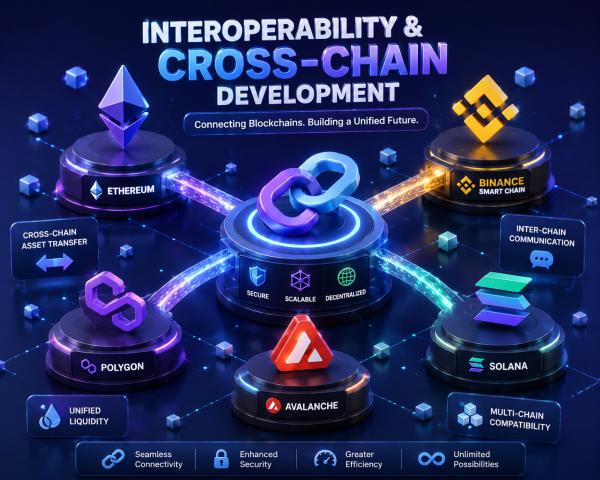
blockchain networks—Ethereum, Binance Smart Chain, Solana, Polygon, Avalanche,
and many more—each operating independently. While each chain has its strengths,
the lack of communication between them creates limitations for users and
developers.
This is where interoperability
and cross-chain development come into play. These technologies aim to
connect different blockchains, enabling seamless data transfer, asset movement,
and communication across networks.
In this blog, we will break down
interoperability and cross-chain development in a simple, easy-to-understand
way, along with their benefits, use cases, challenges, and future scope.
What is Blockchain Interoperability?
Blockchain interoperability refers
to the ability of different blockchain networks to communicate and share
data with each other without intermediaries.
In simple terms, it allows one
blockchain to “talk” to another.
For example:
- Sending tokens from Ethereum to Polygon
- Sharing data between a private enterprise blockchain
and a public blockchain
- Using a single decentralized application (dApp) across
multiple chains
Without interoperability,
blockchains act like isolated islands. With it, they become part of a connected
digital ecosystem.
What is Cross-Chain Development?
Cross-chain development is the process
of building applications and systems that work across multiple blockchain
networks.
Instead of being limited to one
blockchain, cross-chain dApps can:
- Access liquidity from multiple chains
- Execute transactions across networks
- Transfer assets seamlessly
- Interact with different smart contract systems
This approach improves flexibility,
scalability, and user experience.
Why Interoperability Matters in Blockchain
As blockchain adoption grows, users
and businesses face several challenges:
- Different blockchains have different ecosystems
- Assets are trapped within a single network
- High transaction fees on certain chains
- Limited scalability on individual blockchains
Interoperability solves these problems
by creating a unified blockchain ecosystem.
Key benefits include:
- Better liquidity flow
- Improved user experience
- Reduced network congestion
- Enhanced innovation opportunities
How Cross-Chain Technology Works
Cross-chain systems use different
methods to connect blockchains. Some of the most common techniques include:
1. Blockchain Bridges
Blockchain bridges allow tokens and
data to move from one blockchain to another.
For example:
- Locking tokens on Ethereum and minting equivalent
tokens on Binance Smart Chain
Bridges act as connectors between
ecosystems.
2. Wrapped Tokens
Wrapped tokens represent assets from
one blockchain on another.
Example:
- Wrapped Bitcoin (WBTC) allows Bitcoin to be used on
Ethereum-based applications
This enables liquidity without
moving the original asset.
3. Cross-Chain Smart Contracts
These are advanced smart contracts
that can interact with multiple blockchains simultaneously.
They help:
- Execute multi-chain transactions
- Automate cross-network operations
- Reduce manual intervention
4. Interoperability Protocols
Protocols like Polkadot and Cosmos
are designed specifically for blockchain communication.
They create ecosystems where
multiple blockchains can connect through a central framework.
Benefits of Interoperability & Cross-Chain Development
1. Improved Liquidity Across Chains
One of the biggest advantages is the
ability to access liquidity from multiple blockchains. This increases trading
efficiency and reduces capital lock-in.
2. Better User Experience
Users no longer need to switch
between wallets or platforms constantly. Cross-chain systems simplify nteractions
across ecosystems.
3. Scalability Improvements
Instead of relying on a single
blockchain, applications can distribute workloads across multiple networks,
reducing congestion and improving speed.
4. Reduced Transaction Costs
Users can choose cheaper networks
for transactions, optimizing gas fees and reducing costs significantly.
5. Increased Innovation
Developers can build more powerful
decentralized applications that leverage the strengths of multiple blockchains.
Real-World Use Cases
1. Decentralized Finance (DeFi)
Cross-chain DeFi platforms allow
users to:
- Lend assets across chains
- Borrow from multiple liquidity pools
- Swap tokens without centralized exchanges
This improves capital efficiency in
the financial ecosystem.
2. NFT Marketplaces
NFTs can be transferred across
blockchains, enabling:
- Broader marketplace access
- Lower minting costs
- Multi-chain ownership verification
3. Gaming (GameFi)
Blockchain games use cross-chain
systems to:
- Transfer in-game assets between platforms
- Enable cross-game economies
- Improve scalability for large player bases
4. Supply Chain Management
Businesses can track products across
multiple blockchain systems, ensuring transparency and traceability at every
stage.
5. Enterprise Blockchain Solutions
Companies use cross-chain networks
to:
- Connect private and public blockchains
- Share secure data between departments
- Improve global operations
Challenges in Cross-Chain Development
While the technology is promising,
there are several challenges:
1. Security Risks
Blockchain bridges have been
targeted by hackers in the past, making security a top concern.
2. Complexity in Development
Building cross-chain systems
requires advanced technical knowledge and infrastructure.
3. Lack of Standardization
Different blockchains use different
protocols, making integration difficult.
4.
Scalability Issues
Some interoperability solutions
struggle to handle high transaction volumes.
Popular Projects Supporting Interoperability
Several major blockchain projects
are working on cross-chain solutions:
- Polkadot
– Enables multiple blockchains to operate together
- Cosmos
– Focuses on blockchain communication via IBC protocol
- Chainlink
– Provides cross-chain data and messaging services
- Avalanche
– Supports subnet interoperability
- LayerZero
– Enables omnichain communication
These platforms are shaping the
future of connected blockchain ecosystems.
Future of Interoperability & Cross-Chain Development
The future of blockchain lies in multi-chain
ecosystems, not isolated networks.
Key trends include:
- Growth of omnichain applications
- Improved bridge security protocols
- AI-powered cross-chain automation
- Seamless Web3 user experiences
- Institutional adoption of interoperable systems
Eventually, users may not even
realize which blockchain they are interacting with—everything will be connected
behind the scenes.
Why Businesses Should Care
For businesses, interoperability is
not just a technical upgrade—it is a strategic advantage.
It enables:
- Faster digital transformation
- Global scalability
- Better customer experience
- Reduced infrastructure costs
- Access to multi-chain ecosystems
Companies that adopt cross-chain
strategies early will be better positioned in the evolving Web3 economy.
Conclusion
Interoperability and cross-chain
development are solving one of blockchain’s biggest limitations: isolation.
By enabling communication between
different networks, these technologies unlock new levels of efficiency,
scalability, and innovation.
From DeFi and NFTs to enterprise
systems and gaming, cross-chain solutions are reshaping how digital ecosystems
interact.
As the blockchain industry continues
to evolve, interoperability will become not just a feature—but a necessity.