In freight shipping, accuracy is everything. A small mistake in classification can lead to higher costs, shipment delays, and billing disputes. That’s where an NMFC freight class calculator becomes an essential tool.
Instead of relying on complex charts and manual calculations, modern online tools simplify the process and help you determine the correct freight class quickly and accurately. Using a reliable freight class calculator ensures your shipments are classified according to NMFC standards, reducing risks and improving efficiency.
What is an NMFC Freight Class Calculator?
An NMFC freight class calculator is an online tool that determines the correct freight class based on the National Motor Freight Classification (NMFC) system. This system standardizes how LTL (Less-Than-Truckload) shipments are categorized for pricing.
The calculator uses key shipment details such as:
Weight
Dimensions
Density
Handling requirements
Liability
Based on these factors, it assigns a class ranging from 50 to 500, which directly impacts shipping costs.
Why NMFC Classification Matters
NMFC classification is the foundation of LTL shipping pricing. Carriers rely on it to determine how much space a shipment occupies and how difficult it is to transport.
Incorrect classification can lead to:
Reclassification fees
Delayed shipments
Billing disputes
Increased shipping costs
Using an accurate free freight class calculator helps you avoid these issues and ensures compliance with industry standards.
How an NMFC Freight Class Calculator Works
The process is straightforward and designed to save time while improving accuracy.
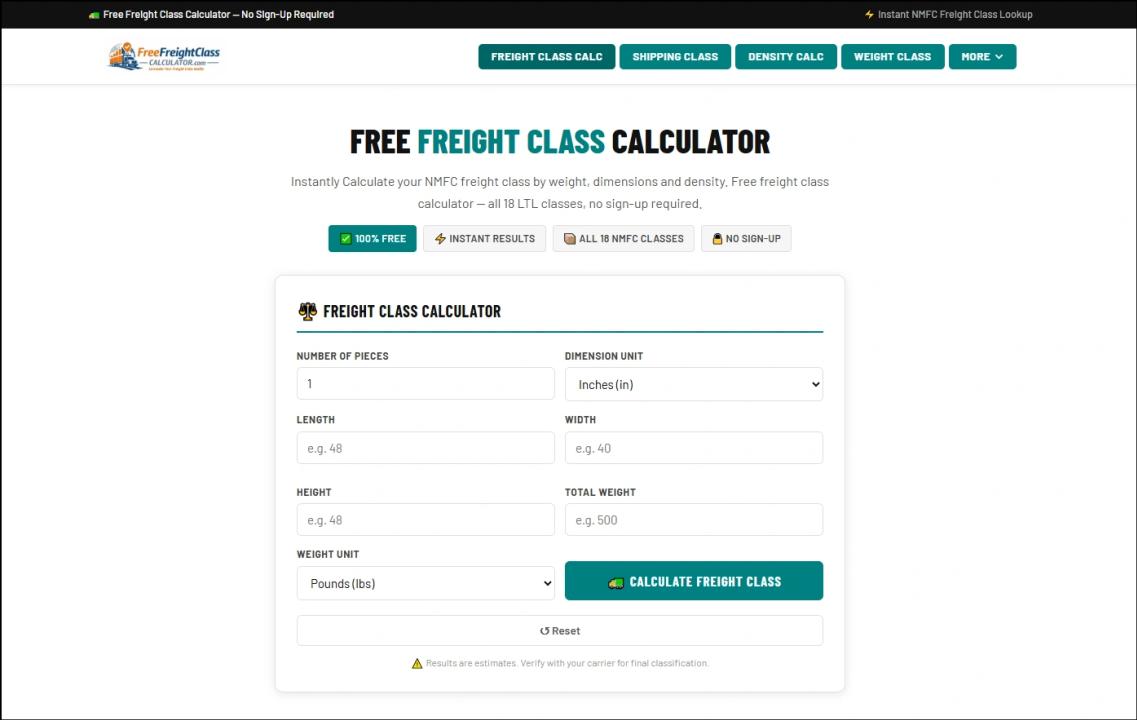
Step 1: Enter shipment dimensions
Input the length, width, and height, including packaging or pallet size.
Step 2: Enter total weight
Make sure the weight reflects the complete shipment.
Step 3: Calculate volume
The tool converts dimensions into cubic feet.
Step 4: Calculate density
Density is calculated by dividing weight by volume.
Step 5: Determine NMFC class
The calculator matches the density and other factors to the appropriate freight class.
For more precise calculations, you can use a density calculator alongside the main tool.
Understanding NMFC Freight Classes
Freight classes are divided into 18 categories, ranging from Class 50 to Class 500.
Lower classes (50–70)
High density
Heavy and compact
Lower shipping cost
Mid-range classes (85–125)
Moderate density
Standard goods
Higher classes (150–500)
Low density
Lightweight but bulky
Higher shipping cost
The more efficiently your shipment uses space, the lower the class and the cost.
The Role of Density in NMFC Classification
Density is the most important factor in determining freight class. It measures how much weight is packed into a given space.
High density leads to lower freight class
Low density leads to higher freight class
This is why using a freight density calculator is highly recommended before determining the final class.
Benefits of Using an NMFC Freight Class Calculator
Accurate classification
Ensures your shipment is categorized correctly according to NMFC standards.
Cost control
Prevents overpaying or facing unexpected charges.
Time savings
Instant calculations eliminate manual effort.
Reduced errors
Minimizes the risk of incorrect classification.
Improved workflow
Simplifies logistics and shipping processes.
Common Mistakes in NMFC Classification
Even experienced shippers can make errors when calculating freight class manually.
Incorrect dimensions
Failing to include packaging or pallet size can lead to inaccurate results.
Wrong weight input
Even small errors in weight can affect density calculations.
Ignoring density
Many users focus only on size and weight without properly calculating density.
Assuming class
Guessing the freight class without using a calculator often leads to costly mistakes.
Using a reliable freight class calculator helps avoid these common issues.
Tips to Improve Your Freight Class
Lowering your freight class can significantly reduce shipping costs. Here are some practical strategies:
Optimize packaging
Reduce empty space inside boxes to increase density.
Use proper pallet sizing
Avoid oversized pallets that waste space.
Consolidate shipments
Combining smaller shipments improves overall density.
Verify with a calculator
Always double-check using a density calculator before shipping.
Who Should Use an NMFC Freight Class Calculator?
This tool is useful for anyone involved in shipping and logistics.
eCommerce sellers
Helps calculate accurate shipping costs and pricing.
Freight brokers
Speeds up quoting and improves accuracy.
Manufacturers
Supports better planning and cost management.
Warehouse teams
Reduces errors and improves operational efficiency.
Why Online NMFC Calculators Are Better Than Manual Methods
Manual classification involves:
Complex NMFC charts
Time-consuming calculations
Higher risk of errors
Online tools provide a better alternative by offering:
Instant results
Accurate calculations
Easy-to-use interfaces
Using a dedicated free freight class calculator eliminates guesswork and simplifies the entire process.
How This Tool Improves Your Shipping Strategy
An NMFC freight class calculator does more than just provide a classification—it improves your overall logistics strategy.
Reduces unexpected costs
Improves pricing accuracy
Enhances customer satisfaction
Streamlines operations
When combined with a freight density calculator, it becomes a complete solution for accurate and efficient shipping.
Final Thoughts
An NMFC freight class calculator is a must-have tool for anyone involved in LTL shipping. It simplifies a complex process, improves accuracy, and helps you avoid costly mistakes.
Using a reliable freight class calculator ensures your shipments are classified correctly every time. This leads to better cost control, fewer disputes, and a more efficient shipping process.
If you want to improve your logistics workflow and reduce shipping costs, starting with the right calculator is the smartest move you can make.