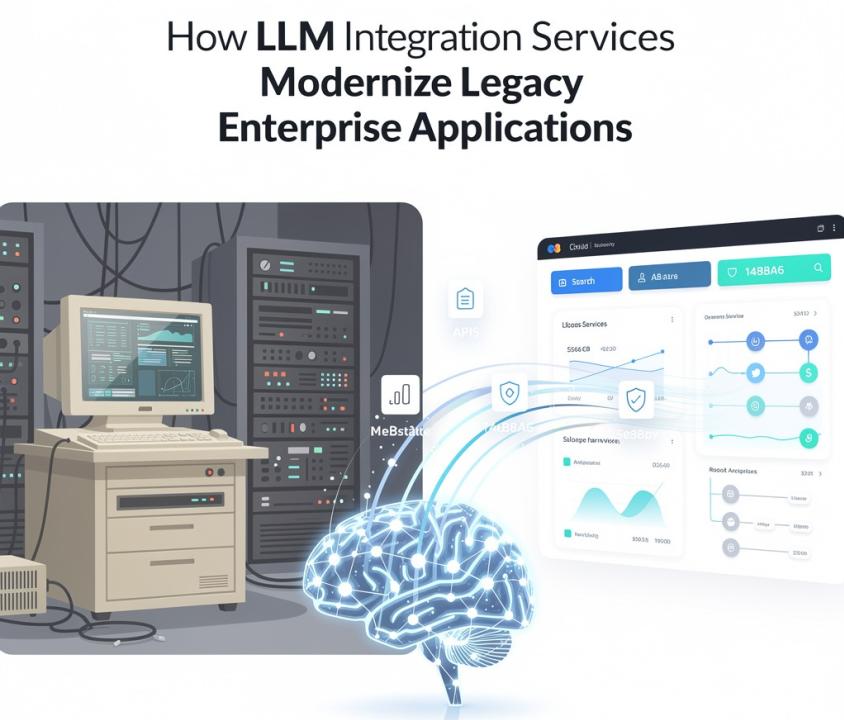
Legacy enterprise software continues to support business processes, although it may be insufficient to meet current business requirements for speed, insight, and flexibility. Banks are based on the 1990s mainframes. Manufacturers monitor inventory using custom built systems that are not updatable. Such arrangements are reliable but face challenges in real-time data processing and in meeting customer expectations defined by AI-driven applications. This is where LLM Integration Services come in. Through the integration of big language models into such older systems, businesses can acquire new functionalities without complete upgrades. In the case of global businesses and startups that have capital, this strategy generates quantifiable benefits by creating cost efficiencies and opening up new sources of revenue.
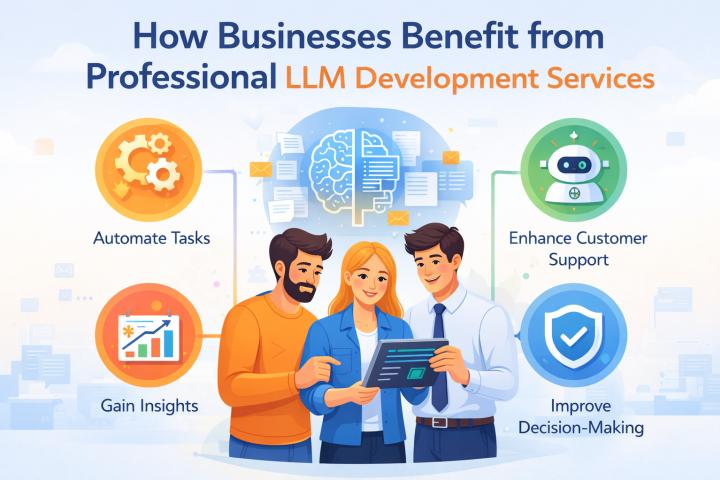
Consider the challenge. Legacy applications are quite efficient with structured data, but fail with unstructured inputs such as emails, reports, and customer queries. The manual processes consume resources and time. A Fortune 500 CTO may be under pressure to upgrade without interfering with 24/7 operations. This is taken care of by LLM Development Services. They have providers like a leading LLM Development Company that focus on old and new tech stack bridging. They combine models like GPT versions or open-source options to automate analysis and decision-making.
Why Legacy Systems Need LLM-Powered Solutions Now
The changes in the market require a response. The Gartner report estimates that 75 percent of enterprises will have integrated generative AI into core systems by 2027, more than 25 percent currently. Unmaintained legacy applications run the risk of becoming obsolete. Startups that grow quickly crash into walls as inflexible software slows down growth. This is fixed by LLM Integration Services through the layer of intelligence. An example of this is where a retail chain uses custom LLM solutions to scan supplier emails and forecast stock demands, reducing procurement time by 40%.
Cost control is the beginning of ROI. Complete rewrites of old applications can cost millions and require years. Integration sidesteps that. An LLM Development Company implements APIs that bridge models with existing databases. Natural language queries retrieve information at a glance. In a 20-year-old ERP system, finance teams ask the query Show revenue trends by region last quarter. The results are ready in seconds, without any SQL. This boosts productivity. According to a study by McKinsey on AI in operations, one logistics company had a 30 percent reduction in reporting time following such an upgrade.
Key Benefits of Custom LLM Development for Enterprises
Custom LLM Development is distinguished by its accuracy. Ready-made models deal with general work but lack enterprise specifics such as compliance or internal data. An exclusive LLM Consulting Services team develops models tuned to your data. They make sure the output is in accordance with the industry regulation, e.g., GDPR in the case of European banks or HIPAA in the case of healthcare providers.
Customer Service and Revenue Gains
Take customer service. Old CRMs have a history of interactions, but are not predictive. Solutions powered by LLM process previous tickets to recommend a response or escalate problems. One telecom giant incorporated this and witnessed a 25 percent improvement in call resolution rates, releasing agents to work on intricate cases. Revenue follows. Upsells are motivated by personalized recommendations based on the purchaser's purchase histories which are generated by an LLM analysis. According to Forrester data, startups in e-commerce report 15- 20 percent lifts in sales as a result of such integrations.
Security and Compliance Advantages
Security matters too. Businesses are concerned with information leaks. Trusted LLM Development Services deploy on-premise or private cloud deployments. Data is processed in models without any external communication. This ensures that sensitive data is kept safe and allows such functions as fraud detection. A bank upgraded its transaction monitoring application using custom LLM solutions. It has now raised red flags on anomalies in real time and this has cut fraud losses by 18 percent.
The Integration Process: Practical Steps from Experts
Assistance under an LLM Development Company has a systematic way. First, assessment. Auditors scan your legacy stack and find integration points such as APIs or batch processes. They chart use cases, giving more weight to those with high ROI like automated reporting or predictive maintenance.
Prototyping and Deployment Phases
Next, prototyping. Custom LLM Development kicks off with proof-of-concept builds. Models are optimized on anonymized data samples by engineers. In the case of a manufacturing startup, this involved connecting an LLM to old PLC systems to do equipment diagnostics. Predicting downtimes was made 35 times more accurate.
Deployment comes third. LLM Integration Services deal with scaling. They make use of containerization tools such as Kubernetes to execute models and old code. The dashboards are used to monitor the performance, and they guarantee 99.9% uptime. Training follows. Simple prompts are taught to the end-users through brief sessions and reduce resistance to change.
Ongoing Support Essentials
It depends on continuous support to close the deal. The models are updated with the help of LLM Consulting Services. Businesses are subject to quarterly audits in order to hone performance. This is what a global insurer did to adapt their claims processing application and they have seen 22% faster payouts and increased customer satisfaction ratings.
Real-World Cases: Enterprises Winning with LLM Services
Value is proven by success stories. One of the biggest banks in the United States collaborated with the LLM Development Company to restore its banking system. Old COBOL code is now used in an LLM layer to approve loans. Processing time was reduced by 12 with an approval rate increasing by 12%. The bank saved 4 million every year on manual labor.
A healthcare-based startup trained its patient records app with LLM-Powered Solutions. Physicians ask questions in everyday language, extracting summaries of centuries of notes.
This is beneficial to supply chain firms. A European manufacturer incorporated LLMs in its ERP to use it in demand forecasting. The model is fed by unstructured market reports which provide forecasts 40% more accurate than standard techniques. Inventory costs fell 15%.
Choosing the Right LLM Partner for Your Business
Choose partners with track records in enterprises. Find experience in your industry. The provider of LLM Consulting Services must provide evidence of integrating with such legacy technology in the past. Case studies and customer testimonials. Inquire about model scalability and model governance.
Budget wisely. Startups will cost 200K upwards and businesses will cost 2M and above; however, it will pay back within 12-18 months through efficiency savings. Include total ownership (maintenance).
When in need of an expert, consider the services of the industry leaders, including Custom LLM Development, which is suggested and suitable for the needs of the enterprise.
Future-Proof Your Operations Today
LLM Integration Services can turn old applications into assets. Companies and startups become agile, reduce expenses, and spur growth. Late is to be behind competitors who are already enjoying these benefits. Get the modernization journey that is started with a reliable LLM Development Company. Your bottom line will be the results.