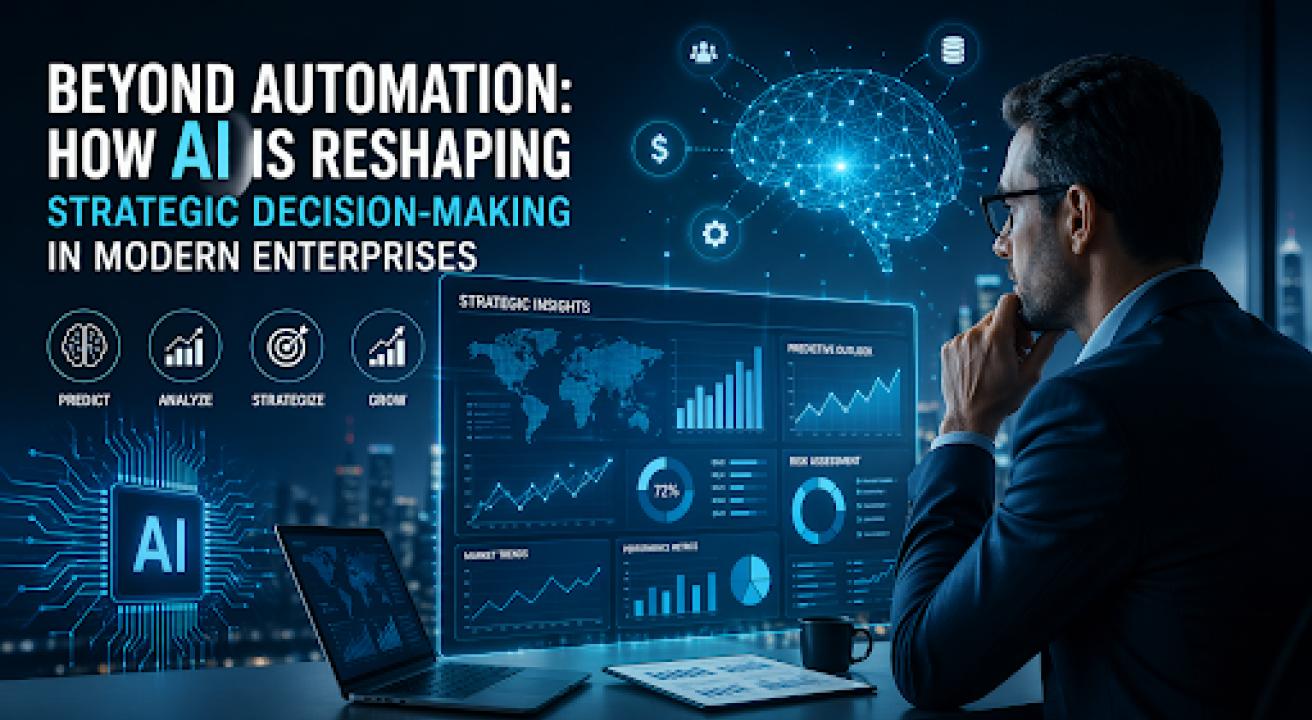
Artificial intelligence has moved far beyond its early reputation as a tool for automating repetitive tasks. Today, it sits at the center of a profound transformation in how organizations think, plan, and compete. Companies are no longer asking whether to adopt AI, they are grappling with how deeply it should influence their decision-making processes. This shift is not just technological; it is cultural, operational, and strategic.
At its core, AI is redefining the role of data. Businesses have always collected information, but the ability to interpret it at scale and in real time is what sets modern organizations apart. AI systems can detect patterns invisible to human analysts, simulate future scenarios, and recommend actions with measurable confidence levels. This creates a new kind of organization, one that is not just data-informed but data-driven at every level.
From Data Overload to Actionable Insight
The digital economy produces an overwhelming amount of information. Traditional analytics tools often struggle to keep pace, leaving decision-makers with fragmented insights. AI addresses this gap by synthesizing structured and unstructured data into cohesive narratives.
For example, machine learning models can analyze customer behavior across multiple channels, web, mobile, and in-store, and identify subtle shifts in preferences. These insights enable businesses to adapt quickly, whether by adjusting marketing strategies, refining product offerings, or optimizing pricing models.
More importantly, AI doesn’t just describe what has happened; it predicts what is likely to happen next. Predictive analytics has become a cornerstone of strategic planning, allowing organizations to move from reactive to proactive decision-making.
The Evolution of Financial Intelligence
One of the most impactful applications of AI lies in financial strategy. Organizations are leveraging intelligent systems to improve forecasting accuracy, reduce risk, and uncover hidden opportunities.
In particular, AI-driven earnings analysis has become a powerful tool for finance teams. Instead of relying solely on historical performance and manual interpretation, AI models can process vast datasets, including market trends, competitor activity, and macroeconomic indicators, to generate more nuanced projections. This enables executives to make informed decisions about investments, cost management, and growth strategies with greater confidence.
The implications extend beyond internal planning. Investors and stakeholders increasingly expect transparency and precision in financial reporting. AI helps meet these expectations by providing deeper insights and reducing the margin of error.
Personalization at Scale
Another area where AI is making a significant impact is customer experience. Modern consumers expect personalized interactions, and businesses must deliver these experiences without sacrificing efficiency.
AI enables personalization at scale by analyzing individual preferences and behaviors. Recommendation engines, dynamic pricing models, and adaptive user interfaces are just a few examples of how companies are tailoring their offerings to meet customer needs.
This level of personalization was once impossible to achieve manually. Today, it is becoming a baseline expectation. Organizations that fail to adopt AI-driven personalization risk falling behind competitors who can deliver more relevant and engaging experiences.
Operational Efficiency and Beyond
While automation remains an important aspect of AI, its role in operations has evolved. Instead of simply replacing manual tasks, AI is enhancing human capabilities.
In supply chain management, for instance, AI can predict demand fluctuations, optimize inventory levels, and identify potential disruptions before they occur. In manufacturing, intelligent systems can monitor equipment performance and recommend maintenance actions, reducing downtime and improving productivity.
These improvements are not just incremental; they can fundamentally change how businesses operate. By reducing inefficiencies and enabling smarter resource allocation, AI frees up time and capital for innovation.
Building Scalable Intelligence
As organizations grow, maintaining consistency and quality becomes increasingly challenging. AI offers a solution by providing scalable intelligence that can be applied across the enterprise.
This is where enterprise ai solutions play a critical role. These systems are designed to integrate with existing infrastructure, ensuring that insights are accessible across departments. Whether it’s marketing, finance, operations, or human resources, AI can unify decision-making processes and create a more cohesive organization.
However, implementing AI at scale requires careful planning. Companies must address challenges related to data quality, system integration, and organizational readiness. Without a clear strategy, even the most advanced tools can fail to deliver value.
The Human Element
Despite its capabilities, AI is not a replacement for human judgment. Instead, it acts as a complement, enhancing the ability of individuals to make informed decisions.
The most successful organizations understand this balance. They invest not only in technology but also in people, training employees to work effectively with AI systems and fostering a culture of continuous learning.
Leadership plays a crucial role in this transformation. Executives must champion AI initiatives, align them with business objectives, and ensure that ethical considerations are addressed. Transparency, accountability, and fairness are essential to building trust in AI-driven decisions.
Ethical Considerations and Trust
As AI becomes more integrated into business processes, ethical concerns are gaining prominence. Issues such as data privacy, algorithmic bias, and accountability must be carefully managed.
Organizations need to establish clear guidelines for AI usage, including how data is collected, processed, and shared. Regular audits and monitoring can help identify potential biases and ensure that systems operate as intended.
Building trust is not just a regulatory requirement, it is a competitive advantage. Customers and stakeholders are more likely to engage with organizations that demonstrate responsible AI practices.
Innovation as a Continuous Process
AI is not a one-time investment; it is an ongoing journey. Technologies evolve rapidly, and organizations must adapt to stay competitive.
This requires a mindset shift. Instead of viewing AI as a standalone project, businesses should treat it as a core component of their innovation strategy. Continuous experimentation, iteration, and learning are essential to unlocking its full potential.
Collaboration also plays a key role. Partnerships with technology providers, research institutions, and industry peers can accelerate innovation and provide access to new capabilities.
The Future of Decision-Making
Looking ahead, the role of AI in business will only continue to grow. Advances in natural language processing, computer vision, and reinforcement learning are opening up new possibilities.
We are moving toward a future where AI systems can not only analyze data but also understand context, interpret complex scenarios, and provide strategic recommendations. This will redefine the nature of decision-making, making it more dynamic, data-driven, and collaborative.
Organizations that embrace this future will be better positioned to navigate uncertainty, seize opportunities, and drive sustainable growth.
Final Thoughts
The impact of AI on modern enterprises goes far beyond efficiency gains. It is reshaping how organizations think, act, and compete in an increasingly complex world. By leveraging intelligent systems, businesses can unlock new levels of insight, agility, and innovation.
The challenge lies not in adopting AI, but in integrating it effectively into the fabric of the organization. Those who succeed will not only keep pace with change, they will define it.