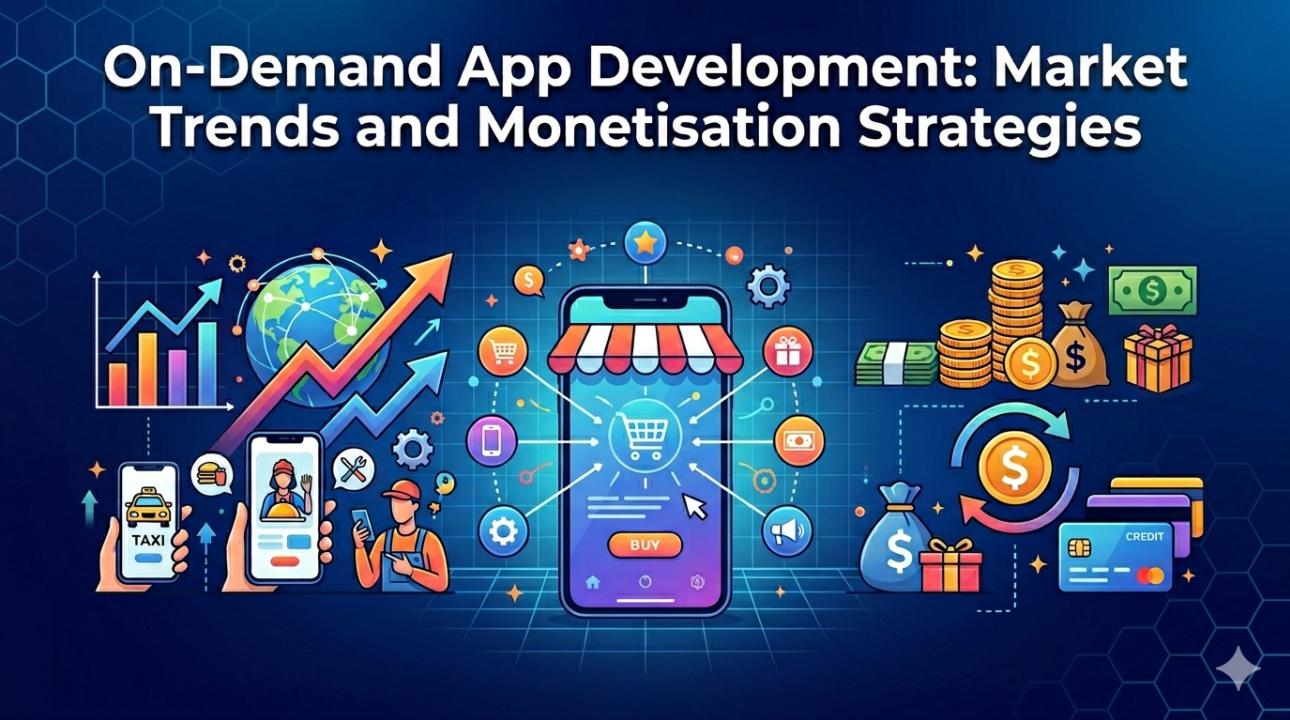
The digital economy has fundamentally changed how people access services. Whether it is booking a cab, ordering food, or scheduling a home repair, consumers now expect instant gratification at the tap of a button. This shift has made on-demand app development one of the most sought-after segments in the technology industry, and businesses that move early are reaping outsized rewards.
The Rise of the On-Demand Economy
The on-demand economy is no longer a niche phenomenon. According to industry estimates, the global on-demand services market is projected to surpass $300 billion in the coming years, driven by increasing smartphone penetration, affordable mobile data, and a consumer base that values convenience above almost everything else.
Sectors that have seen the most explosive growth include ride-hailing, food and grocery delivery, healthcare, home services, beauty and wellness, and freelance talent platforms. What these verticals share is a common architecture: a digital layer that connects supply with demand in real time, eliminating friction and reducing wait times to near zero.
For entrepreneurs and enterprises looking to enter this space, partnering with a reliable on-demand app development company is the critical first step. The complexity involved in building a robust, scalable platform — with real-time tracking, payment integration, dynamic pricing, and multi-role user interfaces — demands deep technical expertise that goes far beyond standard app development.
Key Market Trends Shaping On-Demand Apps in 2025
1. Hyperlocal Delivery Models
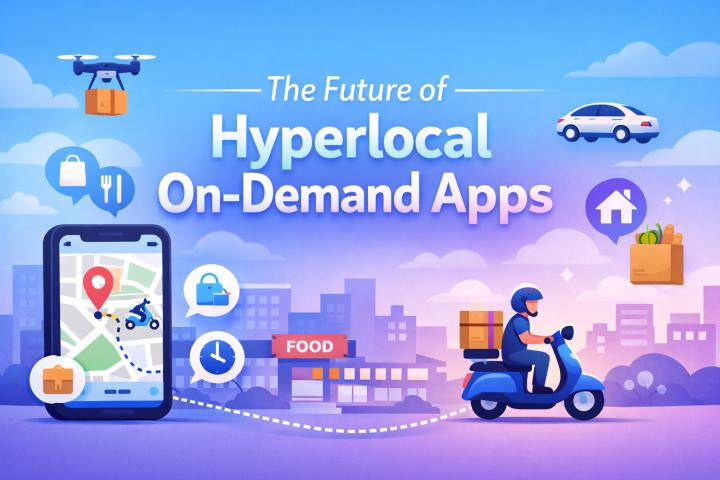
Hyperlocal delivery — where services are fulfilled within a tight geographic radius — has become the dominant operating model. Quick commerce platforms are promising deliveries in ten minutes or less, forcing even established players to rebuild their logistics infrastructure. Apps that can accurately predict demand, optimise last-mile routes, and manage micro-warehouse inventory will lead the next wave.
2. AI and Predictive Intelligence
Artificial intelligence is no longer an add-on feature; it is core infrastructure. Leading platforms use machine learning to predict surge demand, personalise recommendations, detect fraud in real time, and automate customer support through intelligent chatbots. Any app development company building in this space needs to embed AI capabilities from the ground up rather than retrofitting them later.
3. Super App Consolidation
Asian markets pioneered the super app concept — a single platform offering ride-hailing, payments, food delivery, and financial services — and Western markets are following. Companies like Grab and Gojek demonstrated that once you own a user's attention for one service, cross-selling additional services dramatically improves lifetime value and reduces churn. Building modular architecture that supports feature expansion is now a strategic priority.
4. Voice and Conversational Interfaces
Voice-enabled ordering and conversational commerce are gaining traction, particularly in markets with low literacy or strong vernacular language usage. Integrating voice search and natural language processing into on-demand apps opens up entirely new demographics that were previously underserved by traditional touch-based interfaces.
5. Sustainability and Green Logistics
Consumer awareness around environmental impact is reshaping expectations. Electric vehicle fleets, carbon offset programmes, and eco-friendly packaging options are becoming differentiators rather than nice-to-haves. Platforms that build sustainability reporting into their dashboards and communicate environmental impact to end users are building brand equity that converts into loyalty.
Monetisation Strategies That Work
Building an on-demand platform is only half the equation. Choosing the right monetisation model — or blend of models — determines whether the business scales profitably or bleeds cash in pursuit of growth.
Commission-Based Revenue
The most prevalent model in on-demand marketplaces, commission revenue involves taking a percentage cut on every transaction that flows through the platform. Ride-hailing and food delivery giants primarily operate on this model. The advantage is that revenue scales linearly with gross merchandise value. The challenge is that high commission rates push quality service providers off the platform, so calibrating the right percentage is a constant balancing act.
Subscription and Membership Tiers
Subscription models create predictable recurring revenue and reduce customer acquisition costs by locking in loyalty. Amazon Prime is the archetype, but the model scales beautifully for niche verticals. A grocery delivery platform offering free same-day delivery for a flat monthly fee, for instance, increases order frequency and builds habitual usage. An experienced on-demand app development company will build the subscription management infrastructure — billing cycles, tier-based feature access, renewal flows — as a first-class feature rather than an afterthought.
Surge and Dynamic Pricing
Dynamic pricing algorithms adjust the cost of a service based on real-time supply and demand signals. When drivers are scarce and demand spikes, prices rise to incentivise more supply to enter the market. Done transparently, surge pricing improves marketplace efficiency and generates disproportionate revenue during peak periods. Done poorly, it erodes trust and generates regulatory scrutiny — so the implementation must be handled with care.
In-App Advertising and Promoted Listings
Once a platform achieves meaningful traffic volume, advertising becomes an attractive revenue layer. Restaurants and retailers pay to appear at the top of search results, or to feature sponsored banners within the app. This model works best when the platform has strong audience segmentation data to justify premium ad rates. The key is ensuring that promoted content does not degrade the organic user experience.
Data Monetisation and Insights
Aggregated, anonymised data from on-demand platforms is extraordinarily valuable to brand partners, urban planners, and logistics companies. Selling market intelligence reports or offering API access to demand data represents a high-margin revenue stream that requires zero incremental operational effort once the data infrastructure is in place.
Choosing the Right Development Partner
The difference between a platform that thrives and one that stalls often comes down to the quality of the initial build. A capable app development company brings not just technical skills but domain knowledge of marketplace dynamics, regulatory nuance across geographies, and UX patterns proven to reduce drop-off at critical conversion points.
When evaluating partners, look for demonstrated experience in real-time systems, a portfolio of live on-demand products at scale, and a product management philosophy that treats post-launch iteration — not the initial release — as the true start of the product lifecycle.
Conclusion
The on-demand economy shows no signs of decelerating. Consumer expectations will continue to rise, technology costs will continue to fall, and the window to build defensible positions in emerging verticals is still open. Businesses that invest in a high-quality on-demand app development company today, choose the right monetisation architecture, and stay close to evolving market trends will be exceptionally well-positioned to capture the next decade of digital service growth.