Most agency case studies look the same. Metric goes up. Client is happy. Everyone looks good.
This isn't that kind of case study.
What follows is an honest breakdown of six months of GEO work on a Web3 wallet client — active across Asian markets, solid product, real user base. Citations grew significantly. Then they declined. Cited pages kept growing. Mentions barely moved. And every one of those patterns taught us something we didn't fully expect going in.
The Starting Point
When we started in November 2025, our client had near-zero presence in AI-generated answers. Ask ChatGPT about multi-chain wallets — they weren't mentioned. The product was solid. The AI visibility wasn't there.
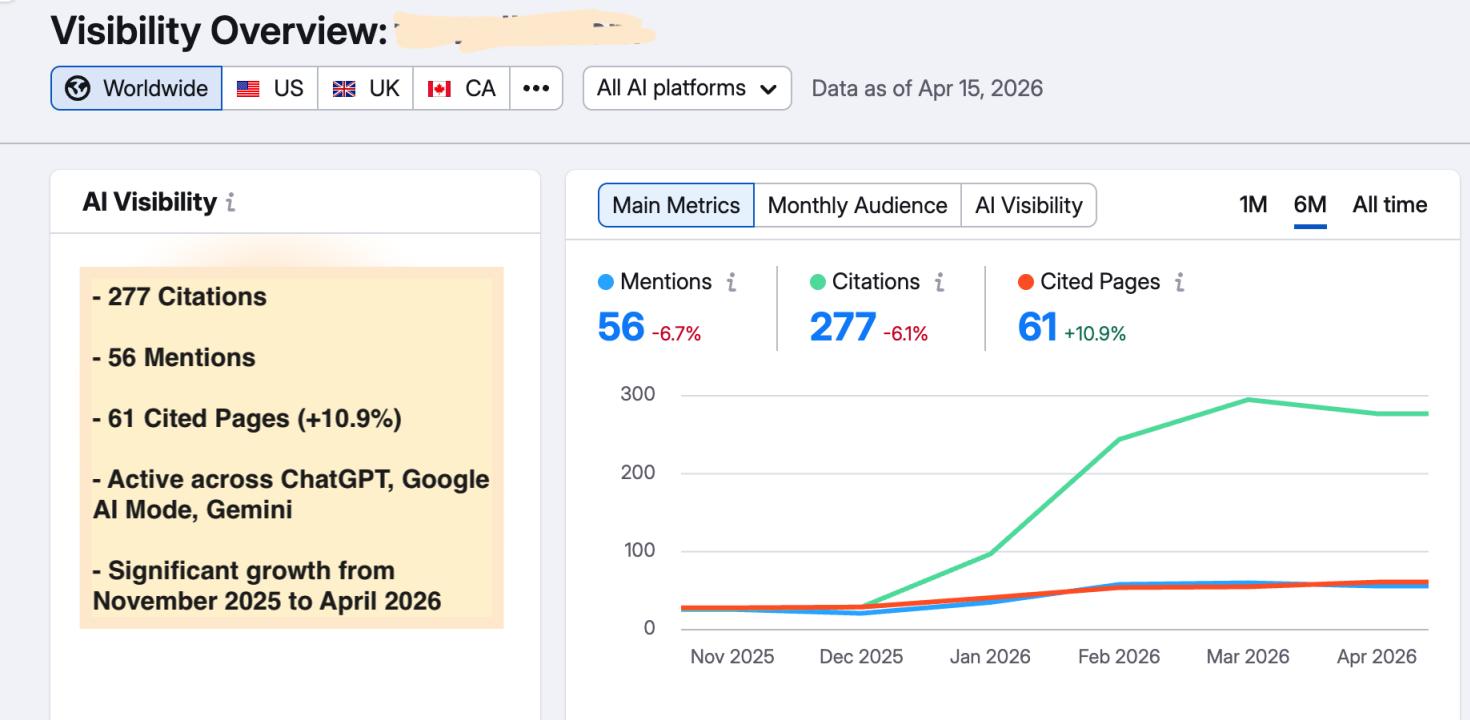
Six months later, here's what the data actually shows:
| Metric | Current (Apr 2026) | Trend |
|---|---|---|
| AI Citations | 277 | -6.1% (declining from March peak) |
| Mentions | 56 | -6.7% (declining) |
| Cited Pages | 61 | +10.9% (still growing) |
| Active AI platforms | 3 | ChatGPT, Google AI Mode, Gemini |
That's a more complicated picture than most agencies would choose to publish. We're publishing it anyway because the complications are where the learning is.
What Worked: Citations Grew Significantly
From November 2025 to March 2026, AI citations grew from near-zero to approximately 300.
Three tactics drove most of that growth:
Comparison content "Client vs [competitor]" articles and on-site comparison tables were cited far more frequently than any other content type. If you want to appear in "best X for Y" answers, you need to exist in comparison contexts first. This was the single highest-leverage tactic in the campaign.
Reddit participation Consistent, expert-level contributions in relevant subreddits produced a clearer correlation with citation growth than almost any other off-site activity. Reddit's conversational format is heavily weighted by AI retrieval systems for recommendation queries.
The rule that worked: 90% genuinely useful contributions, 10% brand mention only when directly and honestly relevant.
Publishing velocity Maintaining a consistent weekly publishing cadence across Medium, dev.to, Hashnode, HackerNoon, and similar platforms created sustained signals that AI retrieval systems respond to over time. The first six weeks showed minimal change. The compound effect kicked in around week 8.
What Surprised Us: Citations Peak, Then Pull Back
By March 2026 the client had reached approximately 300 AI citations — the peak. Since then, citations declined to 277 (-6.1%). Mentions followed the same pattern (-6.7%).
AI citations are not sticky in the way traditional search rankings are.
A page that ranks #1 on Google tends to stay there unless something actively displaces it. AI citations work differently — they reflect the current state of the web ecosystem around a brand. When activity slows, citations follow.
The practical implication: AI visibility requires maintenance, not just an initial build.
What's Still Growing: Cited Pages
The one metric that kept moving in the right direction — still growing at +10.9% — is cited pages.
This matters more than it appears. Cited pages represent the structural foundation of AI visibility: the number of distinct pages AI systems consider credible enough to reference. When citations fluctuate, cited pages is the better indicator of underlying visibility health.
This reframed how SeekLab thinks about GEO success metrics:
- Citations = leading indicator. Responds quickly to activity, pulls back quickly when activity slows.
- Cited pages = lagging indicator. Grows slowly but represents more durable AI visibility infrastructure.
What Barely Moved: Mentions
Mentions stayed relatively flat across the entire six months, ending at 56 with a slight decline.
Our current hypothesis: mentions in AI-generated content are more heavily influenced by brand recognition and training data than by structured content and off-site signals. For a brand operating primarily in Asian markets, breaking into the mention layer of Western AI systems requires either more time or a different set of tactics — possibly more focus on high-DA English-language coverage.
This is an open question we're still working through.
The Honest Summary
Six months of structured GEO work produced real results — the client went from invisible to actively cited across ChatGPT, Google AI Mode, and Gemini.
But the data also revealed something the industry doesn't talk about enough: AI visibility is more like a living ecosystem than a ranking. It requires ongoing care, not just initial optimization.
Three things we'd tell any brand starting a GEO campaign now:
- Start with comparison content. Fastest path to appearing in recommendation queries.
- Build cited pages, not just citations. The page count is the foundation everything else grows from.
- Plan for maintenance from day one. If your strategy doesn't include ongoing publishing and community activity, your citation peak will be temporary.
Want to know where your brand currently stands in AI-generated answers? Open ChatGPT, Perplexity, and Gemini. Search your brand name and core category queries. Record what comes back.