Executive
Summary
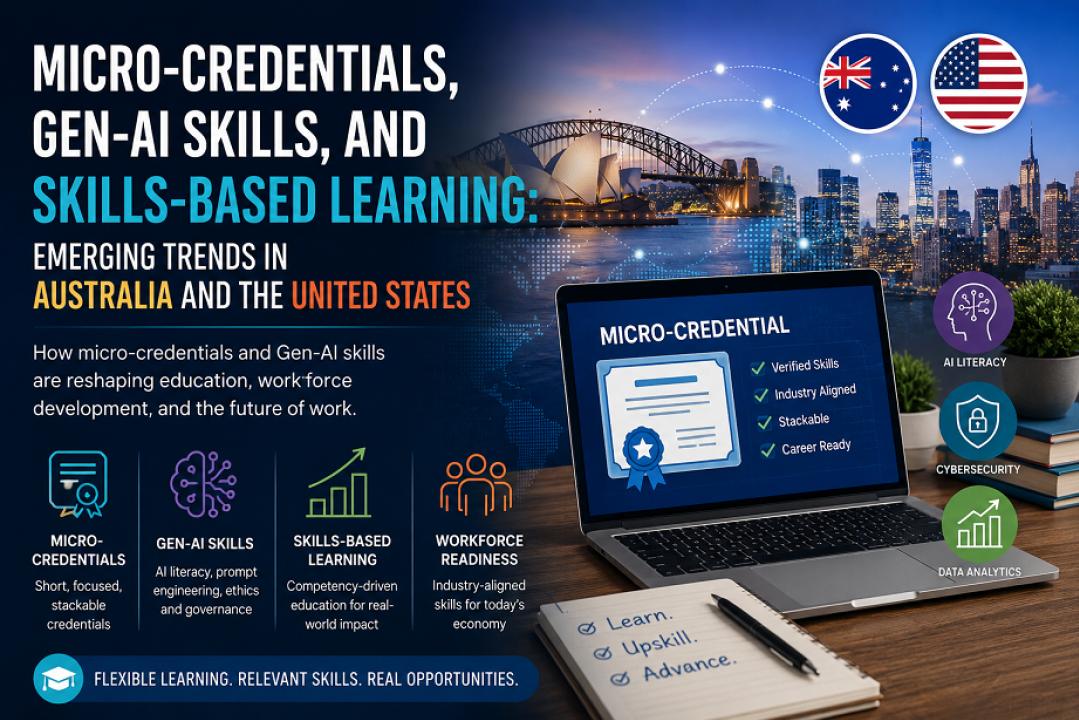
The rapid advancement of generative artificial intelligence
(Gen-AI), digital transformation, and changing labor market expectations are
fundamentally reshaping education and workforce development. Across Australia
and the United States, traditional degree-based pathways are increasingly being
complemented by micro-credentials, professional certificates, and skills-based
learning models that emphasize demonstrable competencies over formal
qualifications alone.
The United States has developed the world's largest
credential ecosystem, offering approximately 1.85 million unique credentials
across multiple categories. Australia, meanwhile, has established one of the
most structured national frameworks for micro-credentials, integrating them
within the Australian Qualifications Framework (AQF) to support stackable and
credit-bearing learning pathways. Growing demand for AI literacy, data skills,
cybersecurity expertise, project management capabilities, and digital
competencies is driving unprecedented interest in short-form, career-focused
credentials. Surveys indicate that over 80% of students now consider Gen-AI
skills essential for future employability.
This report examines emerging trends, policy developments,
opportunities, challenges, and future implications of micro-credentials and
AI-driven skills development in both countries.
1.
Introduction
Higher education and workforce training are undergoing a
significant transformation. Employers increasingly seek evidence of specific
skills and competencies rather than relying solely on traditional academic
qualifications. At the same time, technological disruption—particularly the
rise of generative AI—is creating demand for continuous reskilling and lifelong
learning.
Micro-credentials have emerged as an effective mechanism for
addressing these challenges by providing focused, flexible, and
industry-aligned learning experiences that can be completed in shorter
timeframes than conventional degree programs.
2.
Understanding Micro-Credentials and Skills-Based Learning
Micro-credentials are short, focused certifications that
validate mastery of specific competencies, skills, or learning outcomes. Unlike
participation certificates, quality micro-credentials include:
- Clearly
defined learning outcomes
- Formal
assessment mechanisms
- Industry
relevance
- Potential
recognition by employers or educational institutions
They may be delivered as digital badges, certificates,
nanodegrees, or modular learning units that can often be stacked toward larger
qualifications.
Skills-based learning shifts educational focus from time
spent in classrooms to demonstrated competency. Assessment is often based on
real-world projects and practical applications rather than theoretical
examinations alone. Common focus areas include:
- Data
analytics
- Cybersecurity
- Project
management
- Artificial
intelligence
- Digital literacy
3. The
Impact of Generative AI on Skills Demand
Generative AI represents one of the most significant
technological shifts affecting education and employment today.
Organizations increasingly require workers who can:
- Effectively
utilize AI tools
- Understand
AI limitations and biases
- Apply
ethical reasoning to AI-generated outputs
- Verify
information accuracy
- Manage
AI-enabled workflows
The emergence of AI has expanded demand for competencies
such as prompt engineering, AI governance, data literacy, and critical
thinking. Educational institutions are therefore revising curricula and
introducing targeted credentials to address these evolving workforce requirements.
International organizations, including the OECD, emphasize
that AI's growing cognitive capabilities require education systems to
reconsider which uniquely human skills should be prioritized in future learning
models.
4. The
United States Credential Ecosystem
The United States possesses the world's largest and most
diverse credential marketplace.
Key statistics include:
|
Metric |
Value |
|
Unique Credentials |
~1.85 million |
|
Credential Providers |
~134,491 |
|
Annual Market Value |
~$2.34 trillion |
The ecosystem includes:
- Degrees
- Professional
certificates
- Licenses
- Digital
badges
- Industry
certifications
- Micro-credentials
The market is highly decentralized, resulting in substantial
variation among states, institutions, and providers. To improve transparency
and interoperability, organizations such as Credential Engine have developed
systems like the Credential Transparency Description Language (CTDL), which
standardizes credential information and enables better alignment between
education and employment systems.
Popular credential providers include:
- Coursera
- Google
Career Certificates
- edX
- Udacity
These programs have become particularly influential in
technology, cybersecurity, IT support, UX design, and project management
sectors.
5.
Australia's Coordinated Micro-Credential Framework
Australia has adopted a more structured and nationally coordinated
approach.
The National Microcredentials Framework formally defines
micro-credentials as assessed learning experiences that are smaller than AQF
qualifications but can contribute toward formal educational pathways.
The framework requires providers to disclose:
- Learning
outcomes
- Assessment
methods
- Volume
of learning
- Industry
recognition
- Credit
transfer opportunities
This transparency supports stackable learning pathways,
enabling learners to accumulate micro-credentials that contribute toward
certificates, diplomas, and degrees.
Australia has also invested in a National Microcredentials
Marketplace that allows students to compare credentials and understand credit
recognition opportunities across providers.
6. Student
Demand for AI and Alternative Credentials
Student attitudes reveal strong demand for AI-related
learning opportunities. Research cited in the report indicates that over 80% of
students consider Gen-AI skills important for education and employment. As
learners increasingly seek flexible pathways to develop AI, data analytics,
cybersecurity, and project management competencies, they are turning to
industry-recognized certifications, micro-credentials, and expert learning
support services. Many students also use resources such as subject expert
network to strengthen their understanding of emerging
technologies and academic concepts while pursuing career-focused credentials.
Interest in industry certifications increased from 34% to 56%, while interest
in micro-credentials rose from 25% to 53% within a single year.
Research cited in the report indicates:
- Over
80% of students consider Gen-AI skills important for education and
employment.
- 84%
of Australian online learners view AI skills as critical for workplace
success.
- Interest
in industry certifications increased from 34% to 56%.
- Interest
in micro-credentials rose from 25% to 53% within one year.
Students increasingly perceive short-form credentials as
viable pathways for:
- Career
advancement
- Promotion
opportunities
- Career
transitions
- Skills
updating
- Entry
into emerging technology roles
7. Benefits
and Challenges
Benefits
Micro-credentials provide several advantages:
For Learners
- Flexible
learning schedules
- Lower
costs
- Faster
completion times
- Career-focused
skill development
- Opportunities
for lifelong learning
For Employers
- Better
visibility of candidate skills
- Support
for skills-based hiring
- Improved
workforce mobility
- Alignment with current industry needs
Challenges
Despite their advantages, several challenges remain:
Quality Assurance
Variations in assessment rigor and credential standards may
undermine credibility if not properly regulated.
Credential Recognition
Learners often struggle to determine which credentials hold
meaningful value with employers or educational institutions.
Equity and Access
Differences in access to AI technologies, digital
infrastructure, and learning opportunities may create disparities among student
populations.
8. AI
Literacy, Ethics, and Information Verification
As AI tools become integrated into education and work,
technical proficiency alone is no longer sufficient.
Future-focused micro-credentials increasingly incorporate:
- Ethical
AI usage
- Bias
detection
- Responsible
AI governance
- Information
verification
- Human-AI
collaboration
Students are demonstrating growing awareness of risks
associated with misinformation, deepfakes, privacy concerns, and inaccurate
AI-generated content. Consequently, educational programs are placing greater
emphasis on critical digital literacy and fact-checking skills.
9. Strategic
Implications for Higher Education
Higher education institutions face several strategic
priorities:
- Integrate
micro-credentials into degree programs.
- Develop
AI literacy across disciplines.
- Establish
credit recognition policies.
- Strengthen
student guidance services.
- Enhance
digital credential portability.
- Support
lifelong learning and workforce reskilling.
Institutions must also create robust frameworks for
evaluating external credentials and ensuring alignment with academic standards
and accreditation requirements.
Conclusion
Micro-credentials and skills-based learning are rapidly
becoming central components of modern education systems. While the United
States leads in scale and credential diversity, Australia demonstrates the
advantages of a coordinated national framework that supports quality assurance,
transparency, and stackable learning pathways.
The rise of generative AI is accelerating this transformation by increasing demand for adaptable, career-focused learning opportunities that combine technical expertise with critical thinking, ethical reasoning, and digital literacy. As institutions, employers, and governments continue to embrace skills-based approaches, micro-credentials are likely to play a pivotal role in shaping the future of education, workforce development, and lifelong learning.