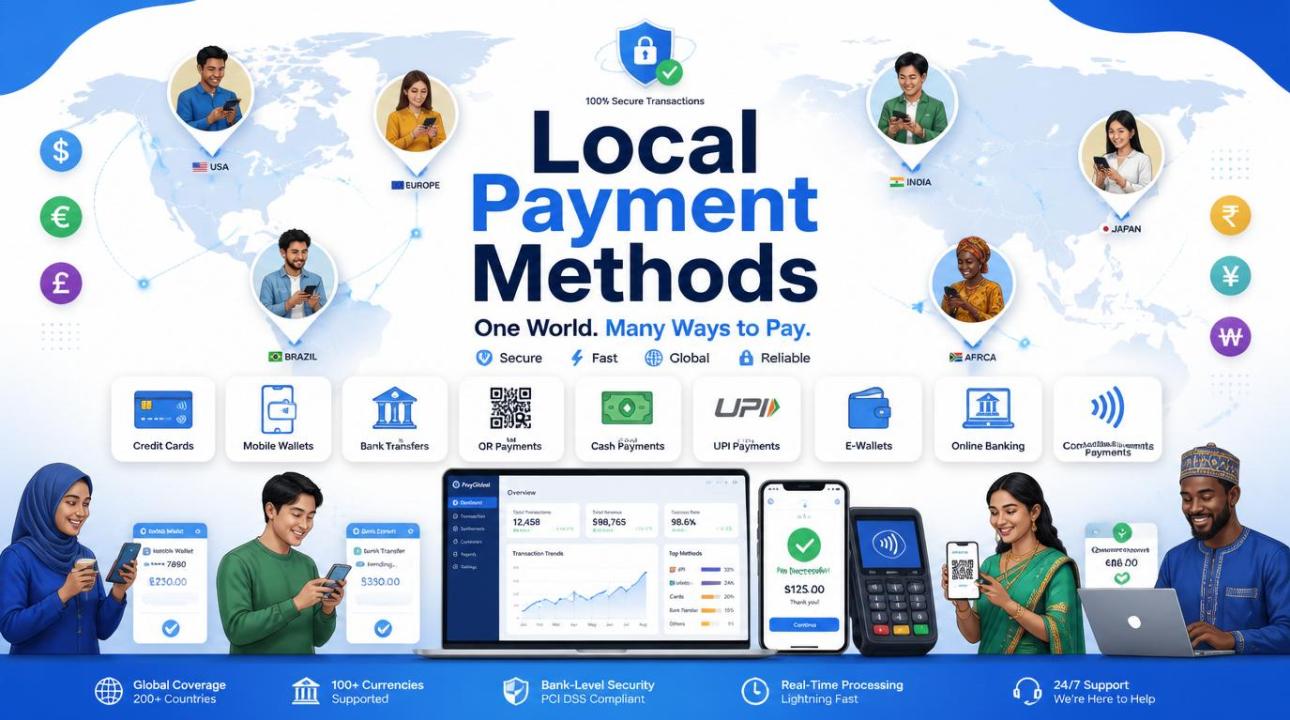
Imagine you've just launched an online store, or you're shopping from a website based in another country, and at checkout, you see payment options you've never heard of. iDEAL. Boleto. GrabPay. UPI. You wonder: what are these, and why don't they just accept a regular credit card? The truth is, for hundreds of millions of people around the world, these are the regular payment methods. They're called local payment methods, and understanding them is essential whether you're a business selling globally or a curious consumer trying to make sense of the checkout page.
What are local payment methods?
Local payment methods, sometimes called alternative payment methods (APMs) or domestic payment methods, are region-specific financial tools that people use to pay for goods and services, usually within their home country or region. Unlike global payment networks such as Visa or Mastercard, which work almost everywhere, local payment methods are built around the banking habits, infrastructure, and trust systems of a specific place.
They exist because not everyone in the world has a credit card, and even among those who do, many people simply prefer to pay using tools they're familiar with. In countries like Brazil, Germany, and Indonesia, local payment methods often command a bigger market share than international card networks. For businesses, ignoring them can mean leaving a significant portion of potential customers behind.
Worth knowing: According to various industry reports, over 70% of global e-commerce transactions are completed using local or alternative payment methods rather than traditional international credit cards.
Types of local payment methods
Local payment methods aren't one-size-fits-all. They come in several distinct forms, each built to solve a different problem or serve a different population. Here's a clear breakdown.
Type 01: Bank transfers and real-time payment rails
These allow buyers to pay directly from their bank account, often in real time, without involving a card network. iDEAL in the Netherlands is one of the most successful examples, with nearly 70% of Dutch e-commerce payments running through it. India's UPI (Unified Payments Interface) processes billions of transactions monthly, enabling instant bank-to-bank payments via a simple ID or QR code. These methods are typically low-cost, fast, and trusted because they're backed by local banking authorities.
Type 02: Digital wallets
A digital wallet stores funds or payment credentials that a user can spend online or in-store. What makes local digital wallets different from something like Apple Pay is their deep regional integration. GrabPay in Southeast Asia, Paytm in India, and GCash in the Philippines have become everyday financial tools that go far beyond simple payments; they handle bill payments, loans, and insurance. Alipay and WeChat Pay in China are perhaps the most advanced examples, operating as near-complete financial ecosystems.
Type 03: Cash vouchers and offline payment methods
In markets with high unbanked populations, cash-based methods remain essential. Brazil's Boleto Bancário generates a barcode that buyers print or display on their phone and pay at a bank or convenience store. Mexico's OXXO operates similarly through its massive convenience store chain. Japan's Konbini payment system lets customers pay for online orders at 7-Eleven or Lawson. These methods solve a critical problem: giving unbanked or cash-preferring consumers access to e-commerce.
Type 04: Buy now, pay later (BNPL)
BNPL allows customers to split a purchase into interest-free installments. While companies like Klarna (Sweden) and Afterpay (Australia) have become internationally recognized, many markets have their own local BNPL players. In the Middle East, Tabby and Tamara have grown rapidly. In Southeast Asia, Kredivo and Akulaku serve millions of people who lack access to credit. The local versions are important because they're adapted to local credit assessment norms and regulatory requirements.
Type 05: Mobile money
Mobile money is transformative in markets where formal banking is sparse, but mobile phone penetration is high. Kenya's M-Pesa is the most cited example, launched in 2007, and it now handles transactions equivalent to nearly half of Kenya's GDP annually. Bangladesh's bKash similarly serves tens of millions of people who have no bank account but do have a phone. These systems work via SMS or simple apps and don't require internet access, making them uniquely powerful in lower-income and rural contexts.
Type 06: Prepaid / Cards
Prepaid cards and vouchers allow users to load money in advance and then use that balance to make payments, without linking to a bank account or credit line. Options like Paysafecard, Neosurf, and Mach (Chile) are commonly used for online purchases, especially in regions where people prefer not to share financial details. Users typically enter a code or use a stored balance to complete transactions, making these methods simple and secure. They are popular for gaming, subscriptions, and digital goods, though they may come with limitations such as fixed balances, spending caps, and limited refund flexibility.
How do local payment methods work?
The mechanics vary by type, but the general flow usually involves three parties: the buyer, the merchant, and a local payment processor or gateway that bridges the two.
When a customer selects, say, iDEAL at checkout, they're redirected to their bank's interface to authorize the payment. The bank confirms the transfer directly to the merchant's account. The entire process is real-time and irreversible; there are no chargebacks, which is one reason merchants often prefer local bank transfers.
For cash vouchers like Boleto, the flow is asynchronous: the buyer generates a payment slip, pays it at a physical location within a set window (often 1–3 days), and the merchant is notified once the cash is received and reconciled. This introduces a delay in order fulfillment but is necessary to serve cash-first consumers.
Digital wallets typically work by pre-loading funds or linking a bank account, then authorizing payments with a PIN, biometric authentication, or a one-time code. Mobile money operates through a network of agents and USSD codes, requiring no smartphone or internet, just a basic mobile plan.
From a business perspective, accepting local payment methods usually means integrating with a payment gateway or aggregator (such as Stripe, Adyen, or dLocal) that manages relationships with dozens of local processors through a single API. This simplifies the technical complexity significantly.
Why do local payment methods matter?
For businesses expanding globally, offering only credit cards can feel like opening a store and accepting only one brand of currency. In countries like Germany, consumers historically distrust credit cards and prefer direct bank transfers. In Indonesia, a large portion of the population is unbanked. In China, WeChat Pay and Alipay are so dominant that international card acceptance at many merchants is essentially optional.
Conversion rates tell the story clearly: studies consistently show that offering preferred local payment methods at checkout can increase conversion by 20–40% in markets where those methods dominate. It's not just a nice-to-have; it's often the difference between making a sale and losing one.
For consumers, these methods offer familiarity, trust, and often better consumer protections under local law. They're designed with local needs in mind, from language and currency to the specific ways people manage money in that culture.
Conclusion
Local payment methods aren't a niche topic reserved for payment industry insiders. They shape how billions of people participate in the economy every day. Whether you're a business weighing global expansion or simply trying to understand why your overseas checkout looked unfamiliar, the core idea is straightforward: money moves differently in different places, and the tools built to move it reflect the real lives of the people using them. Understanding local payment methods is, at its heart, understanding how people around the world manage, trust, and exchange value.
Frequently asked questions
What is the difference between local payment methods and international payment methods?
International payment methods such as Visa, Mastercard, and PayPal are accepted in most countries and work across borders. Local payment methods are designed for a specific country or region and may not work outside it, but they're often more trusted, cheaper, and better adopted within their home market.
What are the most popular local payment methods in the world?
Some of the most widely used include UPI (India), Alipay and WeChat Pay (China), iDEAL (Netherlands), Boleto Bancário (Brazil), M-Pesa (Kenya and East Africa), OXXO (Mexico), and GrabPay (Southeast Asia). Each dominates within its own region.
Are local payment methods safe to use?
Yes, generally. Established local payment methods are regulated by national financial authorities and use strong authentication standards. In many cases, they are safer than card payments because they involve direct bank authorization with no card data transmitted to merchants.
How can a business start accepting local payment methods?
The most practical route for most businesses is via a global payment gateway or aggregator such as Adyen, Stripe, dLocal, or PayU, which supports local payment methods in target markets through a single integration. This avoids the need to partner with dozens of local processors individually.
Why do some countries prefer local payment methods over credit cards?
Several reasons: low credit card penetration in developing markets, cultural preference for debt-free or cash-linked payments (as in Germany), lack of trust in sharing card data online, high card fees, or government promotion of domestic payment infrastructure. In each case, local methods simply fit local financial behavior better.