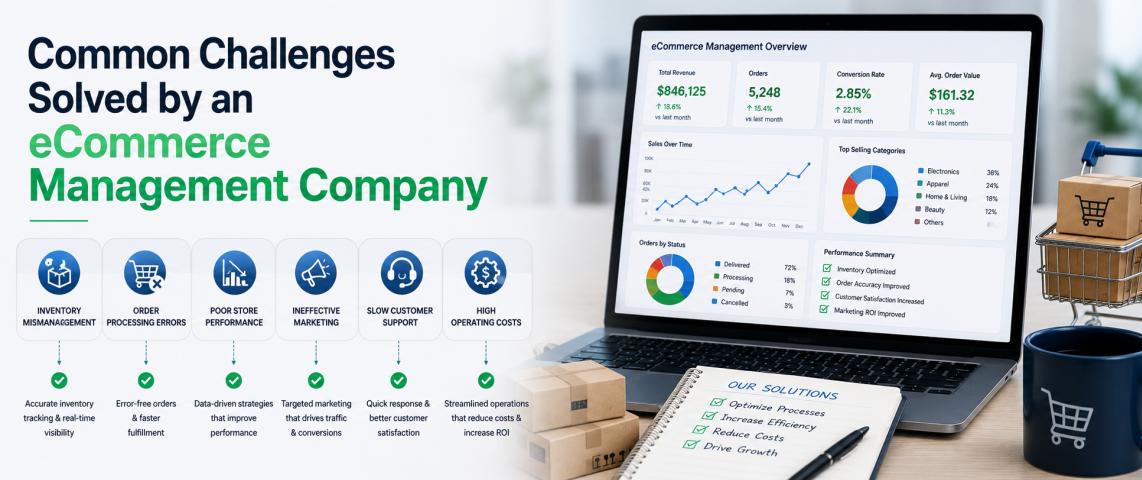
Running an eCommerce business in 2025 is genuinely exciting — and genuinely hard. The global market keeps growing, consumer expectations keep rising, and the operational complexity behind every successful online store keeps multiplying. What works at $100K in annual revenue often breaks completely at $1M. What works across one sales channel becomes chaos across five.
Most eCommerce businesses don't fail because they have a bad product or the wrong audience. They fail — or plateau — because the operational, marketing, and management infrastructure simply can't keep up with the demands of growth.
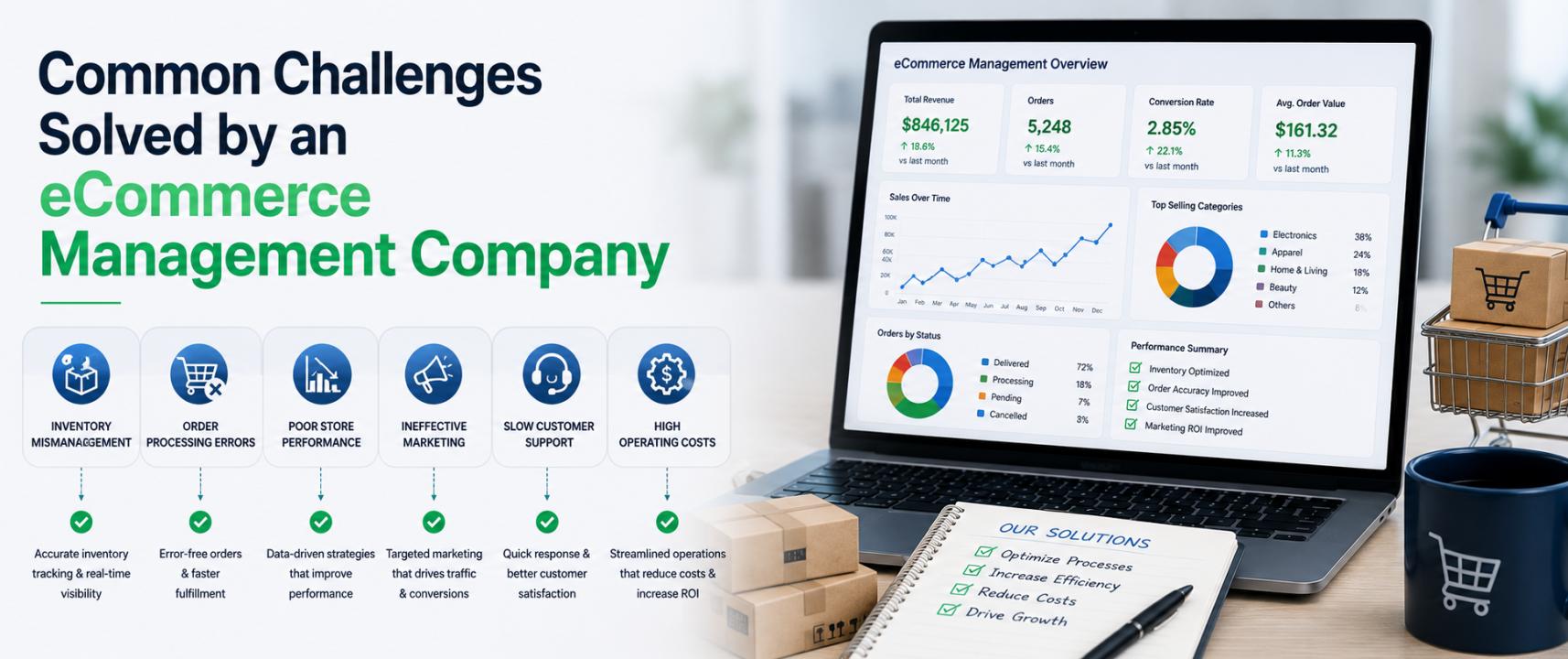
That's the gap a professional eCommerce management company is built to close. From inventory and fulfillment to customer retention and data analytics, eCommerce management services tackle the recurring operational challenges that quietly drain revenue and stall scaling.
Here's a detailed look at the most common challenges — and exactly how they get solved.
Challenge 1: Inventory Mismanagement and Stock Inconsistencies
According to Skailama's eCommerce management guide, common eCommerce management challenges — including inventory inaccuracies, high return rates, and order delays — are all solvable through automation, predictive analytics, and optimized logistics. When inventory isn't properly managed, the damage compounds quickly. Selling products that aren't in stock leads to cancellations and negative reviews. Holding too much stock ties up working capital and drives up storage costs. Manual tracking creates errors that only surface when it's too late.
A professional eCommerce management company resolves this by implementing real-time centralized inventory systems, automated reorder rules based on actual sales velocity, and demand forecasting that anticipates peaks before they hit. The result is leaner, more accurate stock levels — and a business that fulfills orders reliably, every time.
Challenge 2: Cart Abandonment Eating Into Revenue
Few eCommerce problems are as universal — or as costly — as cart abandonment. Shoppers browse, add to cart, and disappear. The revenue was almost yours, and then it wasn't.
According to Baymard Institute's latest research, the average cart abandonment rate sits at 70.19%, representing billions in preventable lost sales every year. On mobile devices, that figure climbs even higher. Most of the time, it's not the product or price causing the exit — it's friction somewhere in the checkout experience breaking momentum right before the purchase.
The reasons are well-documented: unexpected shipping costs, friction-heavy checkouts, forced account creation, limited payment options, and a lack of trust signals near the buy button.
eCommerce management services audit checkout flows from end to end, identify the specific friction points driving abandonment, and implement fixes — streamlined checkout steps, guest checkout options, transparent upfront pricing, multiple payment methods, and strategically placed trust signals. On the recovery side, they set up automated abandoned cart email sequences and retargeting flows that bring shoppers back.
These aren't small improvements. Fixing checkout friction alone can lift conversion rates by 20–30%, translating directly into thousands of dollars in recovered revenue per month.
Challenge 3: Rising Customer Acquisition Costs Without Strong Retention
Getting new customers has never been more expensive. According to Athos Commerce's survey of over 500 eCommerce leaders, the average customer acquisition cost surged by 222% between 2013 and 2024 — rising from $9 to $29. With digital advertising becoming more competitive and less efficient, retailers need smarter ways to grow without breaking the bank.
When retention is weak, the only lever left is constant acquisition spending. That's a treadmill that gets harder and more expensive to stay on.
eCommerce management services shift the focus from pure acquisition to balanced growth. They build loyalty programs, personalized email flows, post-purchase nurture sequences, and win-back campaigns for lapsed customers — all aimed at maximizing the lifetime value of customers you've already paid to acquire. The math is simple: it costs five times more to acquire a new customer than to retain an existing one. A management service that improves retention even modestly has an outsized impact on profitability.
Challenge 4: Multichannel Complexity and Channel Fragmentation
Growing eCommerce businesses don't stay on one channel for long. Shopify, Amazon, eBay, Walmart, TikTok Shop, and a branded DTC site can all be live simultaneously — each operating on its own inventory system, pricing logic, and order flow.
Without centralized management, this creates chaos. Inventory gets out of sync. Orders fall through the cracks. Customer experience becomes inconsistent depending on where someone shops. As NetSuite's multichannel inventory research highlights, selling across multiple channels makes stockouts and overstock situations significantly more likely — and without proper synchronization, managing multichannel inventory can quickly spiral into problems that damage customer trust.
An experienced eCommerce management company brings all channels under a single operational umbrella. Centralized inventory systems sync in real time across every platform. Order management flows are unified. Pricing and promotions stay consistent. And as new channels are added, the infrastructure scales with them rather than breaking under the complexity.
Challenge 5: Poor Data Visibility and Disconnected Analytics
Most eCommerce businesses collect a lot of data. Very few actually use it well.
When analytics tools aren't properly configured, and data is fragmented across platforms, decisions default to intuition rather than evidence. That means ad budgets get allocated to the wrong channels, underperforming products stay live too long, and high-value customer segments never get the attention they deserve.
A study sponsored by Google Cloud, cited by Elogic Commerce, reveals that 22.4% of manufacturers struggle to improve customer experience specifically because of siloed and inaccessible customer data. Poor data quality and integration complexity are two of the most common causes of weak eCommerce decision-making.
eCommerce management services resolve this by building proper analytics infrastructure — clean tracking setups, unified dashboards that pull from every platform, and clear KPI reporting that links operational activity to revenue outcomes. As BigCommerce's analytics guide notes, centralizing data and eliminating silos gives businesses a full view of customer behavior, operations, and performance, enabling more informed and cohesive business decisions.
When the right data is visible to the right people at the right time, every decision in the business gets smarter.
Challenge 6: Inconsistent Order Fulfillment and Shipping Issues
Customers today expect fast, accurate, transparent fulfillment. When orders arrive late, contain the wrong item, or come with no tracking updates, the experience breaks — and a broken post-purchase experience costs you repeat business.
Fulfillment problems often stem from disconnected systems, where the inventory platform doesn't communicate with the order management system, which doesn't sync with the shipping carrier. Each handoff is a potential failure point.
NetSuite's guide on eCommerce challenges puts it directly: rising shipping costs don't just shrink margins — they influence return policies, impair checkout, and make it harder to retain customers.
eCommerce management services wire these systems together. They integrate inventory, order management, and shipping into one seamless flow, configure automation to reduce manual touchpoints, and set up proactive communication that keeps customers informed at every stage. For businesses where in-house fulfillment is no longer viable, they coordinate 3PL partnerships and hold outsourced fulfillment to the same accuracy and speed standards.
Shoppers are more forgiving of five-day shipping when they get consistent tracking updates than a promised two-day delivery that shows up late. Transparency and reliability are what fulfillment management is really about.
Challenge 7: Scaling Operations Without Scaling Headcount
Growth is the goal — but unmanaged growth creates its own problems. When order volume increases, so does the operational workload: more SKUs to manage, more orders to fulfill, more customer service tickets to handle, more platforms to oversee.
Most businesses respond by hiring more people. But headcount is expensive, slow to onboard, and hard to scale back. The smarter answer is operational leverage — using automation, process design, and the right systems to absorb volume without proportional cost increases.
As Pimberly's eCommerce challenges research highlights, automation technology can address many eCommerce problems — from streamlining order fulfillment to improving customer engagement — and businesses that embrace these tools turn operational challenges into competitive advantages.
A professional eCommerce management company redesigns operations for scale. They identify which tasks can be automated, which processes need systematizing, and which areas of the tech stack are creating bottlenecks. The outcome is an operation that handles three to five times the order volume without three to five times the cost.
Challenge 8: High Return Rates Eroding Margins
Returns are inevitable in eCommerce — but unmanaged, they're a significant profit drain. Each return involves reverse logistics costs, restocking labor, potential product damage, and a customer experience moment that may or may not end in retention.
High return rates are often a symptom of upstream problems: misleading product descriptions, inaccurate sizing information, poor imagery, or a gap between customer expectation and actual product experience.
eCommerce management services address returns at both ends. On the prevention side, they audit product listings for accuracy and completeness, optimize imagery, and improve the product information customers use to make decisions. On the process side, they streamline the returns workflow to maximize the likelihood of converting a return into an exchange or store credit rather than a full refund.
A well-managed returns process can actually build customer loyalty — because handling a return smoothly is one of the fastest ways to demonstrate that a brand genuinely stands behind what it sells.
Challenge 9: Weak Product Listings and Poor Organic Visibility
Traffic doesn't convert if it arrives on weak product pages. And weak pages don't get found in search if SEO fundamentals are ignored.
Many eCommerce businesses treat product listings as a one-time task — write a description, add some images, move on. But optimized listings require keyword research aligned to buyer intent, compelling copy, structured data markup, high-quality imagery, and strategic use of reviews and social proof. Without this, even great products get overlooked both in search and on-site.
eCommerce management services bring a systematic approach to product listing optimization. They identify which pages are underperforming, conduct keyword research, rewrite product copy that converts as well as it ranks, and ensure every listing is structured for both search engines and real shoppers.
A fully optimized product catalog isn't just better for organic traffic — it reduces returns, improves customer satisfaction, and increases average order value simultaneously.
Challenge 10: Security Risks and Fraud Exposure
As eCommerce volumes grow, so does exposure to fraud, chargebacks, and data security threats. A single major breach can devastate customer trust and carry significant legal and financial consequences.
The eCommerce landscape presents real hurdles around fraud threats and compliance complexities — and overcoming these isn't just about survival; it's essential for sustainable growth and building lasting customer loyalty.
eCommerce management services implement layered security protocols: fraud detection tools, secure payment gateway configuration, PCI compliance management, and proactive chargeback dispute processes. They also set up monitoring systems that flag unusual activity patterns before they escalate into costly problems.
For growing businesses without dedicated in-house security expertise, having a management partner with proven security protocols is one of the most undervalued risk-reduction investments available.
The Common Thread: Operational Excellence as a Growth Strategy
Looking across these challenges, a clear pattern emerges. Each one — whether it's inventory, fulfillment, retention, or data — is fundamentally an operational problem. And operational problems left unsolved don't just create inefficiency. They cap growth.
The businesses that scale successfully in eCommerce aren't necessarily the ones with the best products or the biggest ad budgets. They're the ones with operational infrastructure strong enough to support growth without breaking under its weight.
That's the core value of working with a professional eCommerce management company — not just solving today's problems, but building the systems that prevent tomorrow's.
Conclusion: Stop Managing Symptoms, Start Solving Systems
Every challenge covered in this post has one thing in common: it's not really a one-off problem. It's a systems problem. Cart abandonment isn't just a bad checkout page — it's a reflection of a conversion process that was never properly optimized. High return rates aren't bad luck — they're usually the result of product listings that over-promise and under-deliver.
Solving these challenges at the surface level provides temporary relief. Solving them at the systems level creates compounding improvement that builds over time.
That's the approach a skilled eCommerce management company brings — systematic, data-driven, and focused on the operational infrastructure that makes sustainable growth possible. Not just for this quarter, but for every quarter that follows.
FAQs: Common eCommerce Management Challenges
Q1. What are the most common operational challenges for eCommerce businesses?
The most recurring challenges include inventory inaccuracies, cart abandonment, rising customer acquisition costs, multichannel complexity, poor data visibility, fulfillment inconsistencies, high return rates, and difficulty scaling operations without proportional cost increases. Most of these problems are interconnected — fixing one often improves several others simultaneously.
Q2. How do eCommerce management services reduce cart abandonment?
They audit the full checkout experience to identify the specific friction points causing abandonment — checkout length, unexpected costs, limited payment options, or missing trust signals. They then implement targeted fixes and layer in automated recovery tools like abandoned cart email sequences and retargeting campaigns to recapture shoppers who left without purchasing.
Q3. Can eCommerce management services help with customer retention?
Absolutely. Retention is one of the highest-ROI areas management services focus on. They build loyalty programs, post-purchase email flows, personalized product recommendations, win-back campaigns for lapsed customers, and subscription models for repeat-purchase products — all designed to increase customer lifetime value without additional acquisition spend.
Q4. How do management services handle multichannel selling complexity?
By implementing a centralized system that syncs inventory, orders, and pricing in real time across all active sales channels — whether that's Shopify, Amazon, eBay, Walmart, or any other platform. This eliminates overselling, reduces manual reconciliation work, and ensures a consistent customer experience regardless of where someone shops.
Q5. What's the impact of poor analytics on eCommerce performance?
Without clean, unified data, businesses make decisions based on incomplete information — misallocating ad spend, missing high-value customer segments, and failing to identify which products or pages are underperforming. Management services configure proper tracking infrastructure, build actionable dashboards, and connect data insights directly to operational and marketing decisions.
Q6. How do eCommerce management services reduce return rates?
By addressing the root causes — typically inaccurate or incomplete product listings, poor-quality imagery, or a mismatch between customer expectations and the actual product. Management services audit and optimize product pages to set accurate expectations, which reduces return rates at the source rather than just improving the returns process after the fact.
Q7. Is it worth hiring an eCommerce management company for a mid-sized store?
Yes, particularly once operational complexity starts consuming time that should be spent on growth. Mid-sized stores typically have enough moving parts — multiple SKUs, several sales channels, a growing customer base — that professional management delivers clear, measurable ROI. The cost of mismanaged operations almost always exceeds the cost of fixing them properly.