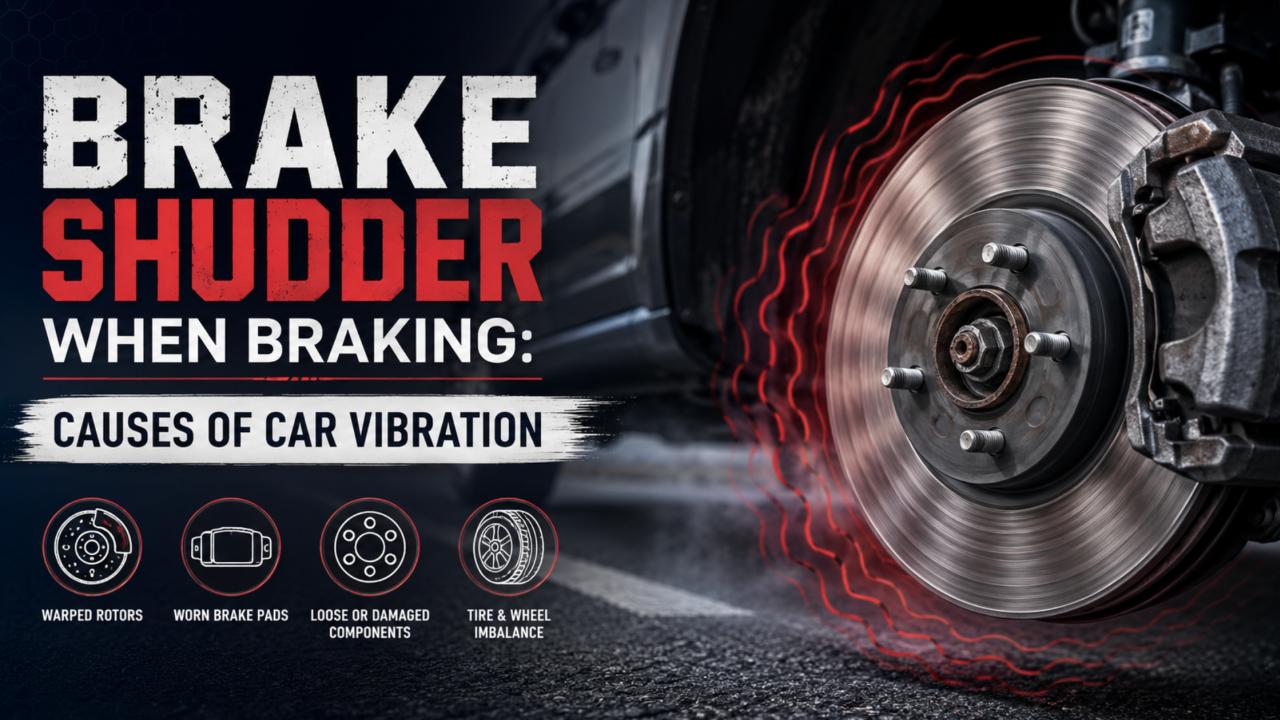
You're driving through Jacksonville traffic when all of a sudden, you step on the brakes, and your steering wheel starts shaking violently. Your immediate thought is probably that your brake rotors are warped.
And they might be, but they aren't always.
Brake shudder is rarely just a single bad part. More often, it’s the result of multiple steering, suspension, and braking components failing to work smoothly together.
Unfortunately, many drivers ignore these early vibrations, putting off professional brake repair until the shaking slowly ruins surrounding parts, turning a simple fix into a massive repair bill.
What Brake Shudder Actually Feels Like
There is a distinct difference between normal road vibration and true brake shudder. The most significant sign is when it happens. If your car shakes only while your foot is actively pressing the brake pedal, the issue is almost certainly brake-related. If the car shakes at high speeds, you're likely dealing with an issue like tire imbalance or bad wheel alignment.
Brake shudder generally happens in two ways:
- Through the steering wheel: This usually indicates a problem with your front brakes or suspension.
- Through the brake pedal: An obvious pulsation that you feel under your foot typically means there’s an issue with the rear brakes or rotor surface variation.
Friction Deposits: The "Warped Rotor" Myth
The default explanation for almost every brake vibration is a “warped rotor.” In reality, actual structural distortion of modern steel rotors is pretty rare. The real problem is normally friction material transfer.
When you are constantly driving in heavy stop-and-go traffic, your brakes can easily reach temperatures of 600°F or more. If you come to a sudden stop and keep your foot clamped down tightly on the pedal, the hot brake pad can actually transfer a thin layer of its own material onto the rotor surface.
It wears on, creating uneven high and low spots of friction. This uneven transfer of material worsens when drivers engage in behaviors that accelerate brake wear, such as riding the brakes downhill or braking suddenly. The rotor spins between the brake caliper. The pads bounce off these microscopic bumps, and a pulse travels through your steering wheel and pedal.
The Technical Culprit: Disc Thickness Variation (DTV)
When uneven friction deposits are left unaddressed, they lead to a condition mechanics call Disc Thickness Variation (DTV).
Because the brake pads constantly catch on the high spots left by friction deposits, those specific areas of the rotor wear down faster than the rest of the disc. Eventually, the rotor no longer has a uniform thickness throughout. Even a tiny variation as small as a fraction of a millimeter is enough to push back against the brake caliper pistons.
This displacement pushes brake fluid back up the lines, which is the physical cause of the rhythmic pulsing you feel under your foot.
Worn Pads and Sticky Calipers
Unevenly worn brake pads are unable to apply even pressure on the rotor. Uneven wearing is often caused by:
- Bad quality of pad materials
- Caliper slide pins frozen or not greased
- A malfunctioning brake caliper
In Northeast Florida, our high humidity and heavy summer rain can cause rust and corrosion to build up on these moving brake parts faster than in drier climates. If a caliper stickily refuses to retract, it keeps the brake pad pressed against the rotor while you drive.
The extreme heat generated quickly ruins the rotor surface and triggers a heavy vibration the next time you try to slow down.
When the Problem Isn't the Brakes: Suspension and Hub Runout
Sometimes your brake system is in great shape, but the problem is your suspension or wheel hub assembly. Slamming on the brakes shifts your vehicle's weight forward, and the front end takes the brunt of it. If your control arm bushings, tie rods, ball joints, or struts are worn and loose, they can’t take that sudden force. The whole front axle starts to oscillate and shake violently, as if the brakes are failing, especially when braking downhill or turning.
Another overlooked cause is wheel hub runout. If a mechanic installs brand-new rotors onto a wheel hub with a tiny bit of dirt, rust, or physical damage on its mounting face, the rotors will sit at a microscopic angle. As the crooked rotor spins, it causes uneven pad contact, resulting in severe DTV and brake shudder within just a few thousand miles.
Resurfacing vs. Replacing Rotors
When you take your car in to fix a brake shudder, the technician will usually measure your rotors to decide between two options:
- Resurfacing (Machining): If your rotors have plenty of metal left and the damage is minor surface friction deposits, a lathe can shave off a microscopic layer to make the surface perfectly flat again.
- Replacement: If the rotors are worn beyond the manufacturer-defined safe thickness limits, exhibit deep heat cracks, or have severe hot spots, they need to be replaced in their entirety. Modern rotors are made thinner to save weight, so replacement is often the safest and most economical solution in the long run.
When to Stop Driving Immediately
A little pedal pulse is annoying, but bad brake shudder is a real safety issue. If you’re shaking with any of the following, book an inspection straight away:
- A spongy or soft brake pedal.
- The vehicle pulls sharply to one side when slowing down.
- Loud metal-on-metal grinding noises.
- An increased distance is required to bring the car to a stop.
Severe brake shudder can eventually affect steering control, tire wear, and suspension stability. That’s especially risky during heavy rainstorms common throughout Jacksonville summers.
What Your Brake Vibration Is Trying to Tell You
Brake shudder generally never fixes itself. The longer the brakes are pulsing, the more likely it is that other parts will start to wear. The longer you wait, the worse it gets, and the more complicated it is to fix.
If the driver feels the steering wheel shaking, pulsation, or repeated brake vibration, the braking system and suspension should be checked simultaneously. Very often, a combination of brake diagnostics and professional car suspension repair can help establish the full cause before further damage occurs.
FAQs - Brake Shudder
Q1. Can I drive with brake shudder?
Ans. Only for a short trip to a mechanic. Leaving it unfixed will shake loose your steering parts and ruin your tires, leading to a much higher repair bill.
Q2. Why do my brakes shake at high speeds but not low speeds?
Ans. At highway speeds, your wheels spin much faster. This makes even tiny bumps on your brake rotors hit the pads harder, causing a violent vibration you won't feel at low speeds.
Q3. How do I prevent brake shudder after getting new brakes?
Ans. Drive gently for the first 200 miles. Avoid slamming on your brakes so the new pads can wear in evenly against the smooth metal rotors without overheating.
Q4. Could a bad wheel alignment cause brake shaking?
Ans. A bad alignment usually shakes all the time while driving. However, if your suspension is also loose, hitting the brakes will cause the misaligned tires to fight for grip, triggering a sudden shake.