The global Recycled Asphalt Market is experiencing steady growth as governments and construction companies increasingly adopt sustainable infrastructure practices to reduce construction costs, conserve natural resources, and minimize environmental impact. Recycled asphalt, commonly referred to as reclaimed asphalt pavement (RAP), is produced by reprocessing existing asphalt pavement for reuse in new road construction, highways, airport runways, parking lots, and other transportation infrastructure projects. Rising investments in road rehabilitation, expanding infrastructure development, and growing emphasis on circular economy principles are significantly driving market expansion.
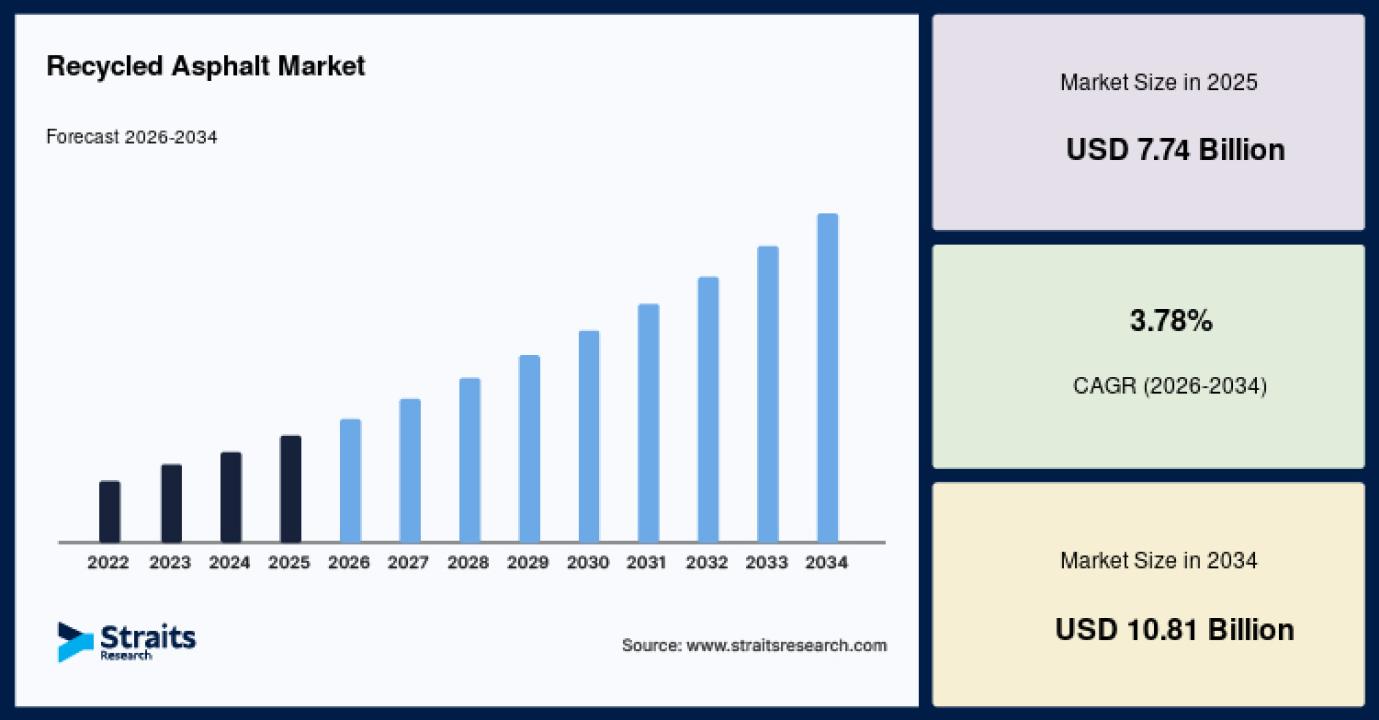
According to industry analysis, the global Recycled Asphalt Market size was valued at USD 7.74 billion in 2025 and is projected to grow from USD 8.03 billion in 2026 to USD 10.81 billion by 2034, exhibiting a CAGR of 3.78% during the forecast period (2026–2034).
Read Full Report: https://straitsresearch.com/report/recycled-asphalt-market
The increasing demand for cost-effective road construction materials, growing government investments in transportation infrastructure, rising environmental regulations, advancements in asphalt recycling technologies, and expanding adoption of sustainable construction practices are among the primary factors driving market growth. Manufacturers and infrastructure contractors are investing in advanced recycling equipment and innovative production techniques to improve recycled asphalt quality and performance.
Growing Road Infrastructure Development Fuels Market Growth
One of the primary drivers of the Recycled Asphalt Market is the continuous expansion of road infrastructure projects across developed and emerging economies. Governments are investing heavily in highway construction, road maintenance, bridge rehabilitation, airport expansion, and urban transportation systems to support economic growth and improve connectivity.
Recycled asphalt provides a durable and cost-efficient solution for these projects while reducing dependence on virgin aggregates and asphalt binders. Its ability to deliver reliable performance at lower costs makes it increasingly attractive for both public and private infrastructure projects.
The continued expansion of transportation infrastructure is expected to support sustained market growth.
Rising Focus on Sustainable Construction Practices
Sustainability has become a key priority for the global construction industry. Recycled asphalt supports environmentally responsible construction by reducing landfill waste, lowering greenhouse gas emissions, conserving natural resources, and minimizing energy consumption during production.
Governments, contractors, and developers are increasingly incorporating recycled materials into infrastructure projects to meet environmental regulations and green building objectives. The use of reclaimed asphalt pavement also contributes to circular economy initiatives by extending the lifecycle of valuable construction materials.
The growing emphasis on sustainable infrastructure development is expected to remain a major driver of market expansion.
Cost Savings Encourage Wider Adoption
Recycled asphalt offers significant economic advantages compared to conventional paving materials. By reusing existing pavement materials, contractors can reduce expenditures on raw materials, transportation, disposal, and energy consumption.
As construction costs continue to rise globally, public agencies and private contractors are increasingly adopting recycled asphalt to optimize project budgets without compromising pavement performance. The availability of reclaimed materials also helps improve supply chain efficiency and reduce dependence on newly extracted resources.
The economic benefits of recycled asphalt are expected to drive greater market adoption throughout the forecast period.
Technological Advancements Improve Recycling Efficiency
Continuous innovation in asphalt recycling technologies is enhancing the quality and performance of recycled asphalt products. Modern recycling plants utilize advanced crushing, screening, blending, and heating systems to produce high-quality recycled asphalt mixtures that meet stringent engineering standards.
Warm mix asphalt technologies, improved binder rejuvenators, automated quality control systems, and digital monitoring solutions are enabling higher recycled material content while maintaining pavement durability and performance. These technological advancements are expanding the range of applications for recycled asphalt.
Ongoing innovation is expected to strengthen market competitiveness.
Government Regulations Support Recycling Initiatives
Governments worldwide are implementing regulations and policies that encourage the use of recycled construction materials in public infrastructure projects. Many transportation authorities have established standards promoting the incorporation of reclaimed asphalt pavement into highway and road construction.
Financial incentives, sustainability targets, and public procurement guidelines are encouraging contractors to increase recycled material utilization. These supportive regulatory frameworks are accelerating investments in asphalt recycling infrastructure and advanced processing technologies.
Government initiatives are expected to create significant long-term growth opportunities for the market.
Increasing Urbanization and Road Maintenance Activities
Rapid urbanization and expanding transportation networks are increasing demand for road maintenance, resurfacing, and rehabilitation projects. Aging infrastructure requires regular repairs to maintain safety, improve traffic flow, and extend pavement lifespan.
Recycled asphalt is widely used in resurfacing and rehabilitation applications because it offers a practical and environmentally responsible solution for restoring existing roadways. Increasing maintenance activities across urban and rural transportation networks continue to support steady market demand.
The growing need for road rehabilitation is expected to contribute significantly to future market growth.
North America Maintains Market Leadership
North America currently holds a significant share of the global Recycled Asphalt Market due to its extensive transportation infrastructure, advanced recycling technologies, and strong regulatory support for sustainable construction practices. The United States remains the largest contributor to regional market growth, supported by widespread adoption of reclaimed asphalt pavement, continuous highway rehabilitation programs, and significant investments in transportation infrastructure.
The region's mature construction industry continues to strengthen market development.
Europe Benefits from Strong Environmental Regulations
Europe represents a major market for recycled asphalt, driven by strict environmental regulations, circular economy initiatives, and increasing investments in sustainable infrastructure. Countries such as Germany, France, the United Kingdom, Italy, and the Netherlands have established comprehensive recycling programs that promote the reuse of construction materials.
Growing emphasis on reducing carbon emissions and improving resource efficiency continues to encourage broader adoption of recycled asphalt across the region.
Asia-Pacific Emerges as the Fastest-Growing Region
Asia-Pacific is expected to witness the highest growth rate during the forecast period. Rapid urbanization, expanding highway construction, increasing government investments in transportation infrastructure, and rising environmental awareness are driving regional demand for recycled asphalt.
Countries such as China, India, Japan, South Korea, and Australia are investing heavily in road modernization, smart city development, and sustainable construction initiatives. Growing infrastructure spending, expanding recycling capabilities, and supportive government policies are further accelerating regional market growth.
As transportation networks continue to expand across the region, Asia-Pacific is expected to become the primary growth engine for the global Recycled Asphalt Market.
Competitive Landscape Focuses on Recycling Technologies and Sustainable Solutions
The Recycled Asphalt Market remains highly competitive, with leading companies focusing on advanced recycling equipment, high-performance asphalt mixtures, sustainable production methods, and digital quality control systems. Companies are investing heavily in research and development to improve recycled material performance, increase recycled content, and reduce production costs.
Strategic partnerships, acquisitions, equipment modernization, and investments in recycling facilities are helping companies strengthen their market positions. Manufacturers are also developing innovative asphalt additives and binder rejuvenators that improve pavement durability while enabling greater use of recycled materials.
These initiatives are expected to drive continuous innovation and strengthen competition across the industry.
Future Outlook for the Recycled Asphalt Market
The future of the Recycled Asphalt Market remains promising as governments and construction companies increasingly prioritize sustainable infrastructure development. Rising investments in road construction, growing adoption of circular economy principles, continuous technological advancements in recycling, expanding environmental regulations, and increasing focus on cost-efficient construction are expected to support steady market growth through 2034.
Innovations in warm mix asphalt technologies, intelligent recycling systems, AI-driven quality monitoring, advanced binder rejuvenators, and low-carbon construction materials will continue to reshape the industry. As infrastructure developers seek environmentally responsible and economically efficient paving solutions, recycled asphalt will remain an essential component of modern transportation infrastructure.
Frequently Asked Questions
What is the current size of the Recycled Asphalt Market?
The market was valued at USD 7.74 billion in 2025.
What is the projected market size by 2034?
The market is expected to reach USD 10.81 billion by 2034.
What is the CAGR of the Recycled Asphalt Market?
The market is projected to grow at a CAGR of 3.78% during 2026–2034.
What factors are driving market growth?
Key drivers include growing road infrastructure development, rising focus on sustainable construction practices, cost savings associated with recycled materials, technological advancements in asphalt recycling, supportive government regulations, and increasing road maintenance and rehabilitation activities.
Which region holds a significant market share?
North America currently maintains a significant share of the global Recycled Asphalt Market.
Which region is expected to grow the fastest?
Asia-Pacific is expected to witness the highest growth rate during the forecast period due to rapid urbanization, expanding transportation infrastructure, increasing government investments in road construction, growing environmental awareness, improving recycling capabilities, and rising adoption of sustainable construction materials.