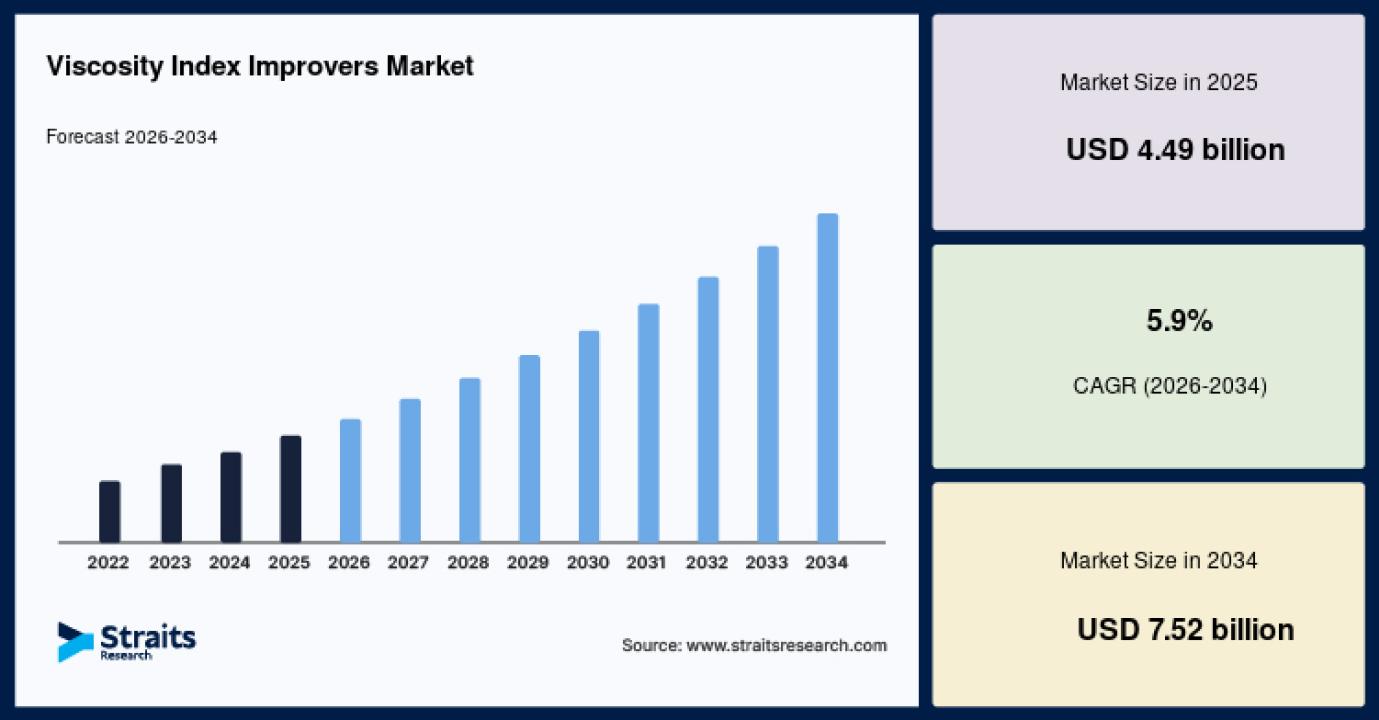
The global viscosity index improvers market is witnessing steady growth due to increasing demand for high-performance lubricants, rising automotive production, expanding industrial manufacturing activities, and growing adoption of synthetic engine oils. The global viscosity index improvers market size was valued at USD 4.49 billion in 2025 and is projected to grow from USD 4.76 billion in 2026 to USD 7.52 billion by 2034, registering a CAGR of 5.9% during the forecast period (2026–2034).
Viscosity index improvers (VIIs) are polymer-based lubricant additives that minimize changes in oil viscosity across varying temperatures. They help lubricants maintain optimal flow characteristics during both low-temperature starts and high-temperature engine operation. These additives are extensively used in automotive engine oils, transmission fluids, hydraulic fluids, industrial lubricants, and gear oils to enhance equipment performance, fuel efficiency, and component durability.
Market Drivers
Growing Demand for High-Performance Engine Oils
The increasing use of premium lubricants in passenger vehicles, commercial vehicles, and industrial machinery is driving demand for viscosity index improvers that deliver superior thermal stability and lubrication performance.
Rising Automotive Production
Growing global production of passenger cars, commercial vehicles, and electric vehicles is increasing the consumption of advanced lubricant additives across the automotive sector.
Expansion of Industrial Manufacturing
Rapid industrialization and increasing demand for hydraulic systems, compressors, turbines, and heavy machinery are supporting the adoption of viscosity index improvers in industrial lubricants.
Increasing Adoption of Synthetic Lubricants
The shift toward synthetic and semi-synthetic lubricants is accelerating demand for advanced viscosity index improvers that improve lubricant performance under extreme operating conditions.
Stringent Fuel Efficiency and Emission Regulations
Governments worldwide are implementing stricter fuel economy and emission standards, encouraging the use of high-performance lubricants that enhance engine efficiency and reduce friction.
For Detailed Insights, Visit:
https://straitsresearch.com/report/viscosity-index-improvers-market
Market Challenges
Fluctuating Raw Material Prices
Variations in petrochemical feedstock prices significantly affect the production costs of polymer-based viscosity index improvers.
Performance Degradation Under Extreme Conditions
Certain viscosity index improvers may experience mechanical shear degradation under severe operating conditions, reducing lubricant effectiveness.
Environmental Regulations
Manufacturers must comply with increasingly stringent environmental regulations regarding lubricant formulations and chemical additives.
Growing Competition from Advanced Additive Technologies
The development of multifunctional lubricant additives and next-generation formulations may create competitive challenges for conventional viscosity index improvers.
Market Segmentation
The viscosity index improvers market is segmented based on product type, application, end user, and region.
By Product Type
The market is categorized into:
Olefin Copolymers (OCP)
Polymethacrylates (PMA)
Styrene-Butadiene Copolymers
Polyisobutylene (PIB)
Others
Olefin copolymers account for the largest market share due to their excellent thermal stability, cost-effectiveness, and widespread use in automotive lubricants.
By Application
The market includes:
Engine Oils
Transmission Fluids
Hydraulic Fluids
Gear Oils
Industrial Lubricants
Others
Engine oils dominate the market owing to increasing global vehicle production and growing demand for fuel-efficient lubrication systems.
By End User
The market is segmented into:
Automotive
Industrial Manufacturing
Marine
Aerospace
Construction
Mining
Others
The automotive sector represents the largest end-user segment due to rising consumption of engine oils and transmission fluids across passenger and commercial vehicles.
By Region
The market is analyzed across:
North America
Europe
Asia-Pacific
Latin America
Middle East & Africa
Regional Insights
North America
North America holds a significant share of the viscosity index improvers market due to strong automotive manufacturing, increasing adoption of synthetic lubricants, advanced industrial infrastructure, and stringent fuel efficiency regulations.
Europe
Europe represents a major market supported by premium automotive production, growing industrial automation, expanding lubricant innovation, and strict environmental regulations.
Asia-Pacific
Asia-Pacific is expected to witness the fastest growth due to rapid industrialization, increasing automotive production, expanding manufacturing activities, and rising lubricant consumption across China, India, Japan, South Korea, and Southeast Asia.
Latin America
Latin America is experiencing steady market growth driven by increasing vehicle ownership, expanding industrial sectors, and growing mining and construction activities.
Middle East & Africa
The region is witnessing gradual growth owing to expanding oil & gas operations, industrial development, infrastructure investments, and increasing demand for heavy-duty lubricants.
Technology Trends and Market Opportunities
The viscosity index improvers market is evolving through innovations in shear-stable polymers, high-performance synthetic additives, low-viscosity lubricant formulations, bio-based lubricant technologies, and advanced polymer engineering. Manufacturers are increasingly focusing on developing additives that improve oxidation resistance, thermal stability, fuel economy, and lubricant lifespan.
Growing investments in electric mobility, industrial automation, renewable energy equipment, advanced engine technologies, and environmentally friendly lubricants are creating significant opportunities for market participants. Furthermore, increasing demand for energy-efficient machinery and high-performance automotive lubricants is expected to support long-term market growth.
Key Players Analysis
The viscosity index improvers market is highly competitive, with leading companies focusing on advanced polymer technologies, sustainable lubricant additives, strategic partnerships, and production capacity expansion.
Major companies operating in the market include:
Lubrizol Corporation
Chevron Oronite Company LLC
Infineum International Limited
Afton Chemical Corporation
Evonik Industries AG
BASF SE
Croda International Plc
LANXESS AG
The Dow Chemical Company
BRB International B.V.
These companies continue to invest in next-generation lubricant additive technologies, high-performance polymer formulations, sustainable manufacturing processes, and global expansion strategies to strengthen their positions in the global viscosity index improvers market.
Related Report
Lubricant Additives Market
https://straitsresearch.com/report/lubricant-additives-market
About Us
Straits Research is a leading market research and intelligence organization specializing in analytics, advisory services, and comprehensive market research reports across multiple industries.
Contact Us
Email: sales@straitsresearch.com
U.S. Tel: +1 646 905 0080
U.K. Tel: +44 203 695 0070