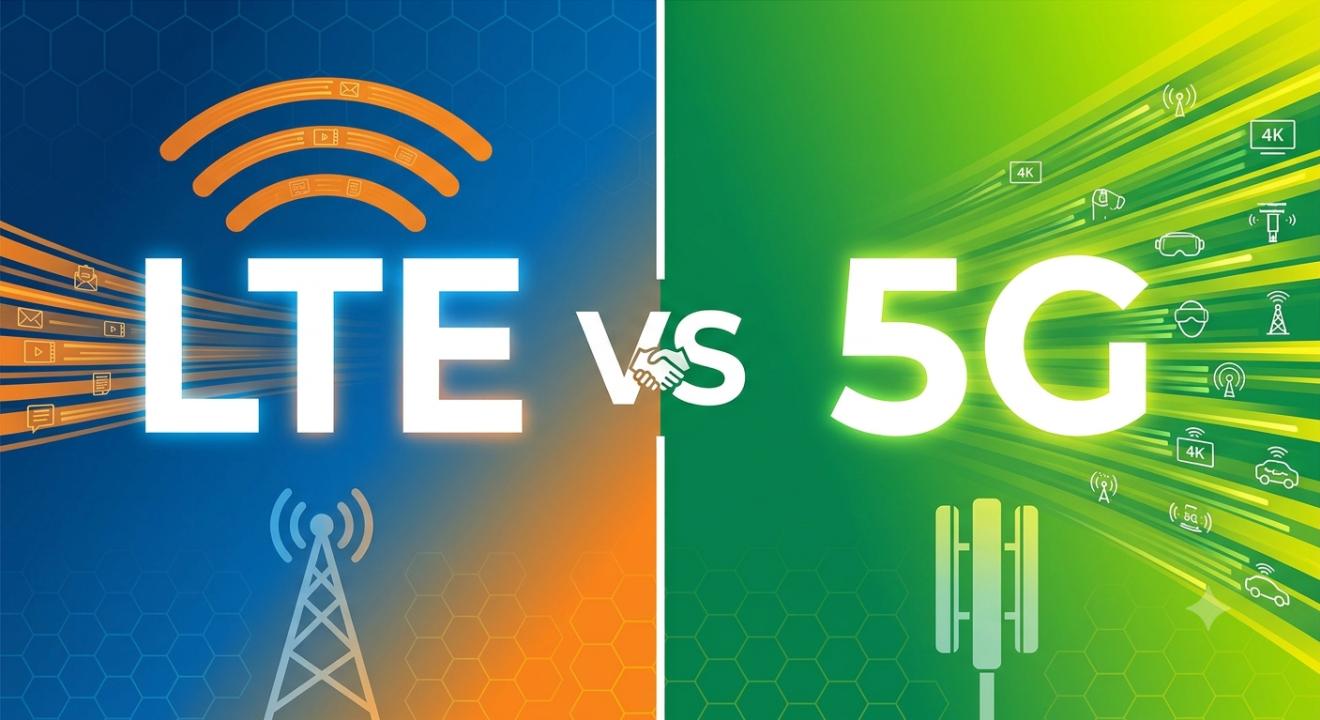
Your phone shows five bars and a "5G" icon, yet the video still buffers, the group chat won't load, and you're left wondering if the fancy new label even means anything. Maybe you've noticed your neighbor's LTE connection outperforming your "upgraded" network, or you're trying to pick a home internet plan and keep hitting the same wall: nobody actually explains what these letters and numbers mean for your daily life; they just assume you already know.
That confusion is fair. Carriers throw around network jargon like everyone took a telecom class, but most of us just want to know which connection will actually stream our shows, hold a video call, and let the kids do homework without the spinning wheel of doom. So let's break down LTE vs 5G in plain terms, no acronyms left unexplained, so you can figure out what actually fits your life.
What Is LTE, Really?
LTE stands for Long-Term Evolution, and it's been the backbone of mobile data for well over a decade. When people say "4G," they usually mean LTE. It was the generation that made things like video streaming, GPS navigation, and quick app loading feel normal on a phone instead of a novelty.
LTE works by sending data over specific radio frequency bands, mostly the lower and mid-range ones, which is actually a strength. Lower frequencies travel farther and push through walls, trees, and hills more easily. That's why LTE tends to reach into rural areas and build interiors where newer signals struggle.
Speeds on LTE typically range from 5 to 50 Mbps for most users, depending on tower congestion and distance from the cell site. That's plenty for browsing, streaming in HD, video calls, and most everyday tasks. It's not flashy, but it's dependable, and dependable matters more than most marketing admits.
What Is 5G, and Why Does It Feel Different?
5G is the fifth generation of mobile network technology, built to handle far more data, far more devices, and far less delay than LTE. It operates across three frequency types: low-band, mid-band, and high-band (often called mmWave).
Here's where it gets interesting. Low-band 5G behaves a lot like LTE in terms of range and speed; it's the "wide coverage" version. Mid-band 5G offers a real jump in speed while still covering decent distances. High-band mmWave gets all the headlines for gigabit speeds, but it has a serious weakness: it barely penetrates walls and quickly loses strength over distance. That's why you might get blazing 5G speeds standing outside a stadium and then watch it vanish the moment you step indoors.
5G also dramatically reduces latency, the lag between an action and a response. This matters more for things like online gaming, video conferencing, and smart home devices reacting in real time than it does for casual scrolling.
LTE vs 5G: The Differences That Actually Matter
Speed is the obvious difference. 5G can outpace LTE by a wide margin under ideal conditions, sometimes ten times faster on mid- or high-band connections. But "ideal conditions" is doing a lot of work in that sentence. Your actual speed depends heavily on which 5G flavor your carrier is running in your area, not just the icon on your screen.
Coverage tells a different story. LTE networks have had over a decade to mature, meaning towers and infrastructure are already built out across cities, suburbs, and much of rural America. 5G, especially the faster mid- and high-band versions, is still expanding and tends to concentrate in urban and suburban pockets. If you live somewhere more remote, there's a real chance your "5G" phone quietly falls back to LTE most of the time anyway.
Latency is where 5G shines brightest. Lower latency means less delay, which is genuinely noticeable in competitive gaming, live video calls, and any application that depends on split-second responsiveness.
Device capacity is another factor people rarely think about. 5G networks are engineered to handle a much higher density of connected devices without slowing down. That matters in crowded places like concerts, stadiums, or busy downtown areas where LTE networks can get congested and sluggish even with strong signal bars.
Battery life quietly tips in LTE's favor, too. Older 5G chipsets, particularly ones handling mmWave signals, tend to draw more power as they search for and maintain connections. Newer devices have improved this significantly, but it's still worth knowing if your phone seems to drain faster since switching networks.
So, Which One Should You Actually Use?
Honestly, this depends on where you live and what you do online, not on which term sounds more advanced. Here's a simple way to think it through:
If you're in a dense urban or well-covered suburban area and you stream a lot, download large files, or play games online, mid-band 5G will likely feel like a genuine upgrade. You'll notice faster load times and smoother performance, especially during peak hours when networks get crowded.
If you're in a rural or semi-rural area, or you spend a lot of time indoors in older buildings, LTE might actually serve you better in practice, even if 5G is technically available. A strong LTE signal beats a weak, spotty 5G one every time.
If your daily tasks are mostly browsing, texting, streaming music, and video calls, both networks will likely handle it fine. The difference you'll feel most is in download-heavy or latency-sensitive tasks, not general use.
For home internet specifically, fixed wireless access has become a genuinely useful option for people outside traditional cable or fiber service areas. UbiFi offers the best 5G and 4G LTE internet for households that need a reliable connection without being tied to a physical line, automatically leaning on whichever network delivers a stronger signal at your location rather than forcing you into one or the other.
It's Not Really LTE vs 5G, It's About Matching the Network to Your Life
The more honest way to frame this isn't "which one wins," because they're not really competing; they're complementary. Most modern networks are built to lean on both, using 5G where it's fast and available, and quietly falling back to LTE where it isn't. Your phone is already doing this handoff constantly without asking your permission.
What actually matters is understanding your own usage. If you're chasing raw speed for downloads and gaming and you live somewhere with solid 5G infrastructure, you'll feel the difference. If reliability and consistent coverage matter more to you, especially outside major cities, LTE remains a genuinely solid foundation, not a downgrade. Technology marketing wants you to believe newer always means better, but connectivity is one of those areas where "better for your situation" is the only ranking that counts.
Frequently Asked Questions
Is 5G always faster than LTE?
Not always. It depends on which type of 5G you're connected to. Low-band 5G can perform similarly to LTE, while mid- and high-band 5G offer noticeably faster speeds, but only where that infrastructure is built out.
Why does my 5G phone sometimes switch to LTE?
Your phone automatically connects to the network that provides the strongest, most stable signal at your exact location. If 5G coverage weakens indoors or in a less-covered area, it falls back to LTE to keep your connection steady.
Does 5G use more battery than LTE?
It can, particularly with older devices searching for high-band signals. Newer phones and updated network chips have narrowed this gap significantly, but it's still a reasonable concern if you're noticing faster battery drain.
Is LTE becoming outdated?
Not anytime soon. LTE still forms the backbone of mobile coverage in many areas, including rural regions, and most networks rely on it as a dependable fallback even as 5G expands.
Should I upgrade my plan just to get 5G?
Only if 5G coverage is strong and consistent where you actually spend your time, at home, work, and anywhere else you regularly connect. If your area still leans heavily on LTE, upgrading might not deliver the improvement you're expecting.