It's a question almost every UAV, robotics, or portable-power team asks LiTrue in the first email: "If we commit to a custom pouch cell today, when do we actually have working cells in hand — and when can we place a production order?" It's a fair question, and it deserves a real answer instead of a vague "it depends." Here's how that timeline typically breaks down, using LiTrue's own 40Ah anode-free solid-state cell, the PE40N-EF, as a concrete reference point throughout.
Step 1: Spec Confirmation
Every project starts with locking down the electrical and mechanical envelope: nominal voltage, capacity, continuous and pulse charge/discharge rates, operating temperature range, cell dimensions, and the certification standards the finished cell needs to meet. This is also where energy density trade-offs get discussed honestly — a cell like the PE40N-EF pushes to 495 Wh/kg specifically because it accepts a shorter cycle life (200–600 cycles) in exchange for that density, and LiTrue's engineering team will flag trade-offs like this before quoting rather than after.
This stage typically takes a few days to a couple of weeks, depending on how settled the requirements already are on the customer's side. A team walking in with a finished spec sheet moves faster than one still iterating on pack architecture.
Step 2: Sample Quotation and Order
Once specs are confirmed, LiTrue issues a formal quote covering sample pricing, minimum order quantity, and lead time. For most custom pouch cell projects, including anode-free designs like the PE40N-EF, sample MOQ starts at 10 pieces and is negotiable depending on cell complexity and format.
Step 3: First Articles (Sample Build)
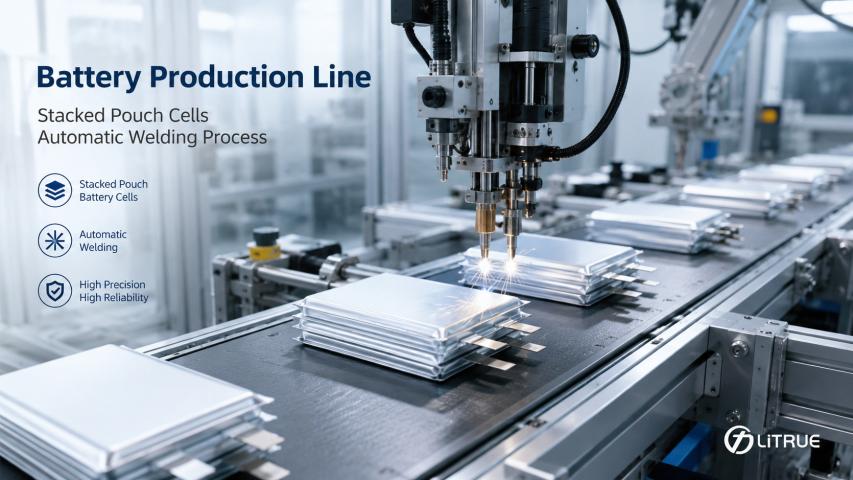
This is the step most programs care about most: how long until real cells are in hand for bench testing? For standard custom builds, sample lead time runs 7–15 working days from order confirmation. That window covers cell fabrication, formation cycling, initial QC, and packaging for shipment — not just cell stacking.
During this stage, it's worth requesting the design and certification documentation alongside the physical samples. LiTrue cells are typically built to GB/T 38058-2019 and GB 31241-2022 design standards, with UN38.3 and RoHS certification — documentation that pack integrators need in hand before they can move their own program toward flight testing or regulatory submission.
Step 4: Sample Evaluation and Iteration
This is the customer-side step, and it's the one most likely to stretch or compress the overall timeline. Bench testing — capacity verification, rate testing at continuous and pulse loads, temperature chamber testing across the cell's rated range — belongs here. For a high-density cell like the PE40N-EF, verifying performance at temperature extremes (the cell is rated -43°C to 55°C) is often the step programs spend the most time on, since it's the number that separates a cell that works on the bench from one that works in the field.
If results require a spec revision, the project loops back to Step 1 with a tighter, better-informed spec — which is normal and, for most programs, faster the second time through.
Step 5: Production Release
Once samples are validated and specs are frozen, the project moves to a bulk production order. Bulk lead time is approximately 45 days, subject to order volume and any final configuration requirements — such as series-parallel arrangement for pack-level assembly, which LiTrue's engineering team can support directly.
Full Product Specifications — PE40N-EF (Reference Cell)
| Field | Value |
|---|---|
| Model Number | PE40N-EF |
| Series | Anode-Free |
| Cell Structure | Pouch |
| Nominal Capacity | 40.0 Ah |
| Nominal Voltage | 3.85 V |
| Cell Weight | 316 g |
| Energy Density | 495 Wh/kg |
| Max. Continuous Charge Rate | 0.5C |
| Max. Continuous Discharge Rate | 3C |
| Max. Pulse Charge Rate | 1C |
| Max. Pulse Discharge Rate | 5C |
| Cycle Life | 200–600 times |
| Operating Temperature | -43°C to 55°C |
| Dimensions (T×W×H) | 5.4 × 74 × 172 mm |
| Design Standards | GB/T 38058-2019, GB 31241-2022 |
| Certification Standards | UN38.3, RoHS |
| Sample MOQ | 10 pcs (negotiable) |
| Sample Lead Time | 7–15 working days |
| Bulk Lead Time | 45 days (subject to volume & requirements) |
Source: LiTrue product page, PE40N-EF
The Realistic Total Timeline
Adding it up: spec confirmation (days to two weeks) + sample build (7–15 working days) + evaluation (customer-driven, typically two to six weeks) + production lead time (45 days) puts most custom pouch cell programs at roughly two to four months from first spec conversation to a production-ready order, assuming no major spec revisions along the way. Programs that arrive with a well-defined spec and a clear test plan consistently land at the shorter end of that range.
Where to Start
If you're scoping a custom pouch cell — whether it's a high-density anode-free design like the PE40N-EF or a more conventional NMC/LFP chemistry from LiTrue's broader cell lineup — the fastest way to get an accurate timeline is to bring your spec (or your constraints, if the spec isn't finalized yet) directly to LiTrue's engineering team through the contact page. They'll flag trade-offs early, which is usually what keeps a project on the shorter end of the timeline rather than the longer one.