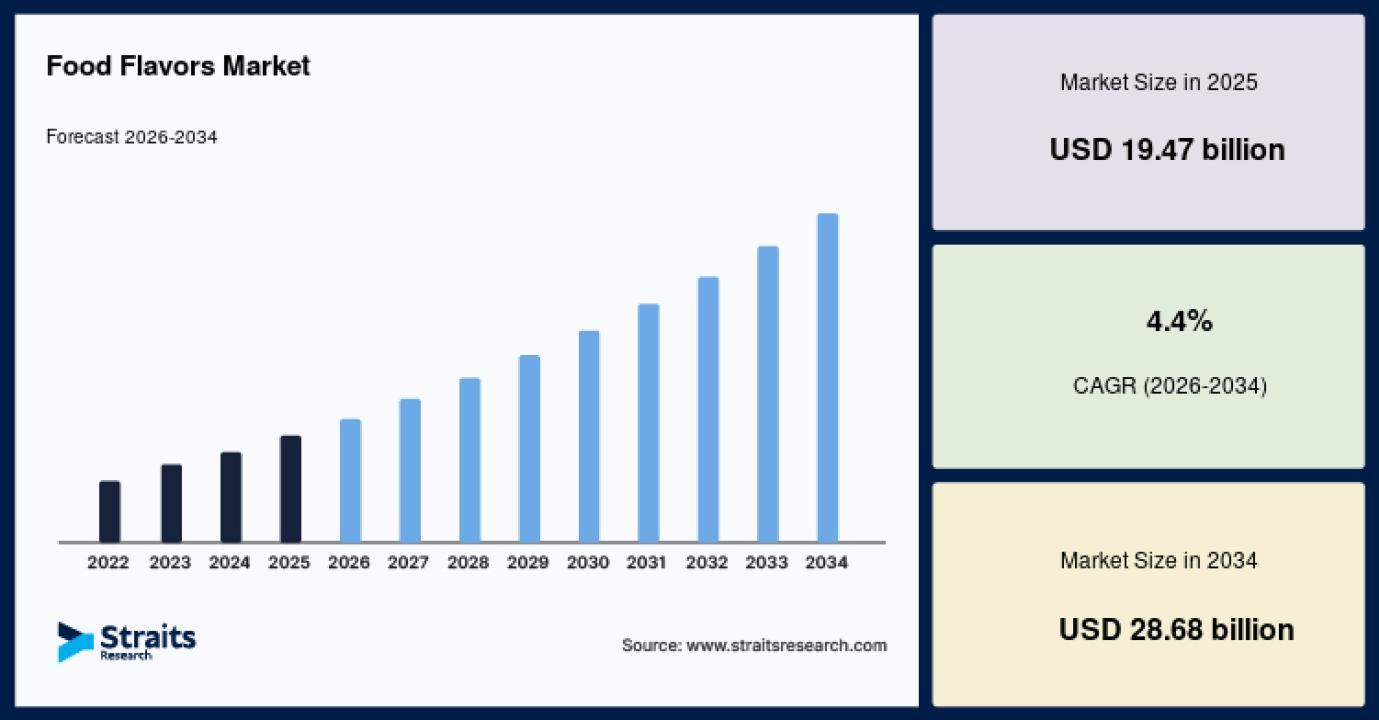
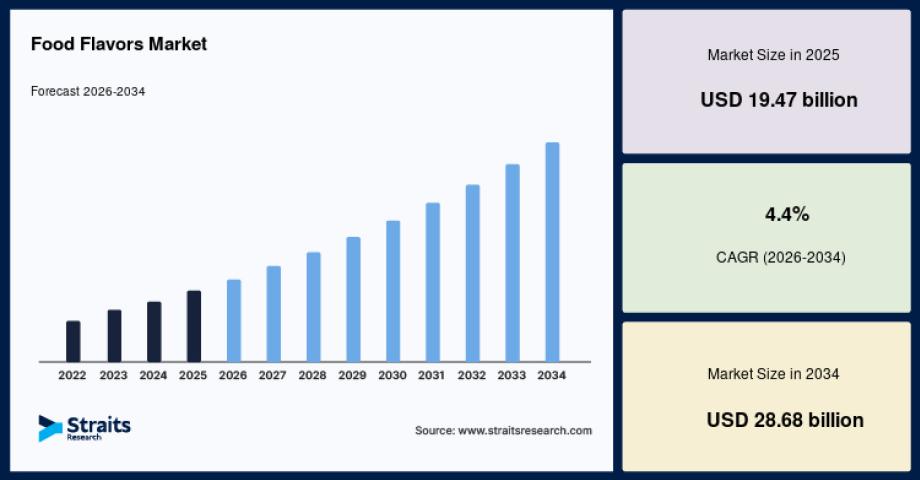
The global food flavors market is witnessing steady growth due to increasing demand for processed and convenience foods, rising consumer preference for natural and clean-label ingredients, growing innovation in functional foods and beverages, and expanding food and beverage manufacturing worldwide. The global food flavors market size was valued at USD 19.47 billion in 2025 and is projected to grow from USD 20.32 billion in 2026 to USD 28.68 billion by 2034, registering a CAGR of 4.4% during the forecast period (2026–2034).
Food flavors are ingredients added to food and beverages to enhance or modify taste and aroma. They can be derived from natural sources such as fruits, vegetables, herbs, spices, dairy, and botanicals, or produced through synthetic and nature-identical processes. Food flavors play a vital role in bakery products, dairy products, confectionery, beverages, savory foods, snacks, meat products, and functional nutrition, helping manufacturers meet evolving consumer taste preferences.
Growing demand for premium food products, plant-based alternatives, and personalized nutrition continues to support the expansion of the global food flavors market.
Market Drivers
Increasing Demand for Processed and Convenience Foods
Rapid urbanization, busy life>
Food manufacturers are utilizing advanced flavor solutions to improve product taste, consistency, and consumer appeal while differentiating their product portfolios.
Rising Preference for Natural Flavors
Consumers are increasingly seeking food products made with natural, organic, and clean-label ingredients.
Manufacturers are responding by replacing artificial flavoring agents with natural extracts derived from fruits, herbs, spices, essential oils, and botanical ingredients.
Growth of Functional Foods and Beverages
The increasing popularity of functional foods, fortified beverages, protein supplements, and nutritional products is driving demand for innovative flavor systems.
Flavor manufacturers are developing solutions that enhance taste while masking the bitterness often associated with vitamins, minerals, plant proteins, and nutraceutical ingredients.
Expanding Food and Beverage Industry
The continuous expansion of global food processing industries is creating significant opportunities for flavor manufacturers.
Growing investments in bakery, dairy, confectionery, beverages, and plant-based food production continue to support market growth.
Increasing Consumer Demand for Premium Products
Consumers are becoming more interested in unique, authentic, and international flavor experiences.
Exotic fruit flavors, ethnic spice blends, botanical ingredients, and gourmet flavor profiles are becoming increasingly popular across food and beverage categories.
For Detailed Insights, Visit:
https://straitsresearch.com/report/food-flavors-market
Market Challenges
Volatility in Raw Material Prices
The availability and pricing of natural raw materials such as vanilla, citrus fruits, cocoa, herbs, and spices can fluctuate due to climate conditions, agricultural production, and supply chain disruptions.
Regulatory Compliance
Food flavor manufacturers must comply with stringent food safety regulations and ingredient labeling requirements across different countries.
Changing Consumer Preferences
Rapid shifts in dietary trends and flavor preferences require manufacturers to continuously innovate and develop new flavor formulations.
Stability and Shelf-Life Challenges
Maintaining flavor stability throughout food processing, storage, transportation, and varying temperature conditions can present technical challenges.
Market Segmentation
The food flavors market is segmented based on type, source, application, end user, and region.
By Type
The market is categorized into:
Natural Flavors
Artificial Flavors
Nature-Identical Flavors
Natural flavors account for the largest market share due to increasing consumer preference for clean-label products and naturally sourced ingredients.
By Source
The market includes:
Fruits
Vegetables
Herbs and Spices
Dairy
Botanical Sources
Others
Fruit-derived flavors represent a major market segment owing to their widespread application in beverages, confectionery, dairy products, and desserts.
By Application
The market is segmented into:
Beverages
Bakery Products
Dairy Products
Confectionery
Savory Foods
Snacks
Meat Products
Others
Beverages dominate the market due to growing demand for flavored water, soft drinks, juices, sports drinks, energy drinks, alcoholic beverages, and functional beverages.
By End User
The market includes:
Food Manufacturers
Beverage Manufacturers
Bakery Industry
Dairy Industry
Confectionery Industry
Others
Food and beverage manufacturers account for the largest end-user segment because of increasing product innovation and expanding production capacity.
By Region
The market is analyzed across:
North America
Europe
Asia-Pacific
Latin America
Middle East & Africa
Regional Insights
North America
North America holds a significant share of the food flavors market due to strong demand for processed foods, premium beverages, functional nutrition products, and clean-label ingredients.
The presence of leading flavor manufacturers and continuous product innovation continue to strengthen regional market growth.
Europe
Europe represents a major market supported by increasing consumer preference for natural ingredients, premium food products, and sustainable sourcing practices.
Countries such as Germany, France, Italy, and the United Kingdom continue to drive innovation in bakery, confectionery, dairy, and beverage flavors.
Asia-Pacific
Asia-Pacific is expected to witness the fastest growth owing to rapid urbanization, expanding food processing industries, increasing disposable incomes, and changing dietary habits.
China, India, Japan, South Korea, and Southeast Asian countries are witnessing rising demand for packaged foods, convenience products, and functional beverages, creating significant opportunities for flavor manufacturers.
Latin America
Latin America is experiencing steady market growth driven by expanding food manufacturing industries, growing beverage consumption, and increasing demand for fruit-based flavors.
Middle East & Africa
The Middle East & Africa market is gradually expanding due to increasing food processing activities, urbanization, and rising demand for premium packaged food products.
Technology Trends and Market Opportunities
The food flavors market is evolving through innovations in natural extraction technologies, biotechnology, fermentation-derived flavors, encapsulation techniques, artificial intelligence-driven flavor development, and personalized nutrition.
Natural flavor extraction methods are becoming increasingly advanced, allowing manufacturers to produce authentic flavor profiles while preserving ingredient quality and sustainability.
Encapsulation technology is improving flavor stability, extending shelf life, and enabling controlled flavor release in processed foods and beverages.
Artificial intelligence is helping flavor companies analyze consumer preferences, predict emerging taste trends, and accelerate product development through data-driven flavor formulation.
Fermentation-derived flavors and biotechnology-based production methods are gaining attention as sustainable alternatives to conventional flavor manufacturing while reducing dependence on limited natural resources.
Growing investments in plant-based foods, functional beverages, sugar reduction technologies, clean-label ingredients, personalized nutrition, and premium food experiences are expected to create substantial opportunities for market participants during the forecast period.
Key Players Analysis
The global food flavors market is highly competitive, with leading flavor manufacturers focusing on natural ingredients, sustainable sourcing, biotechnology innovation, and customized flavor development.
Major companies operating in the market include:
Givaudan SA
International Flavors & Fragrances Inc.
Symrise AG
Firmenich SA
Kerry Group plc
Sensient Technologies Corporation
Takasago International Corporation
MANE Group
Robertet Group
T. Hasegawa Co., Ltd.
These companies continue to invest in natural flavor technologies, biotechnology research, sustainable sourcing programs, and customized ingredient solutions. Strategic acquisitions, research and development, and global manufacturing expansion are strengthening their positions in the global food flavors market.
Conclusion
The global food flavors market is expected to witness steady growth through 2034, driven by increasing demand for processed foods, rising consumer preference for natural ingredients, expanding functional food production, and continuous innovation in flavor technologies.
Advancements in biotechnology, fermentation, flavor encapsulation, and artificial intelligence are transforming flavor development across the food and beverage industry. As consumers continue to seek healthier, more authentic, and premium food experiences, demand for innovative food flavor solutions is expected to grow steadily throughout the forecast period.
Related Report
Food Ingredients Market
https://straitsresearch.com/report/food-ingredients-market
About Us
Straits Research is a leading market research and intelligence organization specializing in analytics, advisory services, and comprehensive market research reports across multiple industries.
Contact Us
Email: sales@straitsresearch.com
U.S. Tel: +1 646 905 0080
U.K. Tel: +44 203 695 0070