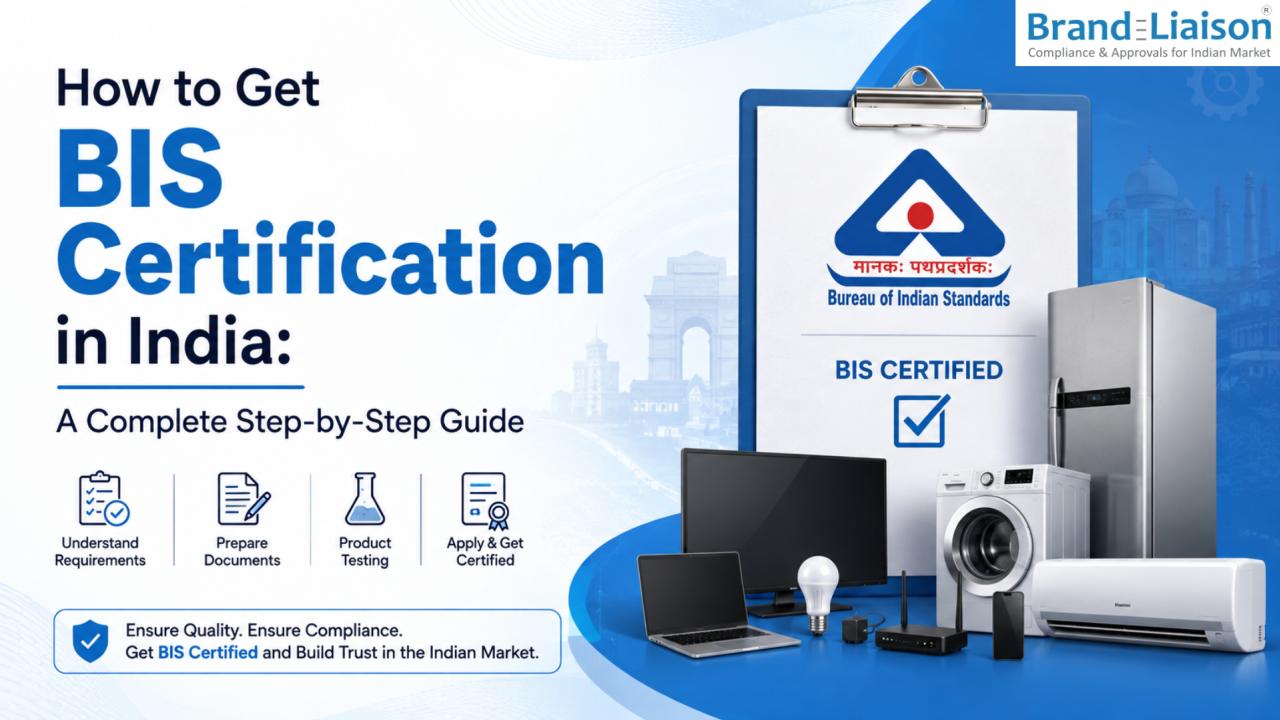
If you manufacture or import products in India, getting BIS certification is often mandatory to legally sell your goods in the market. This guide walks you through the exact process of obtaining BIS certification in india, including the documents required, testing steps, and application procedure.
What is BIS Certification?
BIS (Bureau of Indian Standards) certification is a third-party quality assurance mark that ensures your product meets Indian safety and quality standards. The BIS Act, 2016 mandates certification for specific product categories to protect consumer health and safety.
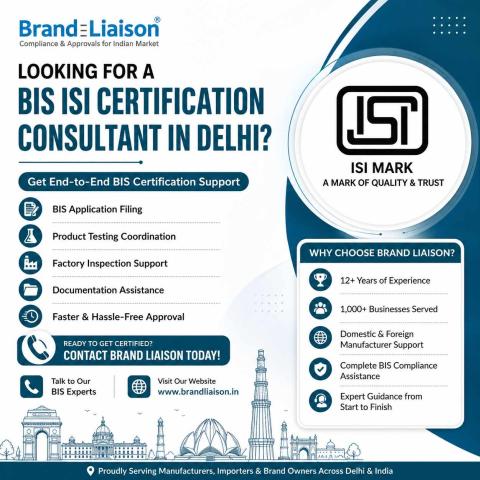
Once certified, manufacturers can use the ISI mark or BIS CRS registration mark on their products, signalling compliance with Indian standards.
Products That Require BIS Certification
Not all products need BIS certification. The Indian government has made it compulsory for certain categories, including:
- Cement and steel products
- Electrical appliances and transformers
- Electronics and IT goods (under CRS scheme)
- Household items like pressure cookers, gas stoves, and water heaters
- Medical equipment and testing instruments
- Automobile accessories
- Rubber and plastic products
- Food and related products
If your product falls under the mandatory list, you must obtain BIS certification before selling in India.
Types of BIS Certification Schemes
BIS offers multiple certification schemes depending on your product type and manufacturing location:
- ISI Mark Scheme – For domestic manufacturers of products like cement, electrical appliances, and household goods.
- Compulsory Registration Scheme (CRS) – For electronics and IT products; no factory audit required.
- Foreign Manufacturers Certification Scheme (FMCS) – For foreign manufacturers exporting to India.
- Simplified Procedure – For domestic MSMEs with faster processing.
- Eco Mark Scheme – For environmentally friendly products.
Choose the scheme that applies to your product category before starting the application.
Step-by-Step Process to Get BIS Certification
Step 1: Identify the Applicable Indian Standard (IS Code)
Before applying, determine which Indian Standard (IS code) applies to your product. Each product category has a specific IS standard that defines quality and safety requirements.
- Check the BIS website or product catalog to confirm your product falls under mandatory certification.
- Verify the latest IS code revision to avoid using outdated standards.
Step 2: Prepare Required Documentation
Documentation is critical for BIS approval. Incomplete or inconsistent documents are the most common reason for delays.
Documents typically required include:
- Business registration certificate (GST, Company PAN, etc.)
- Trademark registration certificate or authorization letter
- Factory address proof and utility bills
- ID proof of the authorized signatory
- Manufacturing process flowchart
- List of machinery and equipment with capacity details
- Plant layout and location map
- Quality control team details and qualification certificates
- Internal testing facility details
- Test reports of raw materials and components
- CDF (Critical Component List) and CCL (Component Compliance List)
- PCB layout, circuit diagrams, and block diagrams (for electronics)
- Product label/mark design
- For foreign manufacturers: details of Authorized Indian Representative (AIR)
- Ensure all documents are accurate and consistent across your application.
Step 3: Register on the BIS Manak Online Portal
- All BIS applications must be submitted online through the official Manak Online portal.
- Create a login ID on the BIS portal.
- Fill in company and factory details accurately.
- Upload all required documents in the specified format.
- Pay the application and processing fees online.
Step 4: Product Testing in a BIS-Approved Laboratory
Your product samples must be tested in a BIS-recognized laboratory to verify compliance with the applicable IS standard.
- Submit product samples to the lab after generating a test request.
- Ensure all mandatory test parameters (safety, performance, EMI/EMC, etc.) are covered.
- Test reports are typically valid for 90 days, so submit them before expiry.
- For CRS products, testing is done before application submission.
- For ISI/FMCS, testing may occur during or after the factory audit.
Step 5: Factory Audit (For ISI/FMCS Schemes)
For ISI and FMCS schemes, BIS officials conduct a factory audit to verify your manufacturing process and quality control systems.
- BIS inspectors will visit your factory premises.
- They will review your quality management system, SOPs, and equipment calibration.
- Product samples will be drawn during the audit for independent testing.
- Ensure your factory is audit-ready with all documentation and infrastructure in place.
Step 6: Application Scrutiny and License Grant
Once testing and audit are complete, BIS officials review your entire application, including test reports, documents, and audit findings.
- If everything meets the required standards, BIS grants the license or certificate.
- For CRS, you receive an R-number (Registration number).
- For ISI/FMCS, you receive a BIS license to use the ISI mark.
Step 7: Post-Certification Compliance
After obtaining BIS certification, you must maintain ongoing compliance:
- Renew your license before expiry (valid for 1–2 years).
- Pay annual license fees and minimum marking fees on time.
- Allow BIS surveillance inspections and sample testing.
- Report any changes in product design, components, or manufacturing process.
- Failure to comply can result in suspension or cancellation of your BIS license.
Common Mistakes That Delay BIS Certification
Avoid these errors to prevent delays or rejection:
- Selecting the wrong IS code for your product.
- Using a non-BIS-approved testing laboratory.
- Submitting incomplete or inconsistent documents.
- Non-compliant product samples or labels.
- Poor factory audit preparation (for ISI/FMCS).
- Slow or incomplete response to BIS queries.
- Not renewing your BIS license on time.
- Each of these mistakes can add weeks or months to your approval timeline.
How Long Does BIS Certification Take?
The timeline varies depending on the scheme:
- CRS (Electronics/IT): 30–45 days from application submission.
- ISI (Domestic): 45–60 days including testing and factory audit.
- FMCS (Foreign): 60–90 days due to additional documentation and audit.
Delays often occur due to documentation errors, slow query responses, or lab testing backlogs.
BIS Certification Cost
The cost depends on your product category, scheme, and number of models. Key fees include:
Application fee
- Testing charges (lab fees vary by product)
- BIS license fee and minimum marking fee (MMF)
- Factory audit fees (for ISI/FMCS)
- Renewal and surveillance fees
- Budget for these costs in advance to avoid surprises during the process.
Final Thoughts
Getting BIS certification in India requires careful planning, accurate documentation, and strict compliance with Indian standards. By following the steps outlined above, you can streamline your application and avoid common pitfalls that cause delays.
If you need expert guidance to navigate the BIS certification process smoothly, Brand Liaison is one of the best BIS Certification consultants in India. With 12 years of experience helping manufacturers and importers secure BIS approval quickly, We offers end-to-end support from IS code selection and documentation to lab coordination and factory audit preparation. Reach out to Brand Liaison today to fast-track your BIS certification and avoid costly mistakes.
Related Links