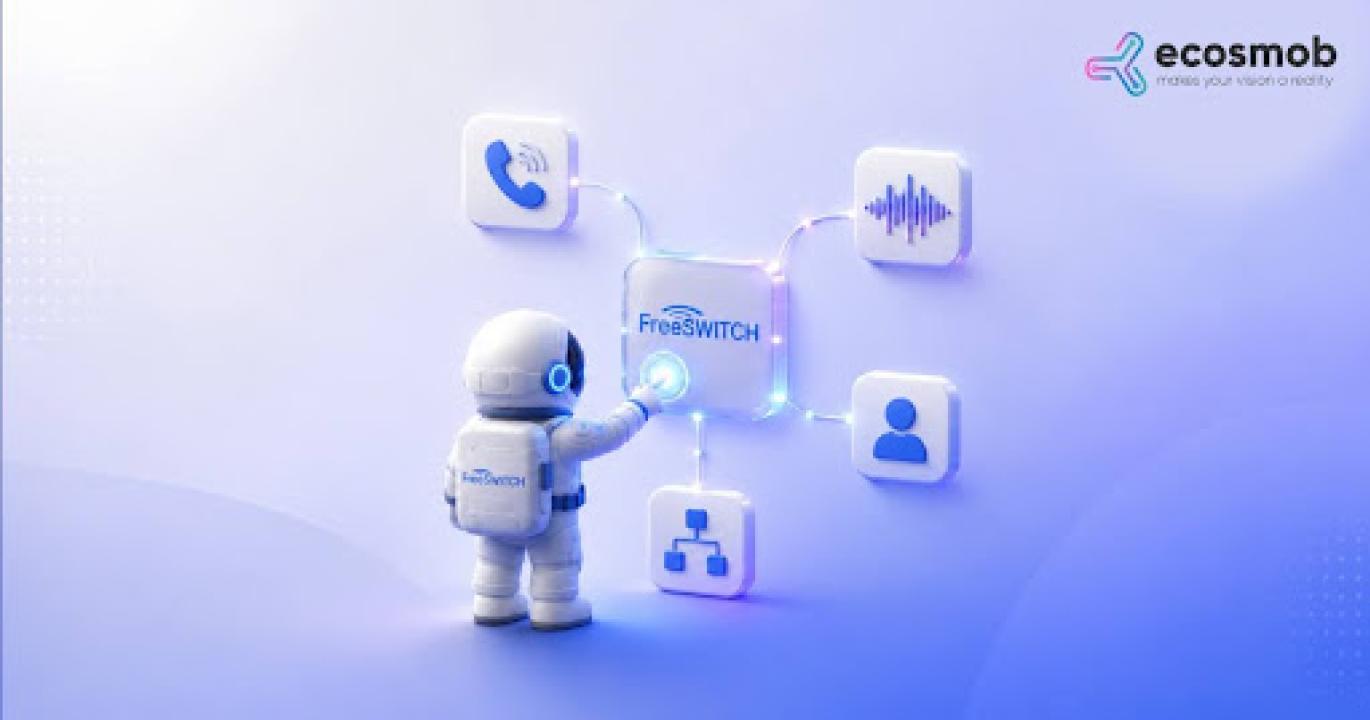
Building a modern VoIP platform is not just about routing calls. You need to react to events as they happen. Whether you are changing call paths, integrating AI agents, or tracking live call activity, your application needs direct access to FreeSWITCH's event engine.
That is where the FreeSWITCH Event Socket Library (ESL) comes in.
While the official documentation explains the protocol, it rarely covers how ESL is used in production. This guide explains how ESL works, common challenges, security practices, and the architectural decisions you should make before deployment.
What is the FreeSWITCH Event Socket Library and How Does It Work?
The FreeSWITCH Event Socket Library (ESL) is a TCP-based control interface that exposes FreeSWITCH's internal event system to external applications.
Every call action generates an event inside FreeSWITCH. This includes call creation, answering, DTMF input, transfers, and hang-ups. Through the mod_event_socket module, these events become available to external software in real time.
Instead of working directly with raw TCP data, ESL provides a structured way to send commands, receive events, and manage connections. This allows your application to monitor calls, execute actions, and build advanced communication workflows without modifying the FreeSWITCH core.
What are the Challenges Faced With FreeSWITCH Event Socket Library
Working with ESL becomes challenging when you move beyond simple testing and into production environments.
1. Blank-Line Message Termination
The Event Socket protocol uses text-based messages separated by blank lines. If your parser does not handle fragmented network packets correctly, messages can break and cause event processing issues.
2. Content-Length Parsing
Many events include a Content-Length header that specifies the exact payload size. Your application must read the complete payload before processing it. Ignoring this can result in corrupted event data.
3. api vs bgapi
FreeSWITCH provides two command execution methods:
api is synchronous and blocks the connection until the command finishes.
bgapi runs asynchronously and returns immediately with a Job UUID.
For production deployments, bgapi is typically the safer option because it prevents your control connection from becoming blocked.
What is the Difference Between Inbound and Outbound ESL?
Choosing between Inbound and Outbound ESL affects how your application scales and interacts with calls.
Dimension | Inbound ESL | Outbound ESL |
Connection Direction | Application connects to FreeSWITCH | FreeSWITCH connects to application |
Scope | Monitors all channels | Controls individual calls |
Connection Count | Low | Higher |
Best Use Case | Monitoring and analytics | IVRs, routing engines, Voice AI |
1. When to Choose Inbound
Use Inbound ESL when you need visibility across the entire platform.
Examples include:
Supervisor dashboards
Predictive dialers
Call monitoring systems
Reporting applications
A single connection can monitor events across thousands of channels.
2. When to Choose Outbound
Use Outbound ESL when your application needs direct control over a specific call.
This approach works well for:
Dynamic IVRs
AI voice agents
Customer service automation
Real-time routing logic
FreeSWITCH hands control of the call to your application, allowing you to make routing decisions as the conversation progresses.
Multi-Language Ecosystem Implementation for FreeSWITCH ESL
One of ESL's strengths is language flexibility.
Node.js works well for event-driven applications and real-time call control.
Python is commonly used when integrating AI, machine learning, or data-processing workflows.
Go is ideal for handling thousands of concurrent connections with low resource usage.
Java 21 offers strong performance and scalability through virtual threads.
Your language choice should depend on your team's expertise and the scale of your platform.
How Do I Secure the FreeSWITCH Event Socket in Production?
Because ESL provides administrative control over FreeSWITCH, security should never be treated as optional.
1. Change the Default Password
FreeSWITCH uses ClueCon as the default password. Replace it immediately before deploying any system.
2. Restrict Network Access
Avoid exposing ESL publicly.
Instead:
Bind the socket to internal interfaces.
Apply strict ACL rules.
Allow only trusted application servers.
3. Encrypt Traffic
If FreeSWITCH and your application communicate across networks or data centers, enable TLS or use secure tunnels such as stunnel or WireGuard.
These steps significantly reduce the risk of unauthorized access and toll fraud.
Production Reliability and Scaling At Scale
High-volume deployments require more than a working connection.
1. Build Reconnection Logic
Network interruptions happen. Your application should automatically reconnect and re-subscribe to required events.
2. Filter Events
Avoid subscribing to every available event. Only consume the events your application actually needs.
This reduces CPU usage and improves processing efficiency.
3. Store State Externally
Do not keep critical call state in application memory.
Instead, store active call information in systems such as Redis. This allows new application instances to recover quickly if a service restarts.
Can I Use FreeSWITCH ESL to Stream Audio for Voice AI or Transcription?
No. ESL controls signaling, but it does not transport raw audio streams.
If you want to build AI transcription, sentiment analysis, or conversational voice applications, you need to combine ESL with media streaming modules such as mod_audio_stream or mod_audio_fork.
A common architecture looks like this:
ESL manages call control and events.
Media modules stream audio to an AI platform.
The AI processes the audio and generates responses.
ESL sends commands back to FreeSWITCH to control the call.
This separation allows you to build advanced Voice AI solutions while keeping signaling and media processing independent.
Conclusion
The FreeSWITCH Event Socket Library gives you real-time control over your communication platform. By choosing the right ESL architecture, securing connections properly, and designing for reliability, you can build scalable IVRs, intelligent routing systems, and Voice AI applications that perform reliably under production workloads.
As your platform grows, the combination of ESL, strong infrastructure design, and modern AI integrations can help you deliver far more than basic call routing.