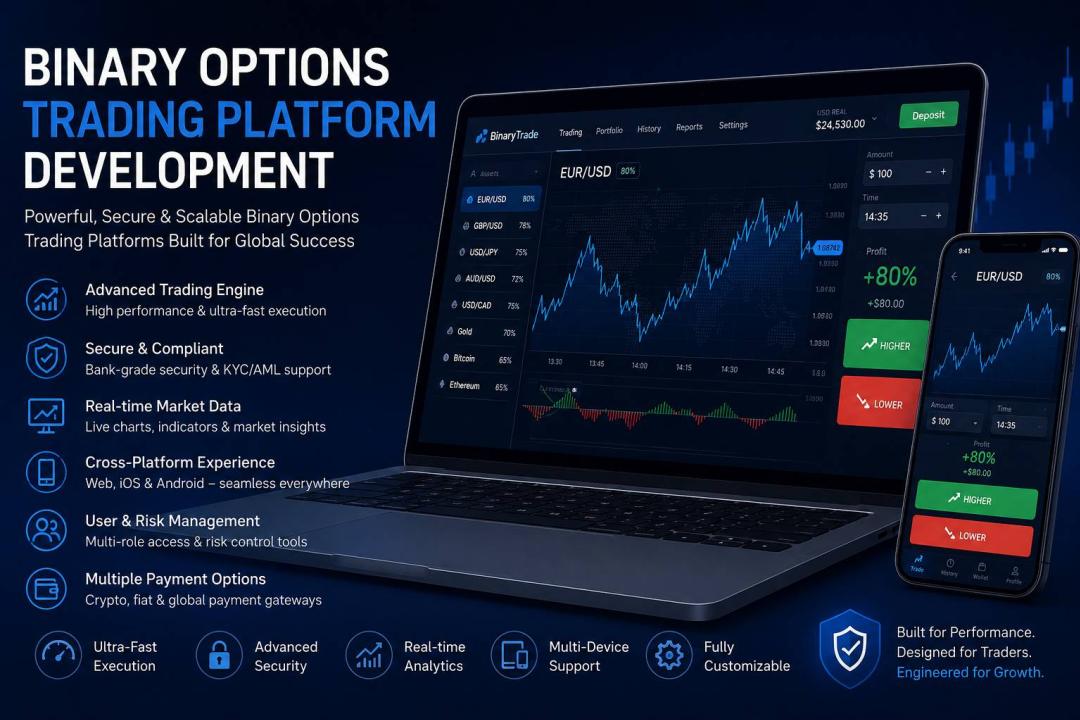
The online trading industry continues to evolve as businesses explore new ways to provide users with fast, accessible, and feature-rich trading experiences. A binary options trading platform is one such solution that allows users to speculate on whether the price of an underlying asset will rise or fall within a predetermined timeframe.
For businesses planning to enter this market, binary options trading platform development involves much more than creating a trading interface. A successful platform requires a reliable trading engine, real-time market data, secure user accounts, risk management tools, payment infrastructure, and an administration system.
This guide explains the essential features, technology stack, development process, estimated cost, and timeline involved in building a binary options trading platform.
What Is a Binary Options Trading Platform?
A binary options trading platform is a digital trading system where users predict the price movement of an underlying asset over a specified period.
Depending on the platform design and applicable regulations, users may select an asset, choose an expiry period, enter a stake, and predict whether the asset price will move above or below a defined level at expiry.
The platform processes the trade, retrieves relevant market data, determines the outcome according to its rules, and updates the user's account accordingly.
A typical platform may support assets such as:
- Cryptocurrencies
- Forex pairs
- Stocks
- Commodities
- Market indices
Businesses should carefully evaluate the legal and regulatory requirements of their target markets before launching such a platform because binary options are restricted or prohibited in several jurisdictions.
Why Invest in Binary Options Trading Platform Development?
Developing a proprietary platform can give businesses greater control over the user experience, trading functionality, technology infrastructure, and business model.
Key advantages include:
- Custom functionality: Build features around specific business requirements.
- Scalability: Design infrastructure to support increasing users and trading activity.
- Brand control: Create a unique interface and trading experience.
- Third-party integrations: Connect market data providers, payment gateways, KYC systems, and analytics tools.
- Automation: Automate trade processing, notifications, reporting, and administrative workflows.
- Data ownership: Maintain greater control over platform and user data.
- Revenue opportunities: Implement legally compliant fees, subscriptions, or other monetization models.
Essential Features of a Binary Options Trading Platform
Feature selection plays an important role in binary options trading platform development. The platform should provide a simple trading experience while maintaining strong security, reliability, and operational controls.
1. User Registration and KYC
Users should be able to create accounts through a streamlined registration process.
Depending on regulatory requirements, the platform can integrate KYC and identity verification solutions to verify users before they access specific services.
Common capabilities include:
- Email and phone verification
- Identity document verification
- Address verification
- User profile management
- KYC status tracking
2. Trading Dashboard
The trading dashboard serves as the central interface for users.
It can display:
- Available assets
- Current market prices
- Price charts
- Expiry periods
- Trading amounts
- Potential payout information
- Open and completed trades
- Account balance
A responsive interface is important because traders may access the platform through desktops, tablets, or mobile devices.
3. Real-Time Market Data
Accurate and timely market data is essential for platforms that rely on underlying asset prices.
The platform can integrate APIs from reputable market data providers to retrieve price feeds and other relevant information.
The architecture should also handle temporary data interruptions and maintain appropriate audit records.
4. Trading Engine
The trading engine is one of the most important components of the platform.
It manages trading operations according to the platform's predefined rules, including:
- Trade placement
- Stake validation
- Expiry processing
- Price reference handling
- Trade status updates
- Account balance updates
- Transaction records
The engine should be designed for reliability and predictable execution.
5. Risk Management System
A risk management module helps operators monitor exposure and manage platform-level risks.
Possible capabilities include:
- Exposure monitoring
- Trading limits
- Stake limits
- Asset restrictions
- User-level controls
- Automated alerts
- Risk reports
Risk controls should be designed alongside the platform's legal and operational framework.
6. Wallet and Payment Management
A secure payment infrastructure allows users to deposit and withdraw funds where legally permitted.
The platform can integrate:
- Payment gateways
- Bank transfers
- Cards
- Supported digital payment methods
- Cryptocurrency payments, where permitted
The wallet module should maintain accurate balances, transaction histories, deposits, withdrawals, and applicable fees.
7. Trading History
Users should have access to detailed records of their trading activity.
A trading history section can display:
- Asset
- Trade amount
- Entry information
- Expiry information
- Outcome
- Transaction status
- Timestamp
This also helps improve transparency and simplifies account management.
8. Notifications
Automated notifications can keep users informed about important account and trading events.
Notifications may include:
- Trade confirmation
- Trade expiry
- Deposit confirmation
- Withdrawal updates
- KYC status
- Security alerts
- Promotional messages, where permitted
9. Admin Dashboard
The administrator dashboard provides centralized control over platform operations.
Admins can manage:
- Users
- KYC verification
- Assets
- Trading parameters
- Transactions
- Payments
- Reports
- Notifications
- Support requests
- Platform settings
Role-based access controls can help restrict sensitive administrative functions to authorized personnel.
10. Analytics and Reporting
Analytics help operators understand platform performance and user activity.
Reports can cover:
- Trading volume
- Active users
- Deposits and withdrawals
- Revenue
- Asset activity
- User behavior
- Transaction history
These insights can support operational and business decisions.
Advanced Features to Consider
Businesses looking to differentiate their platforms can consider additional functionality such as:
- Advanced charting
- Multi-language support
- Multi-currency support
- Referral and affiliate management
- CRM integration
- Customer support tools
- Automated compliance monitoring
- Fraud detection
- Advanced analytics
- Mobile applications
- API access
The exact feature set should depend on the target market, business model, regulatory framework, and user requirements.
Technology Stack for Binary Options Trading Platform Development
Choosing the right technology stack is critical for building a secure and scalable platform.
A typical technology architecture may include:
| Layer | Technologies |
|---|---|
| Frontend | React.js, Next.js, Vue.js |
| Mobile | React Native, Flutter |
| Backend | Node.js, Java, Python, Go |
| Database | PostgreSQL, MySQL, MongoDB |
| Cache | Redis |
| APIs | REST, WebSocket |
| Cloud | AWS, Google Cloud, Microsoft Azure |
| Containers | Docker, Kubernetes |
| DevOps | GitHub Actions, GitLab CI/CD |
| Security | SSL/TLS, encryption, MFA, WAF |
Real-Time Communication
WebSockets can be used where real-time updates are required, such as market data, trade status, and account information.
Database Architecture
A combination of relational and non-relational databases may be used depending on the application's requirements. PostgreSQL or MySQL can manage structured financial records, while Redis can support caching and low-latency operations.
Cloud Infrastructure
Cloud platforms such as AWS, Azure, and Google Cloud can provide scalable infrastructure, monitoring, backups, security controls, and disaster recovery capabilities.
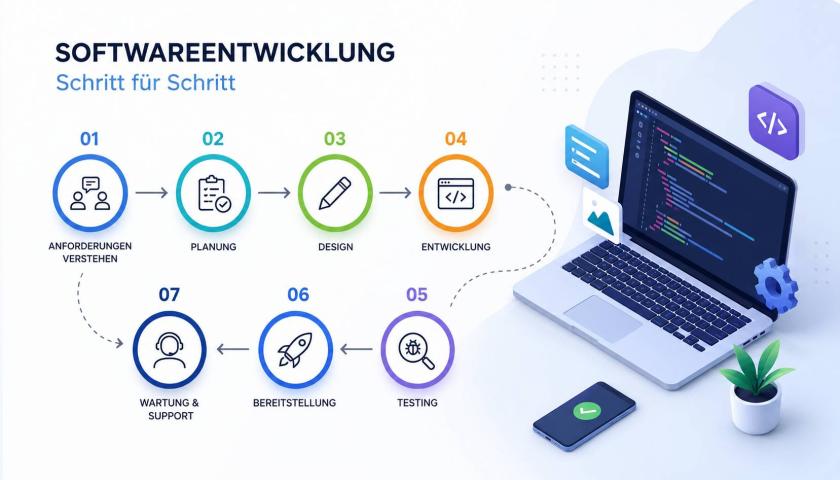
Step-by-Step Binary Options Trading Platform Development Process
The development process generally involves several stages.
Step 1: Business and Regulatory Analysis
Before development begins, define the target market, business model, supported assets, operational rules, and applicable regulations.
This is particularly important because binary options regulations vary significantly between jurisdictions.
Step 2: UI/UX Design
Design the user journey, trading dashboard, charts, account screens, wallet, and administrative interface.
The objective is to make complex trading information easy to understand and navigate.
Step 3: Architecture and Technology Selection
Develop the technical architecture and select the appropriate frontend, backend, database, cloud, API, and security technologies.
Step 4: Core Development
Develop the primary components, including:
- User management
- Trading interface
- Trading engine
- Wallet
- Payment integration
- Market data integration
- Admin dashboard
- Notifications
Step 5: Third-Party Integrations
Integrate required external services such as market data providers, KYC providers, payment gateways, analytics tools, and communication services.
Step 6: Testing
The platform should undergo comprehensive testing before launch.
Testing may include:
- Functional testing
- API testing
- Performance testing
- Security testing
- Compatibility testing
- Regression testing
- User acceptance testing
Step 7: Deployment
After successful testing, the platform can be deployed to the selected cloud infrastructure.
Monitoring, logging, backups, and security controls should be configured before production launch.
Step 8: Maintenance and Optimization
Post-launch maintenance includes bug fixes, security updates, performance optimization, infrastructure scaling, and feature improvements.
How Much Does Binary Options Trading Platform Development Cost?
The cost of binary options trading platform development depends heavily on the platform's complexity, features, integrations, technology stack, and development team.
A rough estimate can be:
| Platform Type | Estimated Cost |
| Basic MVP | $25,000–$50,000 |
| Mid-Level Platform | $50,000–$100,000 |
| Advanced Platform | $100,000–$200,000+ |
These are indicative ranges rather than fixed prices. A platform with multiple asset classes, advanced risk management, mobile apps, extensive integrations, and complex administrative functionality can require a substantially larger investment.
How Long Does It Take to Develop a Binary Options Trading Platform?
Development timelines depend on the scope and complexity of the project.
Typical estimates are:
- Basic MVP: 8–12 weeks
- Mid-level platform: 12–20 weeks
- Advanced platform: 20–32+ weeks
A standard development lifecycle includes planning, UI/UX design, development, integrations, testing, deployment, and post-launch optimization.
Using pre-built components or a white-label solution can potentially reduce the time required to launch, although businesses should carefully assess customization options, security, compliance, and vendor dependencies.
How to Choose a Binary Options Trading Platform Development Company
Selecting the right development partner can significantly influence the platform's security, scalability, and long-term performance.
Before choosing a development company, evaluate:
- Relevant fintech development experience
- Understanding of trading systems
- Technical expertise
- Security practices
- API integration capabilities
- Cloud and DevOps expertise
- QA and testing processes
- Post-launch support
- Development methodology
- Portfolio and case studies
A reliable development partner should also be able to explain the architecture, development roadmap, estimated costs, and technical limitations clearly.
Conclusion
Binary options trading platform development requires a combination of trading technology, secure financial infrastructure, real-time data processing, risk management, and regulatory awareness.
From the trading engine and market data integration to payment processing, KYC, security, and administration, every component needs to be designed around reliability and the requirements of the target market.
Businesses should start by defining their market, regulatory obligations, business model, and required features before selecting a technology stack and development approach.
If you're planning to build a customized binary options trading platform, working with an experienced binary options trading platform development company like Softean can help you design the architecture, integrate the required technologies, and develop a scalable platform aligned with your business objectives.