Market Outlook
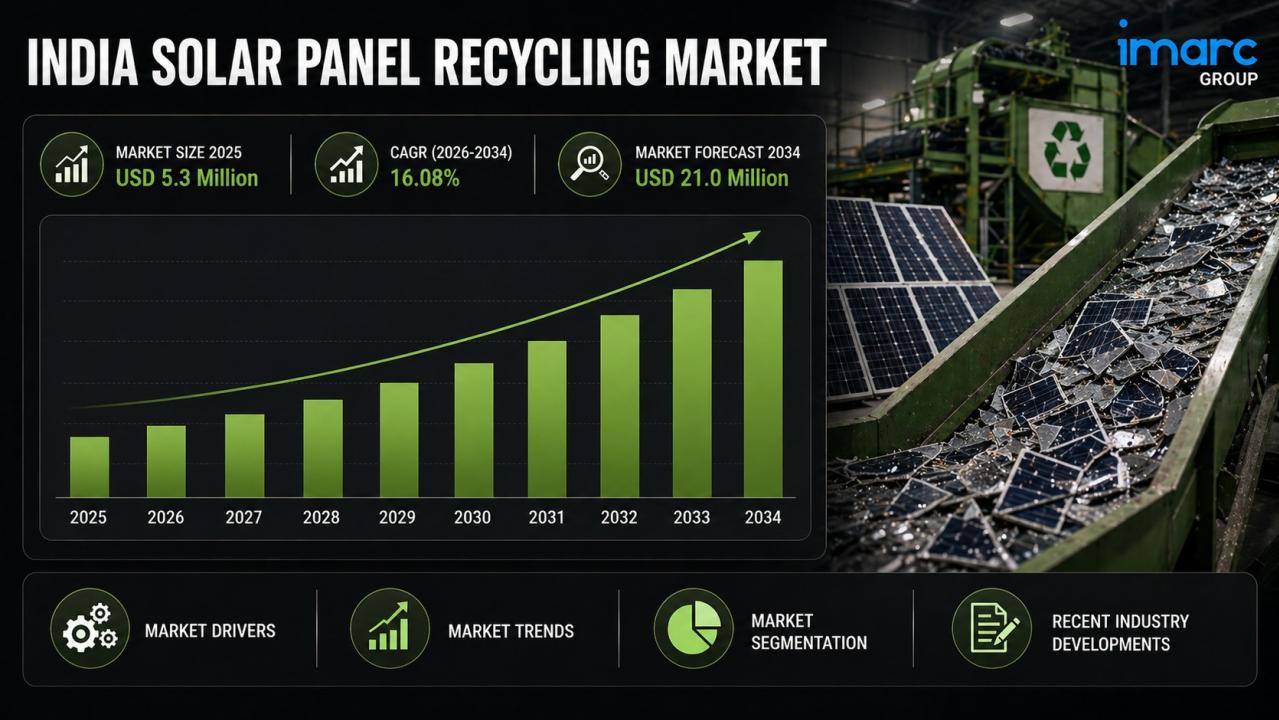
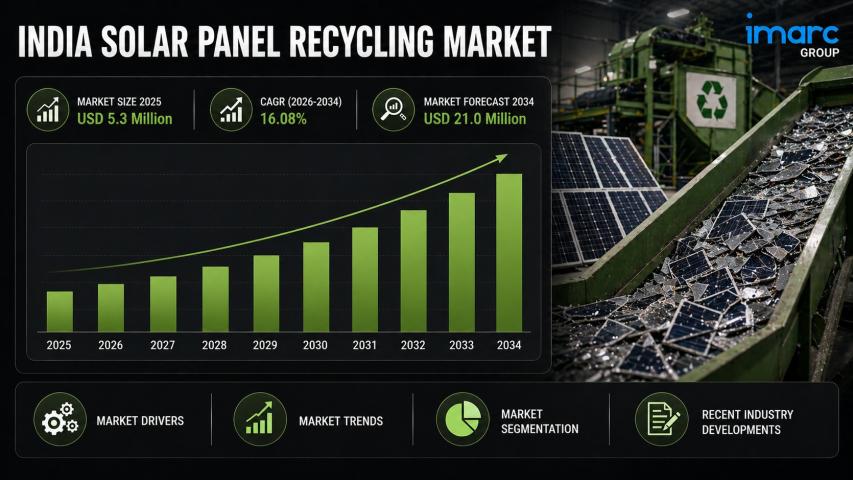
The India
solar panel recycling industry size reached USD 5.3 Million in
2025 and is projected to reach USD 21.0 Million by 2034,
exhibiting a robust compound annual growth rate (CAGR) of 16.08% from
2026-2034. The market is currently at a highly nascent but incredibly critical
inflection point, fundamentally driven by India’s aggressive national pivot
toward renewable energy. With the country having added a monumental 24.5 GW of
solar capacity in 2024 alone and total renewable capacity crossing 209 GW, the
impending wave of decommissioned solar panels presents a massive waste
management challenge and a highly lucrative resource recovery opportunity.
Furthermore, the sector is experiencing a structural
formalization propelled by stringent government policies. The inclusion of
solar photovoltaic (PV) modules under national e-waste management rules and the
active promotion of Extended Producer Responsibility (EPR) mandates are forcing
solar asset developers to prioritize end-of-life disposal. As the earliest
installed grid-scale solar parks approach their 25-30 year operational
lifespans, the urgent necessity to recover critical minerals—such as silver, silicon,
and copper—is driving immense venture capital and corporate investment into
building advanced, closed-loop recycling infrastructure across the
subcontinent.
Market Snapshot:
- Market
Size (Current Year): USD 5.3 Million (2025)
- Forecast
Market Size (Forecast Year): USD 21.0 Million (2034)
- CAGR: 16.08%
(2026-2034)
- Leading
Segment by Type: Crystalline Silicon
- Leading
Segment by Material: Glass
- Leading
Region: South India and West India
What are the Growth Factors of India Solar Panel
Recycling Market?
- Explosive Growth in Solar Installations and Imminent Waste Surge: The absolute primary driver is the sheer volume of solar panels being installed nationwide. Driven by massive utility-scale solar parks and the nationwide rooftop solar push under schemes like PM Surya Ghar, India is projected to generate over 600,000 tonnes of solar waste by 2030, surging to over 11 million tonnes by 2047. This massive influx of end-of-life and defective modules guarantees a highly sustained, exponential baseload of feedstock for recycling plants.
- Recovery
of High-Value Critical Minerals: Solar panels contain highly
valuable and critical materials, particularly silver, copper, and
high-purity silicon. As global supply chain constraints and geopolitical
tensions inflate the costs of mining virgin raw materials, extracting
these critical minerals from discarded panels is becoming economically
viable. Establishing a domestic secondary supply of these metals is
strategically vital for India’s energy and mineral security.
- Stringent
Government Mandates and EPR Frameworks: The market is being
heavily catalyzed by regulatory interventions. The Ministry of
Environment, Forest and Climate Change (MoEFCC) has formally brought solar
PV cells and modules under the purview of E-Waste (Management) Rules. This
enforces Extended Producer Responsibility (EPR), legally compelling
manufacturers and large-scale project developers to finance and facilitate
the systematic collection and eco-friendly recycling of decommissioned
panels.
- Development
of a Circular Economy in Domestic Manufacturing: As India
aggressively scales its domestic solar manufacturing ecosystem via
Production Linked Incentive (PLI) schemes, there is a strategic
industry-wide push to establish closed-loop supply chains. By directly
feeding recycled glass, aluminum frames, and purified silicon back into
the domestic manufacturing loop, OEMs can significantly lower production
costs and reduce their carbon footprint.
Grab a sample copy of this report: https://www.imarcgroup.com/india-solar-panel-recycling-market/requestsample
What Are the Key Trends Shaping the Market?
- Transition
to Advanced Thermal and Laser Recycling Technologies: The market
is rapidly shifting away from basic mechanical shredding (which degrades
material purity) toward highly advanced thermal, chemical, and laser
delamination processes. These next-generation technologies allow for the
clean separation of the EVA (ethylene vinyl acetate) polymer layer without
contaminating the highly valuable silver and silicon cells, drastically
improving the commercial yield of the recycling process.
- Strategic
Partnerships Between Recyclers and Solar Park Operators: To
secure a consistent supply of end-of-life panels, specialized recycling
startups are forging exclusive, long-term offtake agreements directly with
massive Independent Power Producers (IPPs) and utility-scale solar park
operators. These B2B partnerships ensure that large volumes of early-loss
panels (damaged during transit or extreme weather events) bypass the
informal sector entirely.
- Integration
of AI and Robotics in Dismantling Facilities: Given the hazardous
nature of handling broken glass and toxic trace elements (like lead and
cadmium), modern recycling plants are beginning to pilot robotics and
AI-driven optical sorting systems. These automated lines efficiently
dismantle the aluminum frames, safely extract the junction boxes, and sort
the broken glass by color and purity, significantly enhancing operational
safety and throughput.
What Are the Major Market Challenges?
- Prohibitive
Logistics and Reverse Supply Chain Costs: Solar panels are
exceptionally bulky, heavy, and fragile. Transporting decommissioned
panels from remote, grid-scale solar parks in deserts (like Bhadla in
Rajasthan) to centralized recycling facilities incurs massive reverse
logistics costs. In many instances, the cost of transportation heavily
outweighs the intrinsic value of the recovered materials, severely
compressing profit margins for recyclers.
- Dominance
of the Informal Waste Sector: A massive structural hurdle is the
deeply entrenched informal e-waste sector. Unregulated scrap dealers
frequently acquire discarded panels, stripping away only the easily
accessible aluminum frames and copper cables while dangerously dumping the
toxic silicon wafers and heavy-metal-laced glass into local landfills.
This unregulated diversion starves formal, compliant recycling plants of
critical feedstock volumes.
- High
Upfront Capital Expenditure for Deep Recycling: While basic
mechanical separation of aluminum and glass requires moderate investment,
"deep recycling" (the chemical and thermal extraction of silver
and purified silicon) is extraordinarily capital-intensive. Securing the
necessary funding to build out these high-tech facilities remains
challenging due to the currently low volumes of end-of-life panels,
creating a complex "chicken-and-egg" scenario for investors.
Explore the Full Report with Charts, Table of Contents,
and List of Figures: https://www.imarcgroup.com/india-solar-panel-recycling-market
How Is the Market Segmented?
- By
Process: The market is categorized into Thermal, Mechanical,
Laser, and Others. Mechanical processing currently commands the highest
volume due to its lower setup costs and efficiency in recovering bulk
materials (glass and aluminum frames). However, Thermal and Laser
processes are expected to exhibit the fastest growth as the industry
prioritizes high-purity mineral extraction.
- By
Type: Segmented into Crystalline Silicon, Thin Film, and Others.
Crystalline Silicon panels absolutely dominate the market, mirroring their
overwhelming 90%+ share of historical solar installations across India.
The recycling infrastructure is heavily tailored to process this specific
module architecture.
- By
Material: Divided into Metal, Glass, Aluminum, Silicon, and
Others. By sheer weight, Glass constitutes approximately 70-80% of a solar
panel and dominates the recycling volume. However, by economic value, the
recovery of Silver (categorized under metals) and Silicon commands the
absolute highest revenue share for recyclers.
- By
Shelf Life: Categorized into Normal Loss (panels reaching their
25-year lifecycle) and Early Loss (panels damaged during installation,
extreme weather, or manufacturing defects). Currently, Early Loss accounts
for a significant portion of the feedstock, but Normal Loss will trigger a
massive market explosion by the early 2030s.
- By
Region: South India and West India heavily dominate the market.
This dominance is intrinsically tied to the massive concentration of
utility-scale solar parks and rooftop installations across states like
Gujarat, Rajasthan, Karnataka, and Tamil Nadu, making these regions the
prime geographic hotspots for setting up high-capacity recycling
facilities.
Competitive Landscape:
The India solar panel recycling market features a highly
nascent, agile, and rapidly evolving competitive ecosystem. It is primarily
driven by specialized e-waste management startups and forward-thinking
sustainability ventures that are actively piloting advanced extraction
technologies. Market leaders are heavily focused on securing government grants,
scaling their deep-recycling capacities, and forging strategic compliance
partnerships with massive solar OEMs to manage their EPR obligations.
Recent News or Developments:
- CPCB
Enforces Strict Solar Waste Handling and Storage Guidelines (March 2026):
In a critical regulatory move to prevent toxic heavy metal
leaching, the Central Pollution Control Board (CPCB) released detailed, legally
binding guidelines in March 2026 governing the storage, handling, and
transportation of discarded solar PV modules. The new mandate strictly
prohibits open dumping and enforces the use of covered transport vehicles,
impervious facility flooring, and strict stacking limits (a maximum of 20
layers or 2 meters high) to prevent toxic glass breakage. Furthermore, it
mandates that producers must hand over end-of-life panels exclusively to
registered e-waste recyclers.
- Attero
Recycling Recognized for Circular Economy Leadership (May 2026):
Highlighting the rapid maturation of the domestic recycling
sector, Attero Recycling Pvt. Ltd. was officially awarded the
"Circular Economy Icon in Solar Panel Recycling" at the Uttar Pradesh
Energy Expo in May 2026. This recognition underscores the company's aggressive
capacity expansion and its proprietary chemical extraction technologies aimed
at establishing closed-loop recovery systems for critical solar minerals in
India.
- Strategic
Indo-German Technology Licensing (December 2025):
To rapidly bridge the domestic technology gap, Indian
recycling firms are aggressively securing advanced European extraction
capabilities. In December 2025, Malaviya Solar Energy successfully secured
an exclusive license for state-of-the-art German solar panel recycling
technology from LuxChemtech. This strategic partnership is designed to
deploy high-yield, zero-emission material recovery processes in India, pushing
the market beyond basic mechanical shredding.
- Industry
Prepares for Impending Binding EPR Targets (Mid-2026):
While the E-Waste (Management) Rules, 2022, successfully
classified solar panels as e-waste, industry dynamics throughout mid-2026 are
being heavily shaped by the anticipation of full, solar-specific Extended
Producer Responsibility (EPR) mandates. Market stakeholders and
large-scale solar park operators are aggressively preparing for binding
recycling targets expected to be codified by 2027–2028, a move that will
fundamentally guarantee a massive, compliant feedstock pipeline for dedicated
PV recycling plants.
Customization Note: If you require any specific
information not covered within this report's scope, we will provide it as part
of the customization.
Request Report Customization: https://www.imarcgroup.com/request?type=report&id=29664&flag=E