Market Outlook
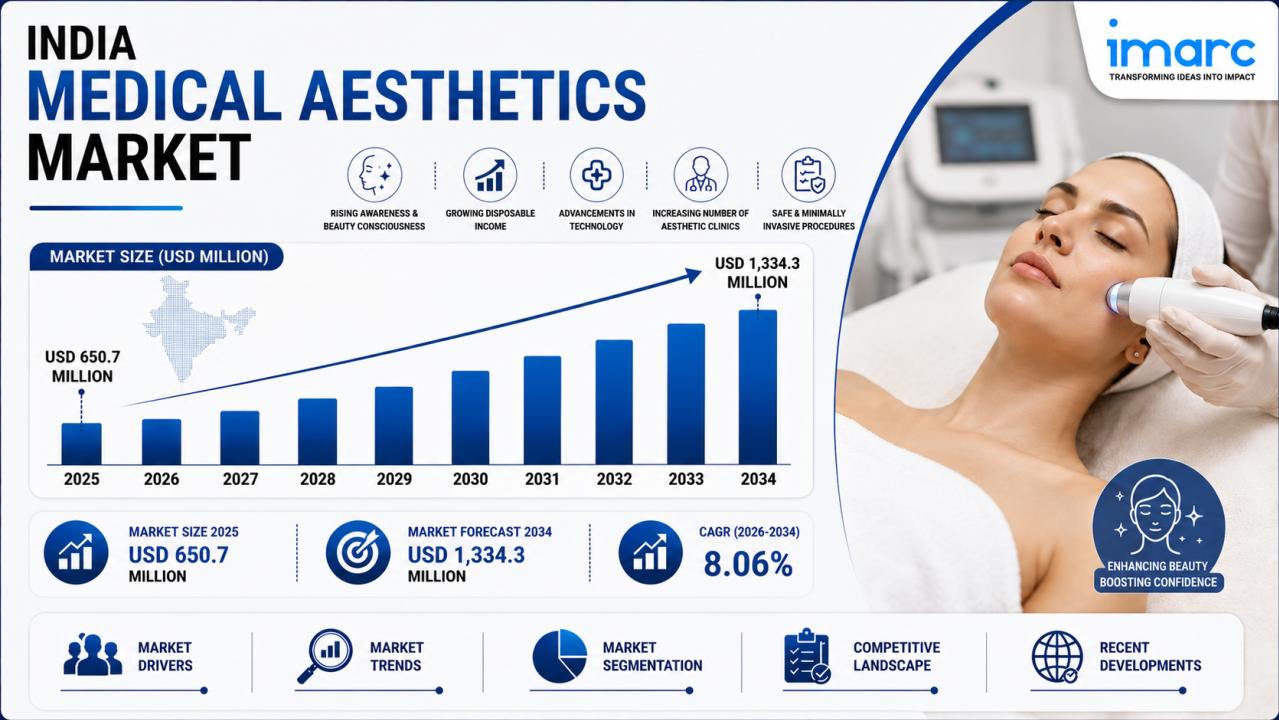
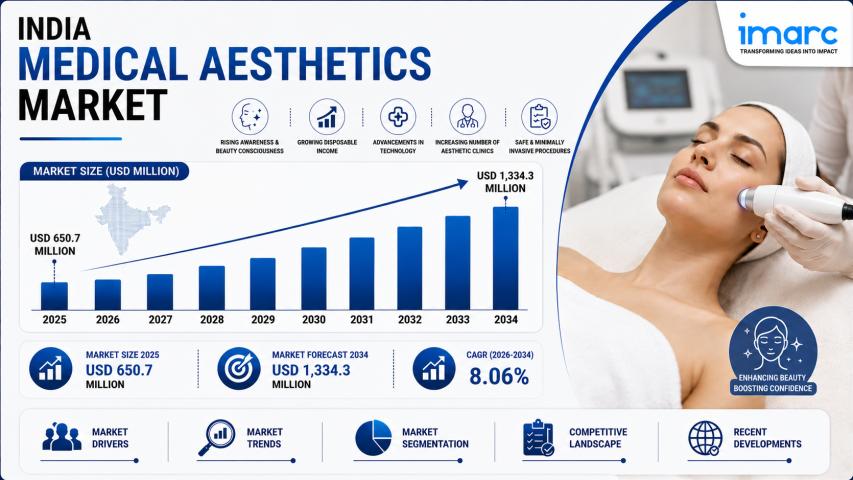
The India medical
aesthetics market size reached USD 650.7 Million in
2025. Looking forward, the market is projected to reach USD 1,334.3
Million by 2034, exhibiting a compound annual growth rate (CAGR)
of 8.06% during the forecast period from 2026 to 2034.
The Indian medical aesthetics ecosystem is undergoing a
massive structural and cultural transition. Once considered a highly
stigmatized, luxury indulgence reserved for celebrities and the ultra-wealthy,
aesthetic treatments have rapidly democratized. This explosive normalization is
fundamentally driven by the rise of a vast, affluent "neo-middle
class" comprising over 250 million individuals. As urbanization, global
exposure, and social media heavily influence beauty standards, the market has
pivoted aggressively from invasive surgical procedures toward highly
accessible, non-invasive, and zero-downtime treatments.
Furthermore, India is aggressively positioning itself as a
global epicenter for medical value travel. Supported by a world-class network
of highly skilled, board-certified dermatologists and plastic surgeons offering
FDA-approved procedures at a fraction of Western costs, the market is capturing
immense inbound demand. Supported by the rapid corporatization of specialized
clinic chains expanding into tier-2 cities, the Indian medical aesthetics
market stands as a highly lucrative, fast-growing pillar of the country's
broader healthcare and wellness economy.
Market Snapshot
- Market
Size in 2025: USD 650.7 Million
- Forecast
Market Size by 2034: USD 1,334.3 Million
- CAGR
(2026-2034): 8.06%
- Leading
Segment by Product: Facial Aesthetics (Injectables & Fillers)
- Leading
Segment by End User: Clinics and Medical Spas
- Leading
Region: West and South India
What are the Growth Factors of the India Medical
Aesthetics Market?
- The
Demographic Shift to "Prejuvenation":
Historically, patients sought aesthetic intervention in
their late 40s to reverse severe signs of aging. Today, there is a massive
demographic shift driven by Millennials and Gen Z who prioritize
"prejuvenation" preventative care designed to delay aging altogether.
This younger cohort is aggressively driving high-volume, recurring demand for
early-stage interventions, such as low-dose botulinum toxin (baby Botox),
preventative skin boosters, and collagen-stimulating laser therapies,
fundamentally expanding the total addressable consumer base.
- Explosive
Boom in Medical Value Travel (MVT):
India's structural cost advantage is pulling patients from
the Middle East, Africa, Southeast Asia, and even Western nations. High-margin,
elective procedures particularly hair transplantation, body contouring, and
advanced laser resurfacing are executed by internationally certified Indian
surgeons at highly competitive rates. With international patient footfall
crossing 7.3 million in recent years, specialized clinics are heavily
engineering their service architectures to cater to this highly lucrative medical
tourism influx.
- Rapid
Commercialization of Tier-2 and Tier-3 Corridors:
The growth of medical aesthetics is no longer confined to
metropolitan hubs like Mumbai or South Delhi. Corporate, surgeon-led aesthetic
chains are aggressively penetrating tier-2 and tier-3 cities (such as
Chandigarh, Kochi, and Indore). Rising purchasing power, combined with the
aspirations of the neo-middle class in these regions, is unlocking massive
virgin markets for accessible treatments like laser hair reduction and chemical
peels.
Grab a sample copy of this report: https://www.imarcgroup.com/india-medical-aesthetics-market/requestsample
What Are the Key Trends Shaping the Market?
- Hyper-Personalization
via AI and Facial Mapping:
Clinics are aggressively moving away from standardized
treatment protocols. Advanced practitioners are now deploying Artificial
Intelligence (AI) and machine learning software to execute hyper-precise facial
mapping and predictive aging analysis. These smart diagnostics allow
dermatologists to design deeply customized, data-driven treatment architectures
that optimize aesthetic outcomes while eliminating trial-and-error
methodologies.
- The
Rise of "Micro-Tweakments" and Authentic Results:
Indian consumers are violently rejecting the exaggerated,
"over-filled" aesthetic prevalent in Western markets. The absolute
dominant trend is "micro-tweakments" subtle, incremental procedures
utilizing bio-stimulators (like polynucleotides) and micro-dosed fillers. The
goal is to achieve an understated, refreshed, and authentic appearance that
leaves no obvious trace of clinical intervention, prioritizing natural facial
dynamics over dramatic transformations.
- Convergence
of Regenerative Aesthetics and Holistic Wellness:
The rigid boundary between surface-level aesthetics and
internal wellness has completely collapsed. Elite medical spas are seamlessly
integrating regenerative medicine such as exosomes and PRP (Platelet-Rich
Plasma) with therapies addressing stress, nutritional deficits, and hormonal
imbalances. This whole-body, holistic approach ensures that clinical beauty
solutions are simultaneously operating as long-term cellular wellness
protocols.
What Are the Major Market Challenges?
- Proliferation
of the Unregulated "Grey Market":
The explosive demand for aesthetic procedures has
inadvertently spawned a massive, heavily unregulated grey market. Unauthorized
beauty salons and under-qualified practitioners frequently administer
counterfeit injectables and operate powerful energy-based devices without
medical supervision. This structural flaw leads to botched procedures, severe
patient safety risks, and significant brand damage to the broader, compliant
medical aesthetics industry.
- Prohibitive
CapEx and Import Duties for Advanced Devices:
The Indian market relies heavily on importing cutting-edge,
FDA-approved laser and energy-based systems from the US, Europe, and South
Korea. Exorbitant import tariffs and fluctuating currency exchange rates
severely inflate the upfront Capital Expenditure (CapEx) required to set up a
high-end clinic, aggressively compressing operating margins and delaying the
ROI for standalone practitioners.
Explore the Full Report with Charts, Table of Contents,
and List of Figures: https://www.imarcgroup.com/india-medical-aesthetics-market
How Is the Market Segmented?
- By
Product/Device Type: The market is segmented into Facial
Aesthetics, Laser Hair Removal Devices, Laser Resurfacing Devices, Body
Contouring Devices, Breast Implants, and Others. Facial Aesthetics
(comprising botulinum toxin and hyaluronic acid dermal fillers) dominates
the market. This segment's sheer volume is driven by the fact that
injectables act as high-frequency, recurring revenue streams with
exceptional clinical efficacy and zero downtime.
- By
Application: Categorized into Anti-Aging and Wrinkle Reduction,
Skin Rejuvenation, Body Shaping and Cellulite Reduction, Hair
Transplantation, and Tattoo Removal. Anti-aging and skin rejuvenation
capture the majority share, though Hair Transplantation operates as one of
the most aggressively expanding, high-margin sub-segments within the
Indian market.
- By
End User: Divided into Clinics and Medical Spas, Beauty Centers,
and Hospitals. Clinics and Medical Spas hold absolute dominance, projected
to command approximately 70% of the market. Consumers heavily prefer these
specialized environments for their outpatient agility, absolute
discretion, highly curated luxury experiences, and direct access to
specialized aesthetic dermatologists.
- By
Region: Geographically mapped across North India, South India,
West and Central India, and East India. West and South India collectively
lead the national demand, deeply anchored by the high-income IT tech hubs
of Bengaluru and Hyderabad, alongside the massive Bollywood and
fashion-driven aesthetic consumption capital of Mumbai.
Competitive Landscape:
The India medical aesthetics market features an intensely
competitive, rapidly formalizing ecosystem. The landscape is a dynamic clash
between massive global Original Equipment Manufacturers (OEMs) dominating the
supply of injectables and advanced lasers, and fiercely expanding domestic
corporate clinic chains standardizing the patient experience. Market leaders
continuously focus on aggressively scaling franchise models, securing
FDA-approved device portfolios, and building surgeon-led networks to foster absolute
clinical trust.
Recent News or Developments:
- Surge in AI-Driven Laser Modalities (Early 2026): To capitalize on the demand for hyper-precise skin treatments, global OEMs like Alma and Cynosure aggressively pushed their next-generation multi-modality platforms into the Indian market throughout early 2026. These updated systems integrate AI-assisted pulse control specifically calibrated for diverse Indian skin tones (Fitzpatrick types IV and V), ensuring safer pigmentation correction and minimized downtime.
- Aggressive Expansion of Surgeon-Led Clinic Networks (Mid-2026): Recognizing the massive gap for standardized, trustworthy care in tier-2 cities, several premium, surgeon-led clinical networks (such as the Mister Hair and Miss Skin Clinic models) announced aggressive five-year expansion blueprints in mid-2026. These networks are leveraging significant private equity backing to scale footprints to over 100 specialized clinics, fundamentally consolidating the highly fragmented regional markets.
- Kosmoderma
Introduces Advanced LPG Body Contouring (Late 2024): Setting a
benchmark in non-invasive body shaping, Kosmoderma Clinic successfully
launched the cutting-edge LPG Endermologie Cellu M6 Alliance at its
Bengaluru facility. This advanced technology directly targets resistant
fat, cellulite, and skin sagging by mechanically stimulating natural
collagen production, addressing the surging demand for zero-downtime body
sculpting among corporate professionals.
Customization Note: If you require any specific
information not covered within this report's scope, we will provide it as part
of the customization.
Request Report Customization: https://www.imarcgroup.com/request?type=report&id=21806&flag=E
Frequently Asked Questions (FAQs):
Conclusion
The India medical aesthetics market is structurally
engineered for exceptionally robust and accelerated expansion through 2034.
Fundamentally propelled by a rapidly expanding neo-middle class and a paradigm
shift that views aesthetic maintenance as a core component of personal
wellness, the historical reliance on invasive cosmetic surgery has transitioned
entirely toward highly sophisticated, non-invasive technologies.
Furthermore, the stringent focus by major clinical chains on integrating AI-driven personalization, holistic regenerative therapies, and absolute clinical safety perfectly addresses the nuanced demands of the modern Indian consumer. Supported by India's unyielding rise as a global medical value travel powerhouse and the continuous democratization of advanced laser technologies across regional corridors, the medical aesthetics sector unequivocally stands as one of the most dynamic, high-margin, and rapidly corporatizing pillars of India's contemporary healthcare economy.