Management education is taking a different shape in 2026. An MBA includes more than accounting, marketing, finance, or human resources concepts taught through textbooks. Business decisions are increasingly connected with data, artificial intelligence, digital platforms, customer behaviour, automation, and changing workplace expectations. This makes the structure and practical exposure offered by a management programme important factors in postgraduate education.
The value mba courses in madurai colleges, the main focus should be on what the programme teaches, how learning takes place, and whether the academic experience connects with actual business situations. A useful MBA programme should build business knowledge while also developing communication, analysis, teamwork, and decision-making abilities.
What an MBA Covers in 2026
An MBA generally introduces students to the major areas involved in running an organisation. Finance explains how businesses manage money and evaluate financial performance. Marketing covers customer needs, branding, sales, market research, and digital channels. Human resource management deals with recruitment, employee development, workplace relations, and organisational behaviour. Operations focuses on production, services, supply chains, quality, and efficiency.
In 2026, these subjects are increasingly connected with technology. Managers are expected to understand how data supports business decisions and how digital tools affect daily operations. AI literacy is also becoming relevant across management roles, with business schools placing greater attention on AI applications and technology-enabled decision-making.
This does not mean every management graduate needs to become a programmer. Instead, business education can help students understand where technology fits into areas such as customer analysis, financial planning, recruitment, marketing campaigns, and operational management.
The Practical Side of a Modern MBA
Classroom knowledge becomes more useful when it is connected with practical situations. Case studies, business discussions, industrial visits, presentations, team assignments, simulations, internships, and entrepreneurship activities can give students a clearer view of how organisations operate.
A business case, for example, may involve a company facing declining sales. Students can examine customer data, identify possible reasons, discuss marketing responses, estimate financial effects, and present a suitable plan. Such exercises develop structured thinking without relying only on examination-based learning.
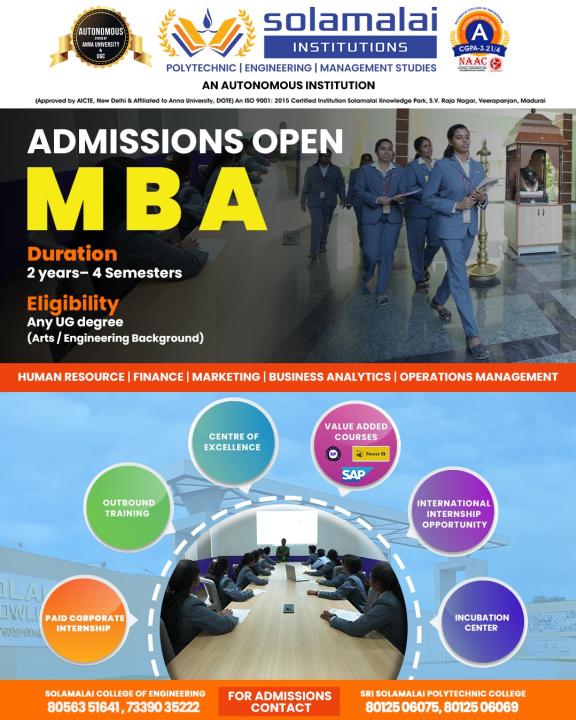
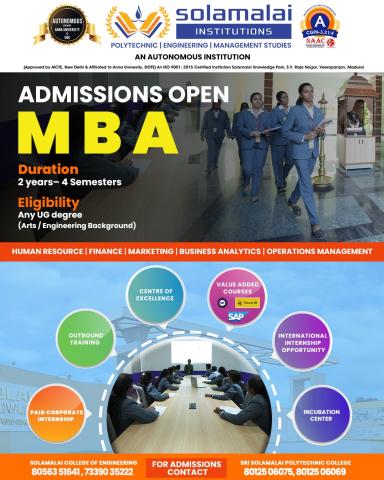
The management programme at Solamalai College of Engineering includes experiential learning, outbound training, startup mentoring, industrial visits, and CEO talks as part of its management education approach. The programme also includes industry-linked and corporate-oriented learning components.
Technology and Business Skills
The business workplace in 2026 requires a combination of management knowledge and digital awareness. Reports on management education this year point towards stronger integration of AI, analytics, digital transformation, and practical business skills within MBA programmes.
For an MBA student, this can mean learning how to interpret dashboards, work with business data, understand automated processes, and assess information before making a decision. Communication remains equally important. A well-prepared manager must explain an idea clearly to a team, present findings to senior staff, negotiate with clients, and handle workplace discussions.
The value of these skills becomes clearer when academic projects involve real business situations. Instead of treating technology as a separate topic, management education can connect it with marketing, finance, HR, operations, and strategy.
Career Areas After an MBA
An MBA can support careers across several sectors. Common areas include banking, financial services, information technology, manufacturing, FMCG, consulting, sales, marketing, human resources, and operations.
The role itself can vary according to academic interests and acquired skills. Some graduates may enter sales or marketing positions, while others may move towards finance, HR, business analysis, operations, or management roles. Experience, communication ability, technical familiarity, internships, and performance in interviews can all influence career development.
What to Check Before Joining a Programme
Several practical points deserve attention before admission:
- Eligibility: Check the academic qualification and university requirements.
- Curriculum: Review whether subjects reflect current business practices.
- Learning method: Find out whether the programme includes projects, case studies, internships, and industry interaction.
- Faculty: Experienced teaching staff can add practical context to management concepts.
- Technology exposure: Basic understanding of analytics, AI, digital business, and business software can be useful in 2026.
- Career support: Training for interviews, communication, aptitude, and workplace skills can help during the transition from college to employment.
- Entrepreneurship: Startup mentoring and business planning activities can be valuable for students interested in building their own ventures.
A Practical View of Management Education
An MBA should not be treated simply as another postgraduate qualification. Its usefulness depends on how well academic knowledge is connected with business situations. A strong programme can provide opportunities to understand how companies operate, how managers handle problems, how teams work, and how information supports decisions.
The 2026 business environment also places greater importance on adaptability. AI and automation are changing routine work, while employers increasingly value graduates who can combine technology awareness with communication, analytical thinking, and sound judgement.
For students evaluating mba courses in madurai colleges, these elements provide a practical basis for understanding the value of a programme. The right academic environment should offer more than syllabus coverage. It should create room for discussion, projects, industry exposure, business problem-solving, and development of skills that remain useful across different roles.
Management education in 2026 is therefore closely connected with both business fundamentals and modern workplace requirements. A balanced MBA programme can help graduates understand finance, marketing, people, operations, and strategy while developing the digital awareness and professional skills expected in a technology-driven business environment.