
Businesses use conventional systems to perform time-consuming operations and process large volumes of data, reducing efficiency. However, organizations also deal with large volumes of digital documents. These may be images, scanned documents, invoices, or even paper-based documents.
To use this data effectively, organizations often turn to OCR services that convert images of text into a digital format. On the other hand, OCR accuracy is the degree to which an OCR system can interpret data from a given document.
High OCR accuracy improves data entry accuracy and reduces search and data management time. The reverse is true when OCR accuracy is low. This article focuses on the impact of OCR accuracy on modern data processing systems.
Understanding OCR Accuracy in Modern Data Processing Models
Optical Character Recognition (OCR) is an emerging technology that identifies text in an image and converts it into digital data. In modern data processing models, OCR accuracy is of paramount importance to an OCR workflow. Without high OCR accuracy, organizations will struggle to extract data from digitized documents.
OCR accuracy refers to how well a system extracts data from a scan. Improving the data processing pipeline, whether for its indexing or analysis, may require slow and sometimes marginal gains in OCR accuracy.
In large-scale automated document recognition systems, OCR accuracy is critical to an organization's success. Even a minor decrease in this metric can lead to many incorrect character recognitions.
For instance, an incorrect digit in an invoice or financial record can affect auditing and reporting processes. Therefore, organizations place great significance on accuracy and continually strive to optimize their processes to achieve better outcomes.
Why Is OCR Accuracy Necessary In Document Digitization?
Organizations are using document digitization to reduce storage costs and improve document accessibility. Although document digitization is necessary, it is not enough to provide accurate data. If errors are introduced during the recognition stage, data correction is necessary. High OCR accuracy in document digitization is essential because it offers many advantages.
Accurate recognition makes document searching easier. With high recognition accuracy, you can use keywords. It also reduces OCR data entry work. Employees will not need to correct each recognized mistake. Accurate document recognition supports business intelligence. From there, a business can learn from digitized documents. OCR accuracy is vital to overall document digitization.
Important Elements Of OCR Accuracy
Many factors impact the overall accuracy of OCR systems and workflows. Understanding these factors is paramount to making document digitization more effective.
Font Style and Layout
Fonts and document layout are necessary for document digitization because they affect OCR accuracy. Well-structured documents are easier to recognize.
Document Quality
Image quality is essential in document digitization, as it affects OCR accuracy. If images are not clear, it is hard to recognize documents.
Language and Character Sets
These OCR systems also need to be trained to read a particular language and character set. If a document is in multiple languages or contains special symbols, this process may also require special configuration.
The Importance of Document Structure for Information Extraction
A well-defined document structure improves both the speed and accuracy of information extraction. This is even more critical for OCR systems because each field in a structurally delineated document has a particular format that the system must identify and extract.
Background Noise
Marks or stains on a document can sometimes interfere with the OCR process. Many image preprocessing techniques eliminate this noise before the OCR process starts.
If these factors are managed effectively, OCR accuracy can increase significantly.
The Vital Role Of AI-Powered OCR Data Processing
Conventionally, OCR systems relied on pattern recognition and character template recognition to read text. With modern artificial intelligence and machine learning, these systems are now AI-powered.
AI-powered OCR systems can read and understand text patterns in documents more accurately. These systems also constantly learn and improve their ability to read text patterns over time. Artificial intelligence also helps in this process. For example, it can identify a number in a date field and understand that it follows a particular format.
These systems are especially useful for reading complex documents, such as medical forms, contracts, and financial documents.
OCR Accuracy For Scanned Documents
One of the most common applications of OCR in business is in scanned documents. Many businesses require paper documents to be scanned into a computer and converted into a format that can be read and written to.
More precise scanning is required for excellent OCR. OCR efficiency can increase by selecting high-quality scanners that provide precise scan alignment. If a document is not aligned, OCR accuracy decreases.
Image preprocessing removes noise, adjusts contrast levels, and finds edges. Aligning images also reduces character-recognition errors.
Some Optimization Methods For Better OCR Performance
Methods that can help minimize errors and improve OCR accuracy include many techniques that can improve the accuracy and reliability of OCR systems.
Image Preprocessing
Preprocessing images usually improves OCR. Edge detection, noise removal, and contrast adjustments are the three main steps in image preprocessing.
Language Recognition
OCR systems must be trained on the language to identify it accurately.
Document Standardization
Using standard documents, such as forms, invoices, or reports, increases speed and reduces OCR costs.
Layout Analysis
Using advanced OCR software is crucial for improving OCR accuracy. OCR software can increase accuracy by analyzing document layout.
These advanced strategies help organizations create a more reliable OCR processing environment.
Integrating OCR Into Automated Data Processing Models
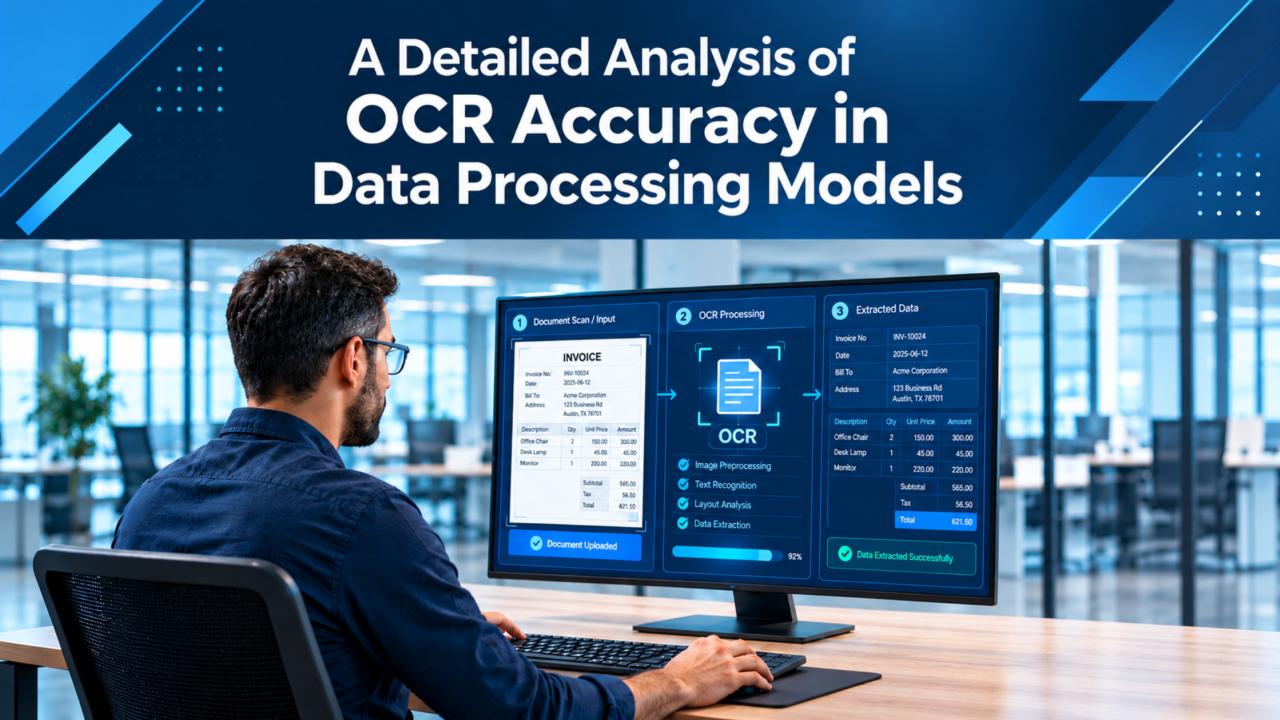
Modern organizations need to integrate OCR into larger automated data processing models. In the OCR data processing workflow, several steps complete the process. First, documents are captured. After capture, the images are preprocessed.
After preprocessing, the OCR engine recognizes the text in the images. After converting the images to text, the system automatically classifies and identifies relevant data fields.
Finally, the system stores the extracted data in databases or enterprise resource planning systems. When OCR is accurate, the process is smooth and requires no human intervention.
The Future Of OCR Accuracy In Data Preprocessing
The future of OCR accuracy looks bright, with the continuous evolution of artificial intelligence. Today, OCR systems can process complex document structures, handwriting, and even multiple languages. The future of OCR systems may involve better context and real-time learning. This function could lead to systems capable of interpreting data like the way the human eye does. For companies looking to increase their data processing, advanced OCR systems remain an essential step.
Increase Efficiency Of Operations With OCR Services For Accurate Data Processing
OCR systems have proven to be an essential tool for companies looking to improve document processing. OCR accuracy must be optimal for these systems to be effective. For businesses looking to improve OCR performance, better document quality, preprocessing, and intelligent optimization strategies can make a big difference.
AI-supported pattern recognition and reliable OCR Scanning services can enhance document processing within a company. Improvements in this area can lead to better business decisions and easier access to business data from company documents.