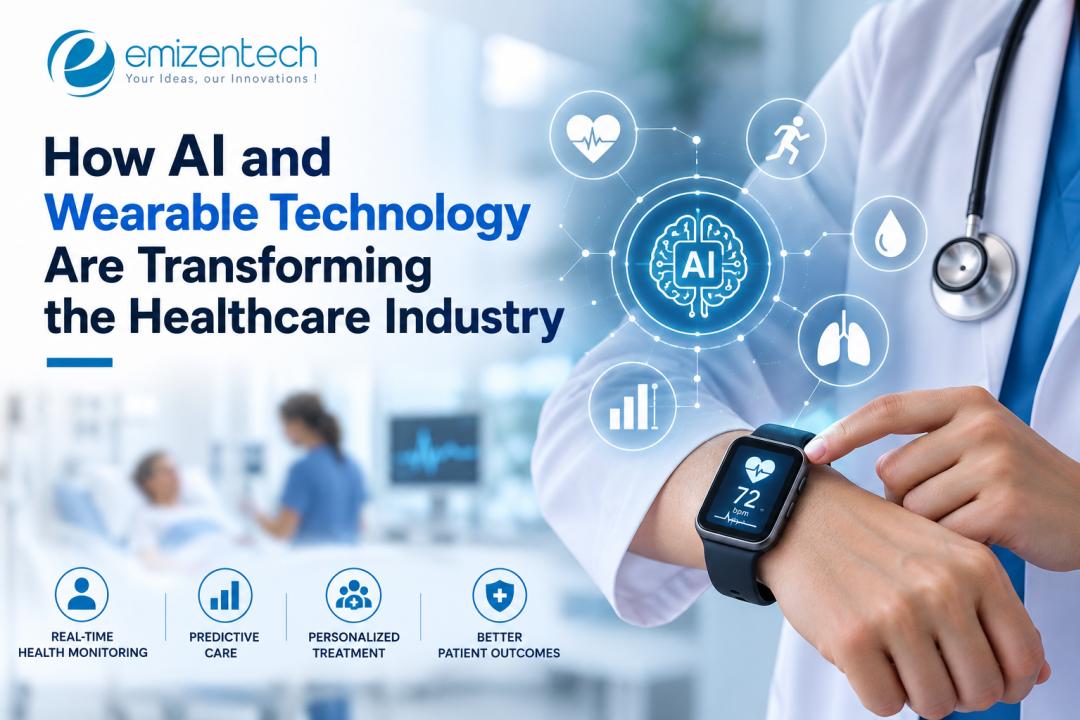
AI and wearable technology are changing how healthcare is delivered, monitored, and managed. Smartwatches, biosensors, fitness trackers, and connected medical devices can collect health data continuously, while artificial intelligence can analyze that information to identify patterns and generate actionable insights.
Together, these technologies are helping healthcare organizations move beyond occasional checkups toward more continuous, personalized, and data-driven care. From remote patient monitoring to early risk detection, their applications are expanding across clinical and consumer healthcare.
What Are AI and Wearable Technologies in Healthcare?
AI and wearable technology serve different functions but become more powerful when used together. Wearable devices collect real-time health information, while AI algorithms can process large volumes of that data and identify meaningful patterns.
Wearable technology includes smartwatches, fitness trackers, continuous glucose monitors, smart patches, ECG devices, and other sensor-based solutions. Depending on the device, they can capture metrics such as heart rate, activity levels, sleep patterns, blood oxygen levels, body temperature, glucose levels, and electrocardiogram data.
AI can then analyze these measurements, detect anomalies, generate personalized insights, and support healthcare professionals in interpreting patient information. This combination creates a connected ecosystem in which health data can be collected continuously rather than only during clinical appointments.
How AI and Wearable Technology Are Transforming Healthcare
AI-powered analytics combined with continuous health monitoring is creating practical opportunities across prevention, diagnosis support, treatment management, and patient engagement.
1. Continuous Patient Health Monitoring
Wearables allow health information to be collected throughout the day rather than only during scheduled medical visits. This provides a more complete view of a person's health patterns.
For example, connected devices can monitor heart rate, physical activity, sleep, blood oxygen, and other metrics. AI can analyze this information over time and identify changes that may require attention. Continuous monitoring can be particularly useful for individuals managing chronic conditions or recovering from treatment.
2. Early Detection of Health Problems
One of the most promising applications of AI is identifying unusual patterns before they become more serious. Algorithms can evaluate large datasets much faster than manual analysis.
If a wearable records repeated changes in a person's heart rate, sleep behavior, glucose levels, or activity patterns, AI models can flag those changes for further assessment. This does not mean the technology independently diagnoses a condition. Instead, it can provide an additional source of information that may support timely clinical evaluation.
3. Remote Patient Monitoring
Remote patient monitoring is becoming increasingly important as healthcare moves beyond traditional hospital and clinic settings. Wearable devices can transmit relevant patient information to healthcare applications and clinical systems.
Patients can remain at home while authorized healthcare professionals monitor selected health metrics remotely. This approach can support chronic disease management, post-surgical monitoring, elderly care, and other situations where regular observation is required.
When building these solutions, organizations need secure data transmission, reliable device integration, appropriate alerts, and interfaces that make information easy for clinicians to interpret. Working with an experienced healthcare app development company can help organizations address these technical requirements while designing a scalable solution.
4. Personalized Healthcare and Treatment
Healthcare is becoming more personalized as more individual health data becomes available. AI can analyze a patient's historical information alongside current wearable data to identify personal patterns.
For example, an application could provide personalized activity recommendations based on an individual's previous behavior or help identify changes in sleep and exercise patterns. In clinical settings, this data may also contribute to more informed care planning when appropriately validated and reviewed by healthcare professionals.
The goal is not simply to collect more information but to turn relevant data into useful insights that fit an individual's circumstances.
5. Predictive Healthcare
Predictive analytics takes wearable data a step further by looking for patterns associated with potential future risks. Machine learning models can evaluate historical and real-time information to identify trends that may otherwise be difficult to detect.
For instance, changes across several health indicators could potentially signal an increased risk that warrants closer monitoring. Predictive models can support preventive strategies, but their outputs must be carefully validated because inaccurate predictions can lead to unnecessary concern or inappropriate decisions.
Clinical oversight, high-quality training data, and continuous model evaluation are therefore essential when implementing predictive AI in healthcare.
6. Improved Patient Engagement
Technology can also make patients more active participants in their healthcare. Wearables provide immediate visibility into activity, sleep, exercise, and other measurable health behaviors.
Healthcare applications can turn this information into understandable dashboards, reminders, progress tracking, and personalized feedback. Patients may find it easier to maintain healthy habits when they can see changes over time.
However, engagement should not become information overload. Healthcare applications should present the most relevant insights clearly and avoid unnecessary notifications that could cause users to ignore important alerts.
7. Supporting Healthcare Professionals
AI and wearable devices can help clinicians manage growing volumes of patient-generated health data. Instead of manually reviewing every data point, AI systems can help organize information and highlight significant changes.
For healthcare professionals, the value lies in prioritization rather than replacing clinical judgment. Relevant trends, alerts, and summaries can provide additional context during consultations and follow-up care.
The effectiveness of these systems depends heavily on how information is presented. Poorly designed dashboards can create additional workload, while well-designed interfaces can make patient data easier to review and act upon.
8. Integration With Healthcare Apps and EHR Systems
Wearable technology becomes more valuable when its data can securely connect with the broader healthcare ecosystem. Healthcare applications can act as an intermediary between devices, patients, providers, and clinical systems.
Integration may involve wearable APIs, cloud infrastructure, patient portals, electronic health records, and other healthcare platforms. Standards and interoperability frameworks can help different systems exchange information more effectively.
Security should be considered throughout the integration process. Encryption, authentication, access controls, consent management, and appropriate data governance are important for protecting sensitive health information.
Key Benefits of AI-Powered Wearable Technology in Healthcare
The combination of AI and wearable devices offers benefits for patients, healthcare providers, and organizations when implemented appropriately.
Key advantages include:
- Continuous monitoring: Health information can be collected outside traditional clinical settings.
- Earlier intervention: Changes in health patterns can be identified sooner for further evaluation.
- Personalized care: Data can support recommendations based on individual health patterns.
- Remote healthcare: Providers can monitor selected metrics without requiring every patient to visit a facility.
- Better chronic disease management: Long-term trends can provide additional information for ongoing care.
- Patient engagement: Users can better understand measurable aspects of their health.
- Data-driven decisions: Healthcare professionals can use longitudinal data as an additional source of clinical context.
Challenges of Using AI and Wearables in Healthcare
Despite their potential, AI and wearable technologies introduce technical, clinical, and regulatory challenges that healthcare organizations cannot ignore.
Data Privacy and Security
Wearable devices generate highly sensitive information. Organizations must establish appropriate security controls for collecting, transmitting, storing, and accessing health data.
Privacy should be incorporated into the architecture from the beginning rather than added after development.
Accuracy and Data Reliability
Consumer and medical-grade devices can differ significantly in their capabilities and accuracy. Sensor errors, missing information, incorrect readings, and inconsistent data can affect AI outputs.
AI-generated insights should therefore be validated and presented within clearly defined limitations.
Interoperability
Healthcare environments often contain systems from multiple vendors. Connecting wearable devices with applications, EHR platforms, and clinical workflows can become technically complex.
Using appropriate APIs, standards, and integration architecture can reduce fragmentation and improve data exchange.
Regulatory and Compliance Requirements
Healthcare technology must account for applicable privacy, security, medical-device, and data protection requirements. The exact obligations depend on the product, location, intended use, and type of health data being processed.
Organizations should identify these requirements before development rather than attempting to address compliance immediately before launch.
What Is the Future of AI and Wearable Technology in Healthcare?
The next phase of connected healthcare will likely involve more sophisticated sensors, AI models, and integrated digital platforms. Wearable devices are becoming smaller and more capable, while AI is improving at processing complex streams of health information.
Emerging areas include advanced biosensors, digital biomarkers, AI-assisted remote monitoring, personalized health recommendations, and more seamless connections between consumer devices and clinical systems.
However, technological capability alone will not determine success. Healthcare organizations will need to focus equally on data quality, clinical validation, privacy, security, interoperability, and user experience.
How to Develop an AI- and Wearable-Enabled Healthcare App
Developing a connected healthcare solution requires more than adding wearable APIs and an AI model. The product needs a clear clinical or business purpose and a reliable technical foundation.
A typical development process includes:
Define the use case: Determine the specific healthcare problem the application will solve.
Identify required data: Decide which wearable metrics are actually necessary.
Select AI capabilities: Determine whether analytics, prediction, personalization, or automation is appropriate.
Choose the technology stack: Select suitable mobile, cloud, database, AI, and integration technologies.
Build secure infrastructure: Protect health information throughout collection and transmission.
Integrate healthcare systems: Connect relevant wearable platforms, APIs, and clinical systems.
Test the solution: Evaluate usability, security, performance, interoperability, and AI reliability.
Launch and monitor: Continuously evaluate system performance and improve the product based on validated feedback.
Choosing the right healthcare app development company is also important because healthcare applications require a combination of software expertise, security awareness, interoperability knowledge, and an understanding of healthcare workflows.
Conclusion
AI and wearable technology are helping healthcare become more connected, proactive, and personalized. From continuous monitoring and remote care to predictive analytics and patient engagement, these technologies can create meaningful improvements when implemented responsibly.
The strongest solutions will not simply collect large amounts of health data. They will convert relevant information into reliable insights while maintaining security, privacy, interoperability, and clinical oversight.
For organizations planning such solutions, EmizenTech brings 12+ years of experience in technology development. Its 4.9 rating on Clutch also provides an external indicator of client satisfaction and reputation. The combination of technical experience and a healthcare-focused development approach can help organizations build connected applications designed for practical, scalable use.