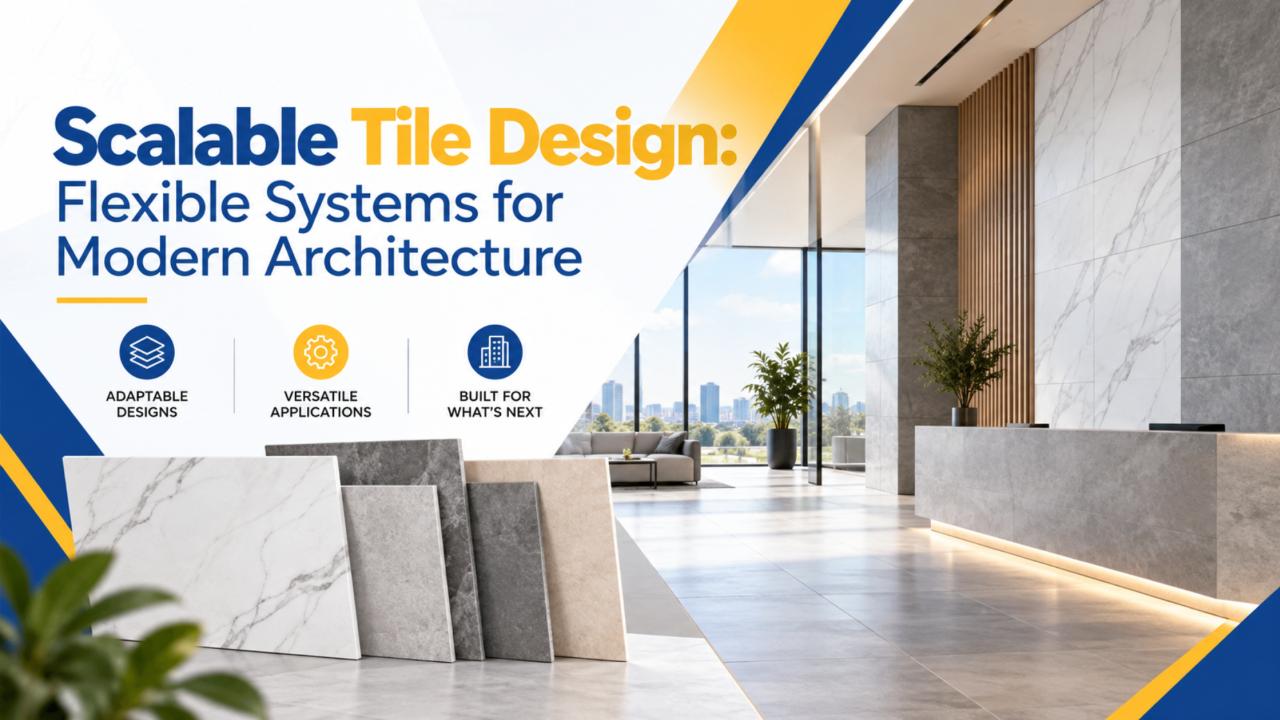
Picture a home that never stops changing. The nursery becomes a study. The guest room turns into a gym.
The balcony that once held two plastic chairs is now an outdoor lounge with proper seating. Walls move, purposes shift, families grow, but the floor underneath rarely gets a say in any of it. It's just expected to keep up.
That quiet pressure on one of the least glamorous parts of a home is exactly why scalable surface design has moved from a niche design term to a genuine architectural priority.
Instead of picking a tile for a single room and hoping it still makes sense five years later, architects and homeowners are now choosing surfaces built to travel, from a small foyer to a sprawling living room, from a quiet bedroom to a busy commercial lobby, without losing their identity along the way.
So What Does "Scalable" Actually Mean for a Tile?
Strip away the design-speak and the idea is refreshingly simple. A scalable tile holds its visual character no matter where it's used or how much space it fills. It doesn't need a different pattern for every room to feel intentional. It adapts.
This is the foundation of modular surface design, treating tiles not as isolated decorative choices but as building blocks of a larger, connected look.
A single collection might cover an entryway, wrap around a kitchen island, line a bathroom wall, and spill onto a terrace, and the whole home still feels like it belongs to one coherent story rather than four unrelated ones.
Consistency without the monotony of repetition, that's the quiet power of flexible surface design.
Why Modern Architecture Demands This Kind of Flexibility
Rooms used to have fixed jobs. The kitchen was for cooking. The living room was for sitting. Not anymore. Open floor plans have blurred those boundaries, and today a single space might function as a kitchen, a dining area, a workspace, and a place to entertain guests, sometimes all before lunch.
When architecture becomes this fluid, materials have to keep pace. Designers no longer have the luxury of hunting for a fresh material every time a room's function shifts. What they need instead is a surface language flexible enough to move with the space, not against it. That's the practical reasoning behind scalable tile design - it's a response to how people actually live now.
Large Format Tiles: Where Scale Meets Simplicity
No conversation about flexible tiling systems is complete without talking about size. Large format porcelain tiles have become the backbone of scalable design, and for good reason.
Fewer grout lines mean fewer visual interruptions, which means a room reads as calmer, cleaner, and noticeably larger than it is.
Common large-format dimensions used across modern residential and commercial projects include:
1200 x 1800 mm - a versatile format for both floors and walls
1200 x 2400 mm - ideal for open living areas and expansive floor plans
1200 x 2800 mm - well suited for feature walls and statement surfaces
1600 x 3200 mm - used in large-scale installations for a near-seamless finish
In an expansive hall, these larger formats amplify the sense of scale. In a compact bathroom or hallway, that same format quietly minimizes clutter and makes the space feel more generous than its actual square footage suggests.
It's one surface doing two very different design jobs, which is precisely the point of scalability.
A Quick Note on Thickness
Getting the tile thickness for modern interior flooring and walls right isn't just a technical footnote, it directly affects durability, underfoot comfort, and how well a slab performs across high-traffic zones versus quieter, low-impact areas. As a general guide:
6–9 mm works well for wall cladding and low-impact vertical surfaces
9–12 mm is the standard range for residential flooring
12 mm and above suits high-traffic commercial floors, kitchens, and entryways
A tile that looks stunning in a showroom still needs the right thickness profile to hold up in a working kitchen or a well-trodden entryway.
One Material, Many Personalities
Here's something that often gets overlooked: the same tile can feel completely different depending on where and how it's used. A subtle stone-look finish spread across an entire floor reads as calm and architectural.
That exact same pattern, used selectively on a single feature wall, suddenly becomes a bold statement. A textured surface across a bathroom floor creates a spa-like hush, while the same texture used as a small accent detail becomes almost sculptural.
This is what separates true architectural surface design from simple decoration. It isn't only about how a tile looks in isolation, it's about how it behaves when the context around it changes.
That behavioral flexibility is what makes large-format tiles and modular collections so valuable to designers working across multiple room types.
Built for Commercial Spaces, Too
Homes evolve slowly. Commercial spaces evolve constantly. A restaurant might redesign its dining floor within a few years of opening. A retail outlet might rebrand overnight. A hospitality property might renovate one wing while leaving another untouched.
In these cases, a flexible surface design isn't a nice-to-have, it's what keeps a brand's visual identity intact through years of partial renovations and shifting layouts.
Premium vitrified tiles are particularly well suited to this demand:
They hold up under sustained foot traffic without losing finish quality
Their design range keeps pace with evolving brand aesthetics
They allow phased renovations without visible mismatches between old and new sections
That combination of durability and design range means a business doesn't have to rip out and replace flooring every time it updates its look.
Flexibility Isn't a Compromise It's an Upgrade
There's a common misconception that adaptable materials mean settling for something generic. In practice, it's usually the opposite. When designers work with a genuinely flexible tile system, they gain more creative room, not less.
They can scale a pattern up or down, mix finishes across zones, create dramatic transitions between spaces, or maintain a quiet, unified thread throughout a property, all without justifying a different material for every application.
The tile becomes a framework. The designer still makes every real decision. Scalability just removes the constraints that used to get in the way.
Future-Proof Your Space with Scalable Surface Design
Every homeowner eventually faces the same realization: the room they designed today isn't necessarily the room they'll need in a decade. Furniture changes. Families change. Trends shift.
A tile chosen purely for how it looks in one moment can start to feel dated once that moment passes.
Scalable tile design solves this by shifting the question. Instead of asking "does this look good in this room," the better question becomes "will this still make sense as the space keeps changing." That single shift in thinking is what separates a short-term finish from a long-term investment.
If a renovation, a new build, or a commercial fit-out is on the horizon, the smartest move is to start that search with surfaces already engineered for this kind of longevity.
Browse a full collection of premium slabs across large formats and finishes, shortlist the sizes and thicknesses that fit the project, and request samples before making a final call.
A well-chosen surface today should still feel right a decade from now, start that search today.