Market Overview
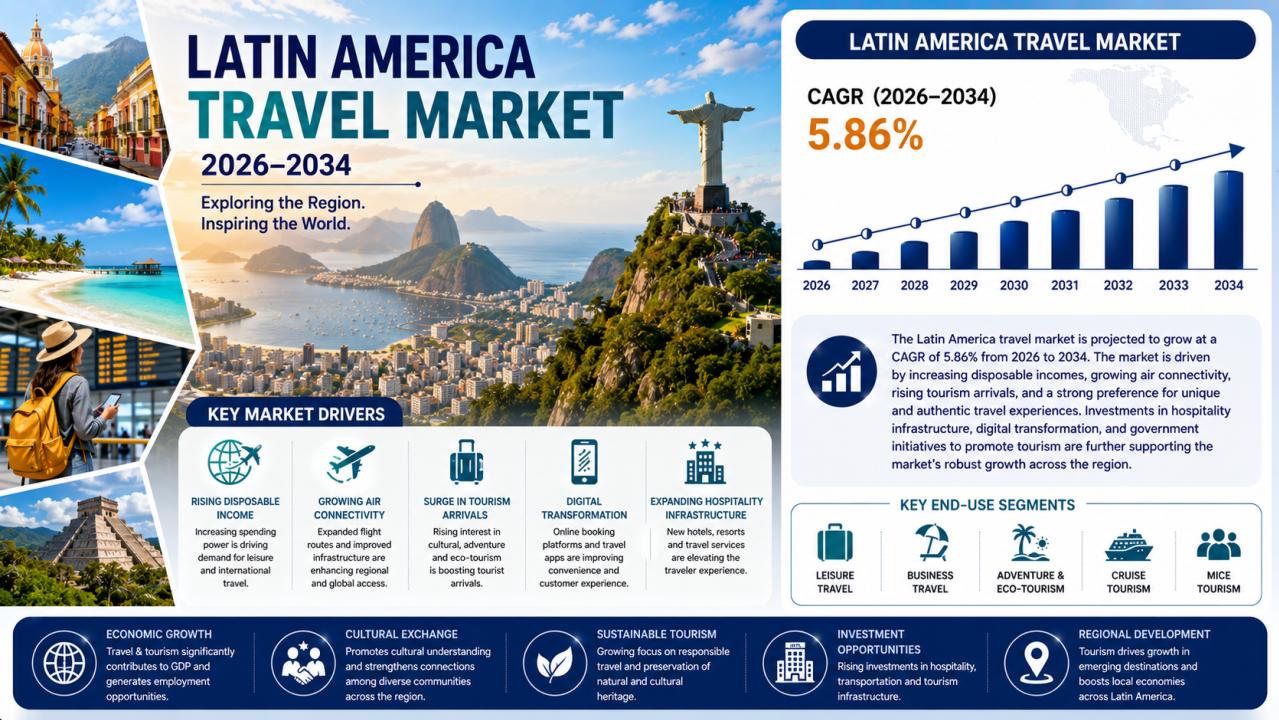
The Latin America travel market grew from USD 109.0
Billion in 2025 to USD 124.7 Billion in 2026. Looking
forward, IMARC Group estimates the market to reach USD 196.6 Billion by
2034, exhibiting a CAGR of 5.86% from 2026-2034. The
rising disposable incomes, improved infrastructure, diverse cultural
attractions, escalating eco-tourism demand, significant digital marketing
advancements, expanding airline routes, favorable currency exchange rates, and
surging demand in experiential, adventure, and sustainable tourism are some of
the factors contributing to the market growth.
Request a Sample Report for In-Depth Market Insights: https://www.imarcgroup.com/latin-america-travel-market/requestsample
Latin America Travel Market Summary
- The
Latin America travel market encompasses a range of travel types, including
leisure travel, business travel, cruise, specialty/activity/sports, and
VFR (visiting friends and relatives), serving domestic and international
tourists across various age groups.
- These
travel experiences are valued for their role in providing cultural
immersion, adventure activities, eco-tourism experiences, and business
connectivity across various destinations in the region.
- The
ecosystem includes travel agencies, tour operators, airlines, hotels,
cruise lines, online booking platforms, tourism boards, and end-users.
- Major
segments identified in the market include type (leisure travel, business
travel, cruise, specialty/activity/sports, VFR), age group (21-30 years,
31-40 years, 41-60 years, 60 and above), tourist type (domestic,
international), and country (Brazil, Mexico, Argentina, Colombia, Chile,
Peru, Others).
- The
market is benefiting from eco-tourism and sustainable travel, adventure
and experiential tourism, advancements in digital marketing and
technology, rising disposable incomes, improved infrastructure, and
expanding airline routes.
- In
February 2024, CAF, the Latin American and Caribbean Development Bank, and
UN Tourism signed a partnership agreement to launch the Green Projects
Innovation Challenge: Transforming the Tourism Sector in Latin America and
the Caribbean.
PORTER'S FIVE FORCES ANALYSIS
- Competitive
Rivalry: High, with numerous established travel companies,
regional operators, and emerging digital platforms competing on price,
innovation, and destination offerings. Business implication: Companies
must differentiate through unique experiences, digital capabilities, and
customer service.
- Supplier
Power (Raw Materials): Moderate. Suppliers of hotels, airlines,
and local tour services have some leverage, but the presence of multiple
suppliers and the ability of large operators to secure long-term contracts
moderates this power. Business implication: Operators
should maintain diverse supplier relationships.
- Buyer
Power (Consumers): High. Travelers have extensive choice across
destinations, travel types, and price points, with low switching costs and
growing awareness of sustainable and experiential travel options. Business
implication: Brands must focus on value, experience quality, and
sustainability to build loyalty.
- Threat
of Substitutes: Moderate. Alternative travel destinations and
staycation options compete, but the unique cultural, natural, and
adventure offerings of Latin America support its position. Business
implication: The industry should emphasize unique experiences,
sustainability, and cultural authenticity.
- Threat of New Entrants: Moderate. Higher barriers for established operators (scale, distribution, brand equity, supplier networks), but lower barriers for niche and digital-first entrants. Business implication: Established players should build defensible positions through innovation and brand equity.
MARKET GROWTH DRIVERS
Eco-Tourism and Sustainable Travel
The rise in eco-tourism and sustainability-driven by the
increasing global awareness of environmental conservation and a desire for
responsible tourism is driving the market growth. The biodiversity in Latin
America reaches its peak through its combination of the Amazon rainforest,
Andes mountains, and untouched seashores which provide tourists with exclusive
natural landscapes and wildlife encounters. Additionally, nations like Costa
Rica, Ecuador, and Brazil have made investments in environmentally friendly
projects, creating protected zones, conserving the environment, and providing
sustainable lodgings in the form of eco-lodges to tourists. This focus on
preserving natural beauty while minimizing tourism's ecological footprint is
attracting eco-conscious travelers seeking immersive, low-impact experiences,
thereby aiding in market expansion. Additionally, local communities are
increasingly involved in sustainable tourism, enhancing the region's appeal to
ethical travelers, which is aiding in market expansion.
Adventure and Experiential Tourism
Latin America has become a hotspot for adventure tourism as
travelers increasingly seek immersive experiences over traditional sightseeing.
The region's diverse geography, including mountains, deserts, and rainforests,
provides an ideal setting for adventure activities like hiking, zip-lining,
scuba diving, and mountain biking. Moreover, iconic destinations like Peru's
Machu Picchu, Argentina's Patagonia, and the Atacama Desert in Chile offer
thrilling, culturally rich experiences that appeal to nature lovers and
adventure enthusiasts. In addition, increasing experiential tourism, as
tourists interact face-to-face with local cultures by staying in locals' homes,
taking traditional cooking classes, or going on tours led by communities,
offers the true essence of Latin American culture. This heightened interest in
further immersion in destinations, benefiting travelers and local populations
alike, continues to drive the market forward.
Advancements in Digital Marketing and Technology
Advancements in digital marketing and technology are
significantly boosting Latin America's travel market, making it easier for
potential tourists to discover and plan trips to the region. In addition to
this, social media platforms have emerged as powerful tools, allowing
destinations to showcase breathtaking landscapes, vibrant cultures, and unique
experiences through visually captivating content. In addition, travel bloggers
and user-generated content enhance exposure, generating natural interest in Latin
American destinations. Furthermore, online booking platforms and travel apps
make planning easier, allowing travelers to personalize their trips, discover
local experiences, and book hotels with ease. Furthermore, technologies like
virtual reality (VR) and augmented reality (AR) allow tourists to preview
destinations, target ads, and build excitement, thus reaching a global audience
and boosting travel demand.
LATIN AMERICA TRAVEL MARKET SEGMENTATION
Type Insights:
- Leisure
Travel
- Business
Travel
- Cruise
- Specialty/Activity/Sports
- VFR
(Visiting Friends and Relatives)
Age Group Insights:
- 21-30
Years
- 31-40
Years
- 41-60
Years
- 60
and Above
Tourist Type Insights:
- Domestic
- International
Country Insights:
- Brazil
- Mexico
- Argentina
- Colombia
- Chile
- Peru
- Others
COMPETITIVE LANDSCAPE
The Latin America travel market features a competitive
landscape of established travel companies, regional operators, and emerging
digital platforms competing on price, innovation, and destination offerings.
Market dynamics are characterized by growing demand for eco-tourism, adventure
travel, and experiential tourism, along with advancements in digital marketing
and technology. Competition is intensifying as companies invest in digital
platforms, unique experiences, and sustainability credentials, with differentiation
through unique experiences, digital capabilities, and customer service.
Key players mentioned in the report context include:
- GoNexus released
Nexus Up in November 2024, an application that works in 19 countries and
52 destinations around Latin America and the Caribbean. It is a travel
technology advancement created especially to improve the visitor
experience for business-to-business clients. With this app, customers can
easily check their itineraries, track their transfers, and get real-time
notifications.
- Touristik
Union International (TUI), a multinational travel and tourism
organization with its headquarters in Germany, expanded the reach of Latin
American locations worldwide by collaborating with agents in Latin America
to sell trip packages to clients in North America, Asia, and Europe in
September 2024.
REGIONAL ANALYSIS
- Brazil: A
key market driven by diverse cultural attractions, strong eco-tourism
offerings, expanding airline routes, and growing demand for adventure and
experiential travel across the Amazon and coastal regions.
- Mexico: A
significant market driven by rich cultural heritage, strong tourism
infrastructure, growing demand for sustainable travel, and high
penetration of digital booking platforms.
- Argentina: A
growing market driven by iconic destinations like Patagonia, growing
adventure tourism, favorable currency exchange rates, and increasing
international tourist arrivals.
- Colombia: A
growing market driven by improving infrastructure, diverse natural
attractions, growing eco-tourism demand, and increasing digital marketing
efforts.
- Chile: A
growing market driven by unique destinations like the Atacama Desert,
growing adventure tourism, increasing sustainable travel options, and
expanding airline connectivity.
- Peru: A
growing market driven by iconic destinations like Machu Picchu, growing
cultural tourism, increasing adventure travel, and expanding digital
marketing initiatives.
- Others: Emerging
markets with growing travel demand, supported by improving infrastructure,
increasing digital marketing efforts, and growing awareness of unique
cultural and natural attractions.
RECENT INDUSTRY DEVELOPMENTS
June 2026: International visitor arrivals to Central America increased 18% year-on-year in Q1 2026, while South America recorded a 1% decline. Within the region, Paraguay’s arrivals increased 46%, Argentina’s 22%, Brazil’s 16%, and Peru’s 13%.
June 2026: Travel and Tourism GDP across Central and South America is projected to grow 4.1% in 2026, exceeding the global growth rate of 3.2%. International visitor spending is projected to increase 7.8%, indicating stronger tourism spending potential across the region.
June 2026: Mastercard data showed that a 10% depreciation of the Argentine peso was associated with a 9.5% increase in foreign tourist arrivals, compared with a global average response of 2.4%. In Brazil, tourists allocated 27.1% of spending to restaurants and 2.4% to bars, compared with 17.8% for lodging.
April 2026: Tourism in Latin America and the Caribbean accounted for approximately 6% of global tourism activity, but generated 20% less revenue per visitor than the global average. The Inter-American Development Bank identified connectivity, sustainability, human capital, regional coordination and investment as key areas for increasing tourism-sector value.
Key Aspects Required for the Latin America Travel Market
- Market
Performance: USD 109.0 Billion in 2025, USD 124.7 Billion in
2026, with a projected trajectory to USD 196.6 Billion by 2034.
- Market
Outlook: A 5.86% CAGR through 2034 indicates steady growth across
types, age groups, tourist types, and countries, driven by eco-tourism,
adventure travel, and digital marketing advancements.
- Growth
Drivers: Eco-tourism and sustainable travel; adventure and
experiential tourism; advancements in digital marketing and technology;
rising disposable incomes; improved infrastructure; expanding airline
routes; and favorable currency exchange rates.
- Competitive
Landscape: A competitive market with established travel
companies, regional operators, and emerging digital platforms.
Differentiation occurs through unique experiences, digital capabilities,
and customer service.
- Value
Chain Analysis: From destination marketing and travel planning
through booking, transportation, accommodation, and on-ground experiences
to end-use by domestic and international tourists, with sustainability and
digitalization trends shaping market dynamics.
- Industry
Trends: Eco-tourism and sustainable travel; adventure and
experiential tourism; advancements in digital marketing and technology;
growth of MICE tourism; and increasing adoption of VR and AR for
destination previews.
- Strategic
Recommendations: Invest in sustainable and eco-friendly tourism
projects; expand digital marketing and online booking capabilities;
develop adventure and experiential travel offerings; leverage social media
and user-generated content; and focus on community-based tourism and
cultural immersion experiences.
Note: If you need any specific information that is not currently covered within the scope of the report, we will provide the same as a part of customization.
Speak to an analyst: https://www.imarcgroup.com/request?type=report&id=31782&flag=C
Report Format, Delivery, and Customization Details
- Report
Format Mode: PDF and Excel (Editable version in PPT/Word format
available on special request)
- Report
Delivery Mode: Online Delivery, Physical Delivery
- Report
Delivery Time: report delivered over email within 24 to 48 hours.
If requested by the client, a physical copy will be delivered within three
to ten days.
- Report
Confirmation Mode: Yes, via email
- Report
Customization Mode: Yes, via Email / Call
- Report
Table of Content: Yes
- Report
List of Figures: Yes
- Report
Methodology Mode: Yes
- Request
For Sample Report: Yes
About Us
IMARC Group is a global management consulting firm that
helps the world's most ambitious changemakers to create a lasting impact. The
company provides a comprehensive suite of market entry and expansion services.
IMARC offerings include thorough market assessment, feasibility studies,
company incorporation assistance, factory setup support, regulatory approvals
and licensing navigation, branding, marketing and sales strategies, competitive
landscape and benchmarking analyses, pricing and cost research, and procurement
research.
Contact Us
IMARC Group
134 N 4th St, Brooklyn, NY 11249, USA
Email: sales@imarcgroup.com
Tel No: (D) +91 120 433 0800
United States: +1-201-971-6302