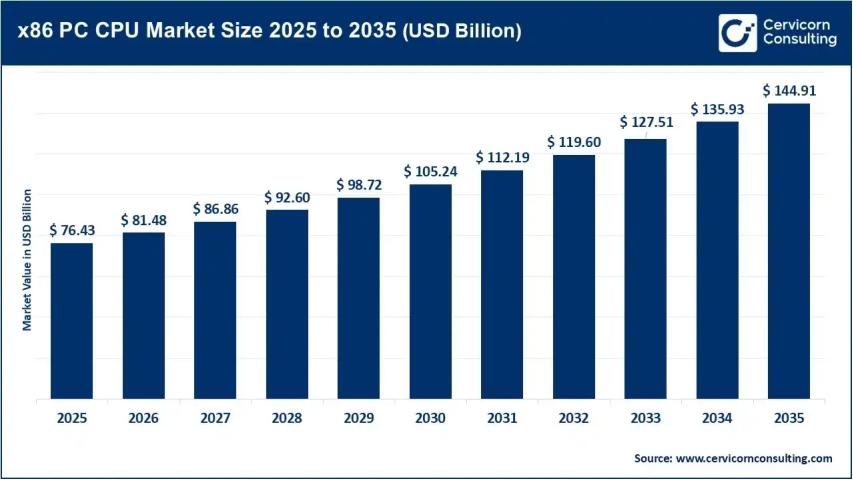
x86 PC CPU market size and growth outlook
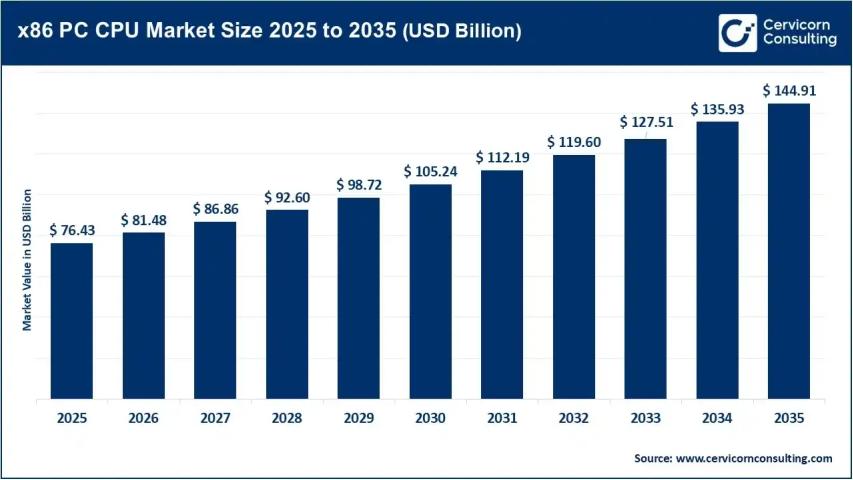
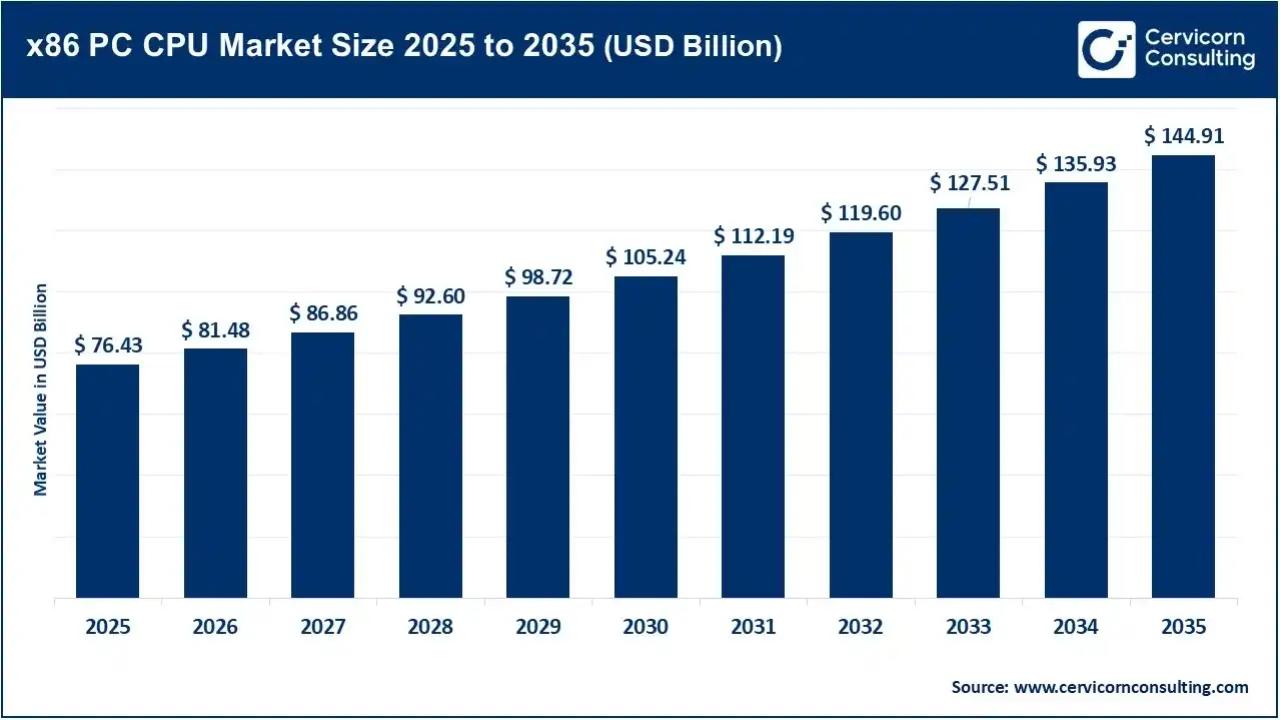
The global x86 PC CPU market reached USD 76.43
billion in 2025 and is projected to reach around USD 144.91 billion by
2035, expanding at a CAGR of 6.6% from 2026 to 2035. The market is
being supported by PC replacement cycles, Windows 11 migration, AI-enabled
computing, gaming, content creation, and increasing demand for higher
processing performance.
The transition toward AI-enabled personal computing is
adding another layer of demand. Modern x86 processors are increasingly
incorporating dedicated AI acceleration alongside conventional CPU and graphics
capabilities, enabling devices to process selected AI workloads locally.
AI PCs are accelerating processor upgrades
The growing adoption of AI-enabled PCs is becoming a
major catalyst for the x86 PC CPU market. The Windows 10 end-of-support cycle
has accelerated hardware refreshes, contributing to a 9.1% increase in
worldwide PC shipments during 2025, with shipments exceeding 270 million units.
Gartner estimated that 77.8 million AI PCs were shipped in 2025,
representing 31% of total PC shipments, compared with 15.6% in 2024.
The integration of neural processing units (NPUs)
with CPUs is supporting local AI inference, productivity applications, content
creation, enhanced security, and other AI workloads. Gartner expects AI PCs to
represent 54.7% of worldwide PC shipments in 2026, highlighting the
industry's shift toward processors capable of handling AI workloads directly on
devices.
For CPU manufacturers, this transition is creating
opportunities to differentiate processors through stronger NPUs, improved
CPU-GPU-NPU integration, power efficiency, and optimized AI software
ecosystems.
Get a Free Sample: https://www.cervicornconsulting.com/sample/3019
Intel and AMD competition is shaping processor innovation
Competition among major x86 CPU manufacturers is encouraging
continuous investment in processor architecture, manufacturing technology, core
counts, integrated graphics, AI acceleration, and energy efficiency.
In Q2 2026, AMD accounted for 30.3% of client x86 CPU
shipments, including 34.9% of desktop CPU shipments and 28.9% of mobile
CPU shipments. AMD's client CPU unit share had also increased to 29.6%
in Q1 2026, compared with 24.1% in Q1 2025.
Recent product developments are reinforcing this
competition. Intel introduced its Core Ultra 200S Plus desktop processors in
March 2026, while Intel's Core Ultra Series 3 processors use its 18A
manufacturing process. AMD's x86 client CPU share reached 29.2% in Q4 2025,
its highest level at that time.
Mobile and laptop CPUs dominate demand
Mobile/laptop CPUs accounted for 68.4% of x86 PC CPU
market revenue in 2025, compared with 31.6% for desktop CPUs. The dominance
of notebooks is supported by demand for mobility, remote work, education,
entertainment, professional productivity, and energy-efficient computing.
Manufacturers are increasingly prioritizing thin and
lightweight systems with improved battery efficiency, thermal management,
integrated graphics, connectivity, and AI acceleration. Premium notebooks,
gaming laptops, business systems, and AI-enabled PCs are therefore becoming
important opportunities for mobile x86 processors.
The mobile and laptop CPU category is also expected to
remain the fastest-growing processor type as consumers and organizations
continue replacing conventional desktops with portable systems.
Mid-range processors address mainstream computing needs
Mid-range CPUs accounted for approximately 43.5% of the
market in 2025, making this the leading performance tier. Their balance of
price, performance, power consumption, and compatibility makes them suitable
for mainstream notebooks, desktops, commercial PCs, and educational systems.
At the higher end, demand for high-performance processors is
increasing as applications become more computationally intensive. Gaming,
content creation, software development, AI-assisted applications, engineering,
and professional workloads are encouraging users to seek additional processing
capacity.
This creates opportunities across both mainstream and
premium processor categories, with manufacturers competing through performance
improvements, advanced caching, AI capabilities, and energy efficiency.
5–8 core processors remain the mainstream choice
The 5–8 core segment held 51.7% of market revenue in 2025,
reflecting its suitability for everyday productivity, multitasking, gaming, web
applications, streaming, and commercial computing. The configuration provides a
balance between processing capacity, system cost, and power consumption.
Meanwhile, the 9–16 core segment is experiencing strong
growth as video production, 3D rendering, software development, data
analysis, gaming, and AI-enabled applications require greater parallel
processing capabilities. High-performance desktops and creator-focused systems
are important sources of demand for processors with larger core counts.
Consumer computing remains the largest application
Consumer computing accounted for approximately 42.8% of
x86 PC CPU market revenue in 2025, supported by widespread PC use for
productivity, education, communication, entertainment, browsing, and personal
content creation.
The large installed base of desktops and notebooks provides
manufacturers with a substantial replacement opportunity as older systems
become less capable of supporting modern operating systems and applications.
Consumers are also increasingly looking for PCs that combine
general-purpose computing with gaming, multimedia, and AI functionality,
allowing newer x86 processors to address multiple workloads within a single
device.
Gaming is creating demand for high-performance CPUs
Gaming represented 25.6% of market revenue in 2025 and
is identified as the fastest-growing application segment. Modern games
increasingly require greater CPU performance, efficient multitasking, and
strong coordination between processors and graphics hardware.
Competitive gaming, game streaming, content creation,
virtual reality, and high-refresh-rate displays are encouraging enthusiasts to
upgrade processors. CPU manufacturers are responding with larger caches, higher
boost performance, specialized gaming technologies, and architectures designed
to reduce latency.
Premium gaming desktops and gaming laptops therefore
represent an important opportunity for high-performance x86 processors.
Asia Pacific represents the largest regional opportunity
Asia Pacific held an estimated 36.8% share of the global
x86 PC CPU market in 2025, making it the largest regional opportunity.
Large PC user populations, enterprise digitization, education deployments,
electronics manufacturing ecosystems, and growing AI-PC adoption are supporting
demand.
The broader Asia-Pacific traditional PC market reached 106.6
million units in 2025, increasing 11.6% year over year. China,
India, Japan, South Korea, and Southeast Asian economies are important demand
centers, while the region also benefits from its extensive electronics
manufacturing and PC supply-chain ecosystem.
However, component shortages and higher memory costs are
creating near-term pressure on PC procurement and processor demand.
India is becoming an important x86 CPU opportunity
India is emerging as an important market for PC processors
as enterprise digitization, education procurement, consumer computing, and
AI-enabled notebook adoption expand.
India's PC market reached a record 15.9 million units in
2025, representing 10.2% year-over-year growth. In Q1 2026,
India's PC shipments increased 31.1% year over year to 4 million units,
while notebook shipments grew 55.4%.
The expansion of PC adoption beyond established metropolitan
markets, government-led education procurement, and demand from tier-two and
tier-three cities are creating opportunities for affordable x86 notebooks and
entry-to-mid-range processors.
North America benefits from enterprise PC refresh cycles
North America remains an important x86 PC CPU market because
of its high PC penetration, advanced technology ecosystem, established
enterprise infrastructure, and presence of major processor and PC
manufacturers. Enterprise hardware replacement, AI-PC adoption, gaming, content
creation, and premium computing are supporting demand.
The region represented 31.4% of market revenue in 2025,
while the United States accounted for approximately 70% of North American PC
shipments. Enterprises are increasingly upgrading hardware to support AI
applications, cybersecurity, data-intensive workloads, and modern productivity
platforms.
Europe benefits from Windows 11 migration and AI
computing
Europe accounted for 20.2% of x86 PC CPU market revenue
in 2025. The region's established enterprise IT infrastructure, high PC
penetration, commercial computing demand, and widespread use of Windows-based
systems provide a strong replacement market.
The Windows 10 end-of-support cycle has encouraged
businesses and consumers to replace older or incompatible systems. AI-enabled
PCs are also gaining traction as European organizations explore on-device AI,
cybersecurity, productivity improvements, and longer device lifecycles.
Local AI creates new enterprise opportunities
The shift toward local AI processing is creating
opportunities for x86 CPU manufacturers to develop processors optimized for
on-device workloads. AI applications involving analytics, collaboration,
cybersecurity, content generation, and productivity can stimulate demand for
processors with stronger AI acceleration.
Gartner research cited by Cervicorn Consulting indicates
that the proportion of AI-enabled business PCs could reach 60% by 2027,
compared with 20% in 2024. This transition could support enterprise replacement
cycles as businesses seek hardware capable of executing AI applications
locally.
Local processing can also provide advantages related to
latency, privacy, and reduced dependence on cloud infrastructure, strengthening
the case for AI-capable PCs.
Arm-based processors create competitive pressure
The x86 PC CPU market is facing increasing competition from Arm-based
processors, particularly in thin-and-light laptops where battery life and
energy efficiency are important purchasing factors.
Arm reached a 15.3% share of the client CPU market in Q2
2026, its highest reported level, supported by growing adoption across PCs
and notebooks. Increasing software compatibility and OEM support could create
additional competitive pressure for x86 processors.
This competitive environment is encouraging x86
manufacturers to focus on power efficiency, integrated AI acceleration,
performance-per-watt, battery life, and broader software optimization.
Rising component costs challenge PC processor demand
Higher memory and GPU prices are making complete PC upgrades
more expensive, potentially discouraging consumers from purchasing new systems
even when CPU performance improves. AI infrastructure is also competing with
consumer electronics for advanced semiconductor manufacturing capacity, memory,
and other critical components.
The impact has been particularly visible in desktop
computing. In Q2 2026, global desktop CPU shipments declined by more than
20% year over year, with elevated memory prices and GPU shortages
contributing to weaker demand for complete desktop systems.
For CPU manufacturers and PC OEMs, managing component costs,
supply availability, product pricing, and inventory planning will remain
important as AI infrastructure continues to absorb semiconductor resources.
Emerging markets offer expansion opportunities
Developing markets provide opportunities for x86 processor
manufacturers as education, digital services, remote work, broadband access,
and enterprise modernization increase PC adoption.
India's PC market grew 31.9% year over year in Q1 2026 to
4.4 million units, while notebook shipments expanded by 45%. Government
education procurement and growing demand outside major metropolitan areas can
support additional adoption of affordable x86 notebooks and mainstream
processors.
Latin America, the Middle East, and Africa also offer
opportunities as businesses, governments, schools, and consumers increasingly
adopt digital technologies and computing devices.
Competitive landscape of the x86 PC CPU market
The competitive landscape includes Intel Corporation,
Advanced Micro Devices, Inc., VIA Technologies, Inc., Zhaoxin, Hygon
Information Technology Co., Ltd., Loongson Technology Corporation Limited,
Shanghai Innosilicon Technology Co., Ltd., Phytium Technology Co., Ltd.,
Centaur Technology, SiFive, Inc., Ampere Computing LLC, and Nanjing Ruixin
Microelectronics Co., Ltd.
Competition is increasingly focused on processor
performance, AI acceleration, energy efficiency, core architecture, integrated
graphics, manufacturing technology, software optimization, and platform-level
capabilities. The growing importance of AI PCs is also encouraging
manufacturers to integrate CPU, GPU, and NPU capabilities into increasingly
heterogeneous computing platforms.
Explore the Full Market Report: https://www.cervicornconsulting.com/x86-pc-cpu-market