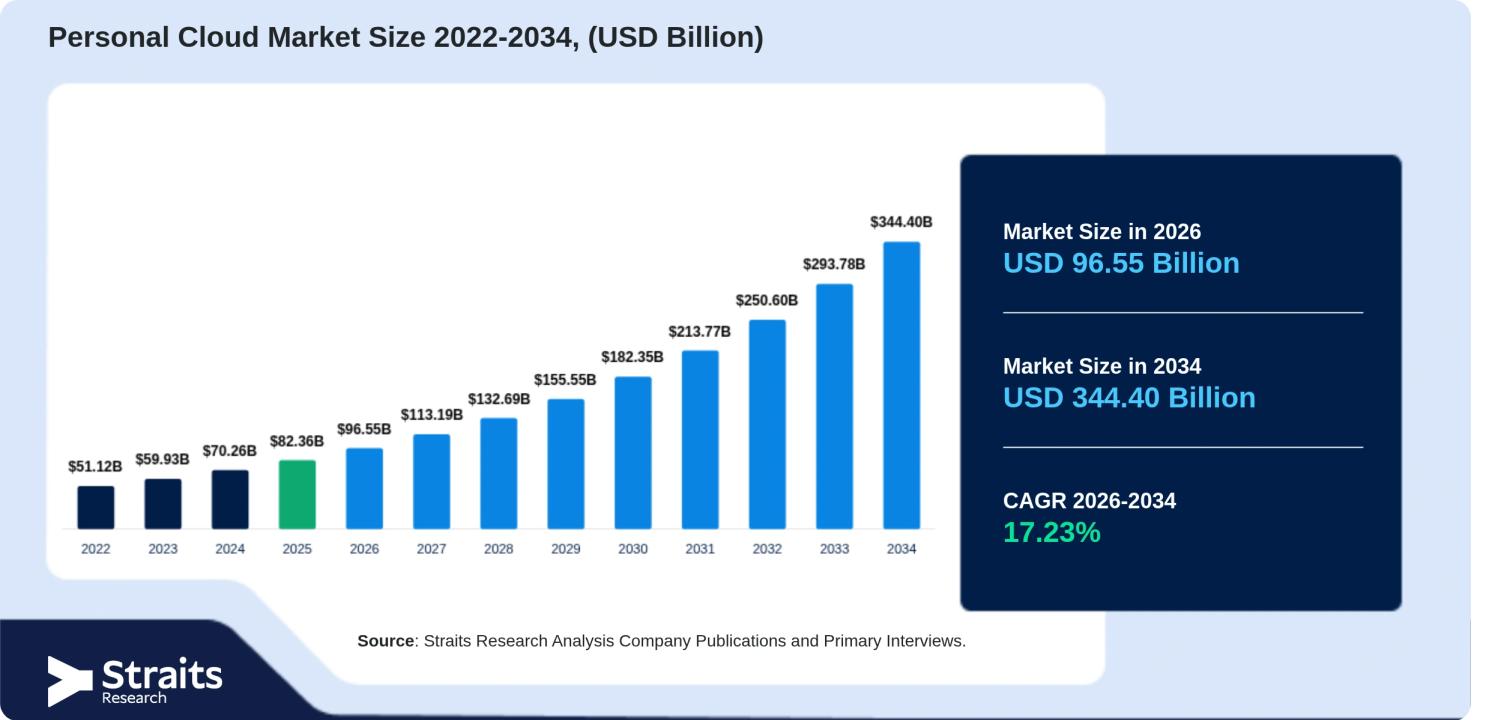
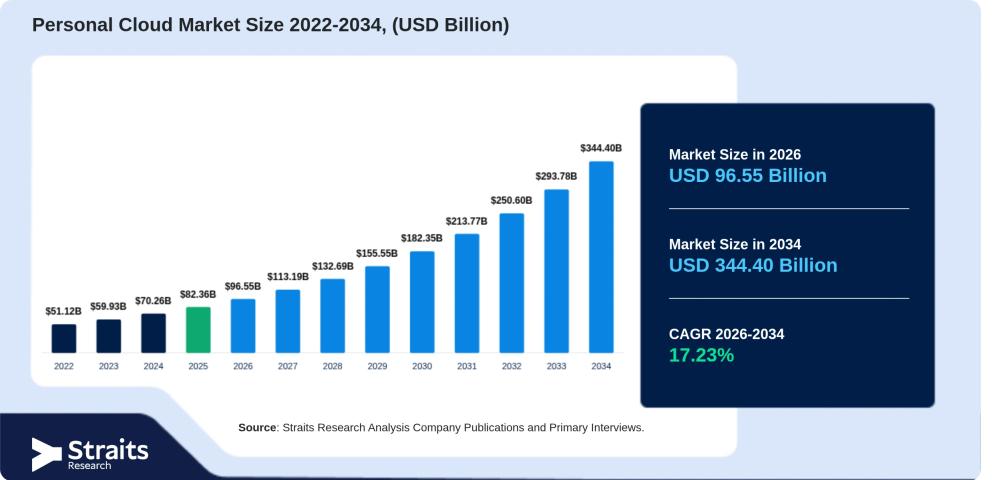
The global Personal Cloud Market was valued at USD 82.36 billion in 2025 and is projected to grow from USD 96.55 billion in 2026 to USD 344.39 billion by 2034, registering a 17.23% CAGR during 2026–2034. North America dominated the market with a 38.6% share in 2025, while Europe is projected to record the fastest growth at a 22.15% CAGR. Rising digital content generation, smartphone adoption, 5G connectivity, cross-device synchronization, and demand for secure data backup are shaping the market outlook. AI-powered data management and family-oriented storage subscriptions are also creating new opportunities for service providers.
Personal Cloud Market Key Highlights
Market Size (2025): USD 82.36 billion
Market Size (2026): USD 96.55 billion
CAGR (2026–2034): 17.23%
Forecast Year: 2034
Projected Market Size (2034): USD 344.39 billion
Dominant Region: North America — 38.6% share in 2025
Fastest-Growing Region: Europe — 22.15% CAGR
Market Overview
Personal cloud services enable users to store, synchronize, share, and access digital content across connected devices. The market includes backup and recovery, file sharing and synchronization, and public, private, and hybrid cloud deployment models. Increasing volumes of photos, videos, documents, and other digital files are driving demand for scalable storage and convenient remote access. Smartphones, laptops, tablets, wearables, and connected devices are strengthening the need for seamless synchronization, while AI-powered organization and intelligent search are expanding the role of personal cloud platforms beyond basic storage. However, price sensitivity toward free storage tiers, concerns about ecosystem lock-in, and dependence on reliable internet connectivity continue to influence the competitive landscape.
Growth Drivers
Rising Digital Content Volumes Strengthen Demand for Cloud Storage
The increasing volume of personal digital content is a key driver of personal cloud market growth. High-resolution photos, videos, documents, and application data generated across smartphones, laptops, tablets, and connected devices create demand for scalable storage, automated backup, and cross-device synchronization. The wider adoption of 5G and connected digital ecosystems further supports real-time access to personal files, while cloud subscriptions allow users to expand storage without relying exclusively on local device capacity. AI-enabled organization and search features are also improving the user experience by helping consumers manage large digital libraries. In 2025, Google continued expanding Google One with additional storage, AI-powered features, and integrated consumer services, reflecting the shift toward centralized personal cloud experiences.
Challenges
Connectivity Dependence and Ecosystem Lock-In Constrain Adoption
Personal cloud services depend on reliable internet connectivity for synchronization, backup, and remote access. Network interruptions, poor broadband availability, or service outages can prevent users from accessing important files, particularly in areas with inconsistent connectivity. Consumers may therefore retain local copies or adopt hybrid storage arrangements to reduce reliance on online access. At the same time, ecosystem lock-in can make it difficult to move files, subscriptions, and integrated services between providers. Price sensitivity toward free storage tiers may also limit conversion to paid plans, requiring providers to demonstrate clear value through storage capacity, security, convenience, and intelligent features. In 2026, the continued integration of OneDrive with Microsoft 365 illustrates how connected productivity and storage ecosystems can improve convenience while making switching between platforms more complex.
Opportunities
Hybrid Storage and Family-Sharing Models Create New Revenue Streams
Hybrid cloud storage presents an opportunity for providers to combine local storage with cloud-based backup, synchronization, and remote access. This approach allows users to retain selected data on personal devices while benefiting from cloud scalability and recovery capabilities. Family and multi-user subscriptions also create opportunities by enabling several people to share storage through a single plan, with features such as shared folders, individual permissions, and parental controls. These models can improve subscription value, strengthen customer engagement, and support recurring revenue. In 2025, Google continued expanding Google One family-sharing capabilities, allowing subscribers to share storage and selected benefits with family members through a single plan.
Segment Analysis
By Service Type
The file sharing and synchronization segment accounted for a share of 53.2% in 2025, supported by the need to access and maintain updated files across smartphones, laptops, tablets, and other connected devices. Consumers increasingly rely on synchronization to manage photographs, videos, documents, and personal files across their digital ecosystems. Remote work, digital collaboration, and the use of multiple devices further support demand. Backup and recovery services also remain important as users seek protection against accidental deletion, device failure, and data loss.
By Deployment Model
The hybrid cloud segment is projected to register the fastest CAGR of 21.85% during 2026–2034, driven by demand for flexible storage that combines local control with cloud scalability. Hybrid solutions allow users to retain sensitive information locally while using cloud services for backup, synchronization, remote access, and recovery. Public cloud services continue to appeal to users seeking convenient and scalable storage, while private cloud models offer greater control and customization.
By User Type
The individual consumers segment accounted for a share of 64.3% in 2025, owing to widespread smartphone adoption, digital content creation, and demand for convenient file access across devices. Consumers increasingly use personal cloud platforms to store and organize photographs, videos, documents, and other personal information. Prosumer users and small and medium-sized businesses also contribute to demand through their requirements for larger storage capacities, file sharing, backup, and remote access.
By Device Type
The tablets and wearables segment is projected to register the fastest CAGR of 22.05% during 2026–2034, supported by increasing use of connected tablets, smartwatches, fitness trackers, and other wearable devices. These devices generate personal, multimedia, and health-related data that users may want to synchronize and access across connected platforms. Smartphones and laptops and PCs remain important devices in the market, supporting demand for photo and video storage, document management, and automated backup.
Regional Analysis
North America Personal Cloud Market Analysis
North America dominated the personal cloud market with a 38.6% share in 2025, reaching USD 31.79 billion. High smartphone and connected-device penetration, widespread use of cloud storage, and demand for secure backup and file synchronization support regional market growth. The presence of major technology providers and increasing consumption of high-resolution digital content further strengthen the market ecosystem. The United States accounted for USD 26.08 billion in 2025, while Canada reached USD 5.71 billion, reflecting demand for cloud storage, remote file access, and connected digital services.
Europe Personal Cloud Market Analysis
Europe accounted for 27.4% of the global market in 2025, with a market value of USD 22.57 billion. The region is projected to record the fastest growth at a 22.15% CAGR during 2026–2034. Increasing digitalization, connected-device usage, and demand for secure, privacy-conscious cloud storage are supporting the regional outlook. Germany recorded a market value of USD 6.36 billion in 2025, while the United Kingdom reached USD 5.07 billion. Demand for file synchronization, backup, and cloud-based digital services is contributing to market expansion.
Asia Pacific Personal Cloud Market Analysis
Asia Pacific accounted for 24.8% of the global market in 2025, reaching USD 20.43 billion. Rapid smartphone adoption, expanding internet access, 5G deployment, and increasing digital content creation are supporting demand for personal cloud services. The region’s large connected-device user base creates opportunities for affordable storage, automated backup, and synchronization platforms. China accounted for USD 7.94 billion in 2025, while Japan reached USD 4.10 billion, supported by demand for cloud-based storage and connected digital services.
Latin America Personal Cloud Market Analysis
Latin America represented 5.6% of the global market in 2025, with a value of USD 4.61 billion. Increasing smartphone penetration, expanding mobile internet access, and growing use of digital services are supporting regional demand. The rising use of social media and digital content platforms is increasing the need for cloud-based storage, backup, and file synchronization. Brazil accounted for USD 2.36 billion in 2025, supported by growing demand for accessible cloud storage solutions.
Middle East and Africa Personal Cloud Market Analysis
The Middle East and Africa accounted for 3.6% of the global personal cloud market in 2025, reaching USD 2.96 billion. Increasing smartphone adoption, expanding broadband and mobile connectivity, and digital transformation initiatives are supporting the regional market. Investments in 5G infrastructure and connected services are creating opportunities for cloud storage, backup, and synchronization providers. The UAE market reached USD 0.85 billion in 2025, supported by demand for secure storage and convenient access to digital content.
Competitive Landscape
The personal cloud market includes technology companies and specialized providers competing through storage capacity, security, synchronization, sharing features, AI-enabled data management, and integration with broader digital ecosystems. Key market participants include Google Drive (Google), Microsoft OneDrive (Microsoft), Apple iCloud (Apple), Dropbox, Box, Amazon Drive (Amazon), pCloud, Sync.com, MEGA, Tresorit, Internxt, Proton Drive, Icedrive, Koofr, and Nextcloud. Competition is shaped by subscription pricing, cross-device compatibility, family-sharing features, data privacy, and the ability to integrate cloud storage with productivity and consumer services.
Recent Developments
August 2025: Reliance Jio introduced its AI-powered Jio AI Cloud platform, reflecting the development of personal cloud services toward intelligent storage and automation.
November 2025: AWS and Google Cloud announced multicloud networking capabilities designed to improve connectivity between cloud environments. While focused on cloud infrastructure, the development reflects broader industry efforts to improve cloud connectivity and interoperability.
2025: Google continued expanding Google One storage, AI-powered features, and family-sharing capabilities, supporting centralized storage and multi-user cloud plans.
2026: Microsoft continued strengthening the integration of Microsoft 365 and OneDrive, illustrating how cloud storage is increasingly embedded within productivity and consumer software ecosystems.
Future Outlook
The Personal Cloud Market is projected to grow from USD 82.36 billion in 2025 to USD 344.39 billion by 2034, registering a 17.23% CAGR during 2026–2034. Rising digital content volumes, smartphone and wearable adoption, 5G connectivity, and demand for seamless synchronization are expected to support market growth. AI-powered data organization, hybrid storage architectures, and family-oriented subscriptions are creating additional opportunities for providers. North America is expected to retain its leading market position, while Europe is projected to record the fastest regional growth. Pricing, privacy, interoperability, and service reliability will remain important factors shaping the competitive landscape.
Click to Read the Complete Insights & Report: Personal Cloud Market Size, Share & Forecast 2034
About Straits Research
Straits Research is a global market research and business intelligence organization providing industry reports, market analysis, strategic insights, competitive intelligence, and customized research services across a broad range of industries. Its research covers market size, growth forecasts, market trends, competitive landscapes, regional analysis, and emerging opportunities to support informed business decisions.