Picture two coffee shops on the same street in Corpus Christi. Both open a Google Ads campaign on the same morning, target the same neighborhood, and spend the same daily budget.
Three weeks later, one is booked out with new regulars and the other is wondering where the money went. The difference almost never comes down to luck or a bigger budget. It comes down to what got tested first.
Local business owners often assume that launching ads is the hard part. In reality, it's the easy part. The real work, and the real payoff, happens in the testing that follows.
A campaign that never gets tested never gets better; it just spends money on autopilot while competitors quietly figure out what works.
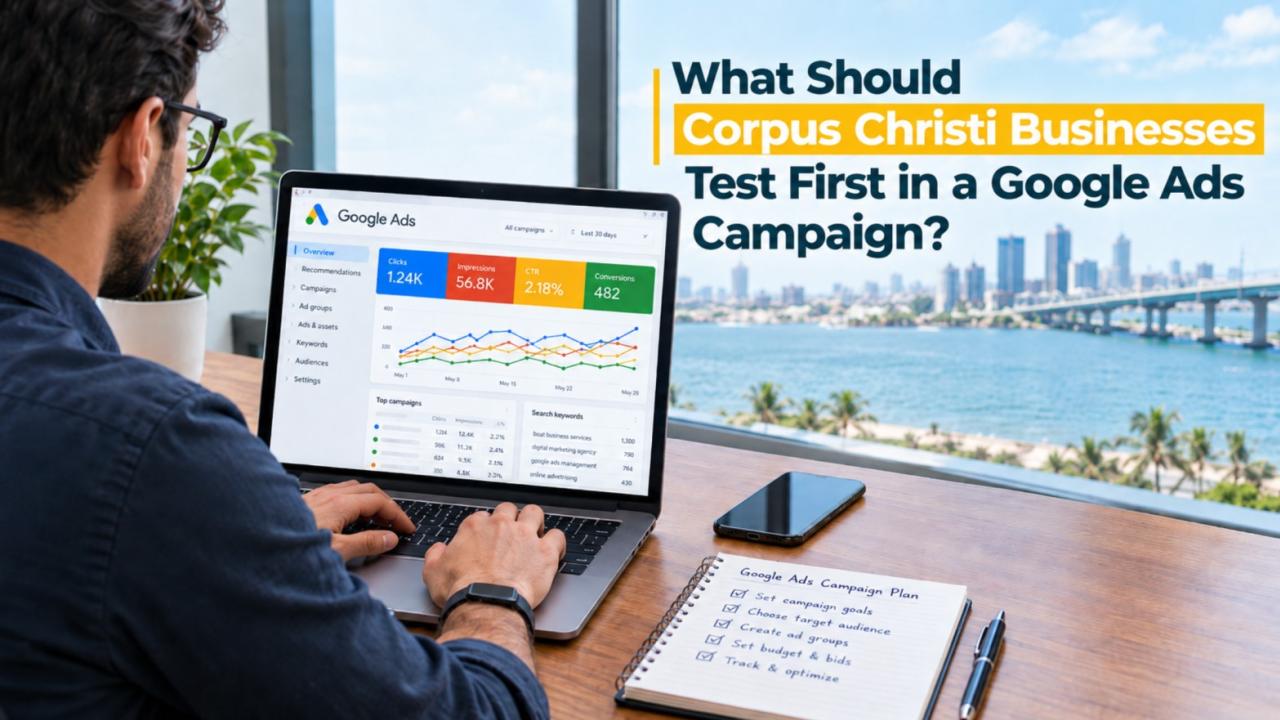
So before diving into every possible tweak, it helps to know which tests move the needle first, especially for a coastal, tourism-heavy, fast-growing market like Corpus Christi.
Start With Search Intent, Not Just Search Volume
Before touching ad copy or bidding strategy, the first thing worth testing is intent. Corpus Christi has a mix of year-round residents, seasonal visitors, and a strong base of local service seekers, from HVAC repair to boat maintenance to storage rentals.
That mix means the same keyword can carry very different intent depending on who's typing it.
This is where Google Search Ads become the foundation of the entire strategy. Search campaigns capture people actively looking for a solution right now, which makes them the most reliable starting point for testing.
Rather than guessing which keyword phrases convert best, businesses should launch a small, controlled set of keyword groups, branded terms, service-specific terms, and location-specific terms like "near Corpus Christi" or "Corpus Christi Google Ads" targeted content, and measure which group brings in the highest-quality clicks, not just the most clicks.
This single step, done early, often reveals surprising results. A tile installer might discover that "bathroom tile Corpus Christi" outperforms a broader term like "flooring contractor," simply because it matches what someone is actually ready to buy.
Intent testing works in both directions, though. Alongside building out keyword groups, it's worth building a negative keyword list from day one, excluding obvious budget-drainers like "jobs," "salary," "DIY," or "free," depending on the industry. Skipping this step is one of the fastest ways to burn through a daily budget on clicks that were never going to convert in the first place.
Test Ad Copy Before Anything Else Gets Fancy
Once search intent is confirmed, ad copy testing comes next. This is one of the most underrated levers in Google Ads optimization, largely because it's inexpensive and fast to execute.
Two or three headline variations, tested against each other for a week or two, will almost always reveal a clear winner in click-through rate.
The mistake many local businesses make is writing one ad and considering the job done. A stronger approach treats every ad as a hypothesis. Does mentioning a fast response time outperform mentioning a price point?
These are small, decisive tests, and a natural entry point into the broader discipline of A/B testing, which is essentially the engine behind every meaningful improvement in paid search.
Headlines aren't the only thing worth testing, either. Call extensions, sitelinks, and location assets deserve just as much attention, especially in a market like Corpus Christi, where a local searcher often converts straight from the ad itself, tapping a phone number or a map pin, without ever landing on a website.
Testing which combination of these earns the most engagement can quietly outperform even the best headline.
Landing Pages Deserve Equal Attention
A common and costly assumption is that a great ad automatically leads to a great result. It doesn't, if the landing page fails to deliver on what the ad promised.
Landing page testing is where many Corpus Christi campaigns quietly lose money, because the click was won but the conversion was lost.
The fix isn't complicated. Test one variable at a time: a shorter contact form against a longer one, a phone number front and center against a scheduling widget, a photo of the actual storefront against a stock image.
Local trust signals matter enormously in a community-sized market, where people often recognize business names from daily life. A page that feels local and specific will typically outperform a generic, corporate-feeling one, even with an identical ad driving traffic to it.
Conversion Tracking Is the Test That Makes Every Other Test Meaningful
None of the tests above matter without accurate conversion tracking in place first. This is easy to overlook because it doesn't feel like a "test" in the traditional sense, but it's arguably the most important one.
Without knowing which clicks turn into calls, form fills, or bookings, every other optimization is a guess dressed up as data.
Setting up call tracking, form tracking, and in-store visit tracking where relevant should happen before a dollar is spent testing anything else.
This single step turns every future test, from keyword testing to landing page testing, from a hunch into a measurable outcome, and it keeps businesses optimizing for customers instead of cheap clicks.
Choose the Right Bidding Strategy Before Automating Anything
One test that gets skipped far too often is the bidding strategy itself. It's tempting to hand control to an automated approach like Target CPA right out of the gate, but automated bidding needs data to learn from, and a brand-new campaign doesn't have any yet.
Starting with Manual CPC, or Maximize Clicks with a firm cost cap, gives a campaign a few weeks to gather real conversion data before an algorithm starts making decisions.
Once tracking is confirmed and enough data has come in, that's the point to test a switch toward automation — not before.
Let Local PPC Performance Guide the Budget, Not the Other Way Around
Once intent, ad copy, landing pages, and tracking are all being tested in a structured way, budget decisions become far easier. Rather than spreading spend evenly across every keyword group out of caution, the data starts to show where local PPC advertising actually earns its keep.
Some campaigns will show that mobile searches during evening hours convert better than desktop searches during the day. Others will reveal that one specific service line, say emergency repairs versus routine maintenance, carries a dramatically lower cost per lead.
This is the natural progression of PPC campaign testing: start narrow, learn fast, and let real performance numbers reshape the strategy over time.
A paid search strategy built this way tends to be far more resilient than one built purely on assumptions, because it's constantly being corrected by fresh data rather than a single upfront plan.
Make Every Dollar Count in Your Next Google Ads Campaign
None of this requires an enormous ad spend. It requires a sequence: confirm intent, test copy, test landing pages, track conversions properly, and only then scale the budget toward what's proven to work.
Corpus Christi businesses that follow this order tend to outperform competitors spending two or three times as much, simply because every dollar is being pointed at something that's already shown it works.
Skipping steps to launch faster is tempting, but it usually means paying full price to learn lessons that structured testing would have revealed for a fraction of the cost.
For businesses ready to stop guessing and start testing with a clear plan, working with an experienced corpus christi seo company can turn this testing framework into a genuine competitive advantage, one where every click, every headline, and every landing page is working exactly as hard as it should.
Reach out today to build a Google Ads strategy that's tested, tracked, and built to convert from day one.