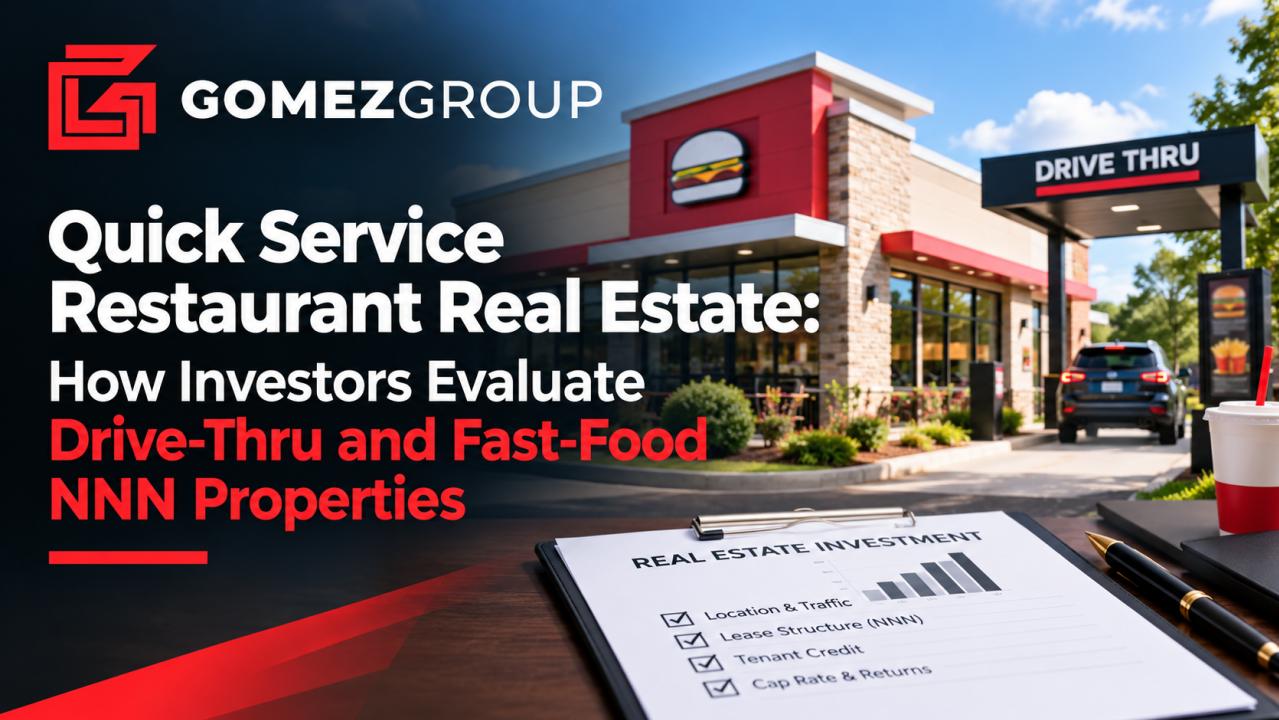
Quick service restaurant (QSR) real estate combines several characteristics that can appeal to commercial real estate investors: recognizable restaurant concepts, high-traffic locations, drive-thru access, long-term leases, and potentially predictable rental income. However, not every fast-food property offers the same investment profile.
A successful evaluation requires more than looking at the asking price or capitalization rate. Investors typically examine the lease structure, restaurant sales performance, site visibility, traffic patterns, tenant financial strength, franchise agreement, remaining lease term, rent increases, property condition, and potential exit value.
For investors considering a restaurant investment property, understanding how these factors interact can help provide a more complete picture of the opportunity.
What Is Quick Service Restaurant Real Estate?
Quick service restaurant real estate refers to commercial properties occupied by restaurants that generally emphasize speed, convenience, limited table service, and high transaction volume. These properties can include standalone buildings, pad sites, drive-thru locations, and restaurant units within larger retail developments.
Common QSR categories include:
- Burger restaurants
- Chicken restaurants
- Mexican fast-food concepts
- Sandwich shops
- Coffee and beverage concepts
- Pizza restaurants
- Breakfast-focused QSRs
- Convenience-oriented food concepts
From an investment perspective, the real estate can be structured under different lease arrangements. A property may have a traditional retail lease, a modified gross lease, or a net lease.
A QSR net lease property is particularly relevant to investors because the lease can transfer some property-related expenses to the tenant.
Why Investors Consider Fast-Food Investment Property
A fast food investment property can have several characteristics that distinguish it from other retail assets.
1. Established Consumer Demand
Restaurants serving frequently purchased products can benefit from recurring consumer demand. However, demand varies significantly by concept, location, competition, pricing, and local demographics.
2. Drive-Thru Convenience
Drive-thru access can be an important component of restaurant performance. It allows customers to purchase food without entering the building and can increase convenience for commuters, families, and nearby workers.
3. High-Visibility Locations
Many QSR properties are positioned along major roads, intersections, shopping corridors, and high-traffic commercial areas. Visibility can contribute to customer awareness and support the tenant's operations.
4. Long-Term Leases
Some restaurant properties are offered with long-term leases, potentially giving investors greater income visibility than short-term retail arrangements.
5. Net Lease Structures
Under a restaurant NNN lease, the tenant generally assumes responsibility for expenses such as property taxes, insurance, and maintenance, subject to the specific lease language.
Investors should always review the actual lease rather than assuming that every property marketed as NNN allocates expenses identically.
How to Evaluate a Drive-Thru Restaurant Investment
A drive-thru restaurant investment should be evaluated as both a real estate asset and an operating business location.
The restaurant's financial performance can influence the tenant's ability to remain in the property and pay rent, while the real estate itself determines long-term usability and resale potential.
Here are the major factors investors should examine.
1. Location and Traffic
Location is one of the first considerations when analyzing a QSR property.
Investors should review:
- Average daily traffic
- Traffic direction and patterns
- Road visibility
- Intersection positioning
- Access points
- Nearby highways
- Median restrictions
- Turning movements
- Signalized intersections
- Population density
- Daytime population
- Household growth
- Nearby employment centers
- Competition from other restaurants
A property on a busy road is not automatically a strong investment. Traffic must also be accessible to customers.
For example, a restaurant may have substantial road exposure but limited accessibility because of restricted turns or difficult ingress and egress.
Visibility vs. Accessibility
Investors should distinguish between visibility and accessibility.
Visibility determines how easily motorists can see the property.
Accessibility determines how easily customers can reach it.
An ideal site can provide both.
2. Drive-Thru Configuration
The physical drive-thru layout deserves detailed attention.
Investors should examine:
- Number of drive-thru lanes
- Queue length
- Entrance and exit configuration
- Stacking capacity
- Menu-board placement
- Pickup-window configuration
- Parking availability
- Pedestrian circulation
- Delivery access
- Site circulation
- Potential traffic conflicts
A constrained drive-thru can create operational problems during peak periods.
Investors should also determine whether the current site configuration can accommodate future changes in restaurant operations.
3. Tenant and Operator Strength
The quality of the real estate does not eliminate tenant risk.
An important component of QSR underwriting is understanding who actually operates the restaurant.
This is where franchise operator credit becomes important.
A nationally recognized restaurant brand may have thousands of locations, but the tenant on a particular lease could be an individual franchisee or franchise operating company.
Investors should investigate:
- Legal tenant entity
- Franchisee ownership
- Number of locations operated
- Operating history
- Financial statements, when available
- Rent coverage
- Franchise agreement
- Corporate guarantees
- Personal guarantees, where applicable
- Default history
- Lease obligations
- Financial strength of the guarantor
The brand name and lease guarantor are not necessarily the same entity.
4. Lease Structure
The lease is one of the most important documents in evaluating a restaurant NNN property.
Investors should review the entire lease rather than relying solely on marketing terminology.
Important provisions include:
Remaining Lease Term
A property with a long remaining lease term may provide greater income visibility than one approaching expiration.
However, lease term should be considered alongside rent levels, tenant strength, renewal options, and market rents.
Renewal Options
Determine:
- Number of renewal options
- Length of each option
- Exercise requirements
- Rent during renewal periods
- Notice requirements
- Whether options are controlled by the tenant
Rent Escalations
Look for scheduled increases and determine whether they are:
- Fixed percentage increases
- Fixed dollar increases
- CPI-based
- Market-based
- Limited by a cap or floor
Rent growth can affect both future income and potential property value.
Expense Responsibilities
Under a typical NNN arrangement, the tenant may be responsible for taxes, insurance, and maintenance.
But the precise allocation matters.
Review who is responsible for:
- Roof
- Structure
- Parking lot
- HVAC
- Plumbing
- Landscaping
- Property taxes
- Insurance
- Capital expenditures
- Code compliance
Lease language can vary substantially between properties.
5. Restaurant Sales and Rent Coverage
Real estate investors should understand the relationship between restaurant sales and contractual rent.
A restaurant generating strong sales may have greater capacity to support its rent obligations, while weak sales can create additional tenant risk.
One commonly examined concept is the rent-to-sales ratio.
The calculation is generally:
Annual Base Rent ÷ Annual Restaurant Sales × 100
For example, if annual rent is $180,000 and annual sales are $2 million:
$180,000 ÷ $2,000,000 × 100 = 9%
The ratio should not be interpreted in isolation. Appropriate levels can vary by restaurant concept, market, operating model, occupancy costs, and other expenses.
Investors should also consider whether reported sales are current and whether the information comes from reliable documentation.
6. Cap Rate
The capitalization rate is another major metric used in evaluating restaurant real estate.
The basic formula is:
Cap Rate = Net Operating Income ÷ Purchase Price
For example, if a property produces $300,000 of annual NOI and is offered for $5 million:
$300,000 ÷ $5,000,000 = 6.0%
A higher cap rate does not automatically indicate a better investment.
The cap rate should be considered alongside:
- Lease term
- Tenant credit
- Rent increases
- Location
- Property condition
- Market fundamentals
- Replacement cost
- Financing conditions
- Re-leasing risk
- Exit assumptions
Two QSR properties with identical cap rates can have very different risk profiles.
Restaurant Investment Property: What Makes the Real Estate Valuable?
A restaurant investment property has value beyond the existing tenant's lease.
Investors should ask what happens if the current restaurant operator leaves.
This is especially important for single-tenant properties.
Questions to Ask
- Can another restaurant operate at the site?
- Is the zoning appropriate?
- Is the drive-thru legally permitted?
- Are there restrictions on restaurant use?
- Is the building adaptable?
- Is there adequate parking?
- Does the property have sufficient utility capacity?
- Are the building and site economically reusable?
- Is the location attractive to competing restaurant concepts?
A highly specialized building may have a narrower pool of replacement tenants.
7. Building and Site Condition
A long-term NNN lease does not necessarily eliminate the investor's need to understand the physical condition of the property.
Due diligence should examine:
- Roof condition
- HVAC systems
- Building structure
- Plumbing
- Electrical systems
- Parking lot
- Signage
- Drive-thru equipment
- Exterior improvements
- Drainage
- Landscaping
- ADA compliance
- Environmental conditions
Even when the tenant is responsible for maintenance, major physical issues can influence the property's long-term value and future marketability.
8. Franchise Agreement Considerations
Franchise-operated QSR properties require another layer of analysis.
The lease and franchise agreement may interact in ways that affect the investment.
Investors should understand:
- Franchise expiration date
- Renewal rights
- Transfer provisions
- Franchise termination rights
- Required property improvements
- Remodeling obligations
- Brand standards
- Assignment requirements
A franchisee may have a long real estate lease but a different franchise agreement expiration date.
That distinction can matter when assessing tenant continuity.
9. Brand Strength vs. Real Estate Fundamentals
Brand recognition can be useful, but investors should avoid evaluating a property solely because a well-known restaurant occupies it.
A recognizable tenant can operate from an inferior location, while a smaller concept can occupy highly desirable real estate.
The analysis should therefore separate:
Brand risk + operator risk + lease risk + real estate risk
This creates a more comprehensive underwriting framework.
QSR Net Lease vs. Traditional Restaurant Investment
Not all restaurant properties have the same investment characteristics.
| Factor | QSR Net Lease | Traditional Restaurant Property |
|---|---|---|
| Lease structure | Often net-based | Can vary |
| Expense responsibility | Often shifted toward tenant | May be shared |
| Tenant operations | Frequently franchise or corporate | May be independent |
| Drive-thru | Common in many concepts | Less universal |
| Lease term | Can be long-term | Varies |
| Tenant improvements | Often brand-specific | Varies |
| Re-leasing | Depends on site adaptability | Depends on property |
| Investor focus | Lease + tenant + real estate | Operations + lease + real estate |
The specific lease always takes precedence over assumptions based on property type.
10. Analyze Rent Escalations Carefully
Rent increases can significantly affect the long-term economics of a QSR property.
Suppose a property starts with $200,000 annual rent and includes 2% annual increases.
Future rent can be modeled as:
Future Rent = Current Rent × (1 + Annual Increase)^Years
After 10 years:
$200,000 × (1.02)^10 ≈ $243,799
Investors can use these projections to estimate future contractual income.
However, rising contractual rent can eventually become a consideration for the tenant if sales growth does not keep pace.
Therefore, investors should evaluate rent growth alongside tenant sales and market rental rates.
11. Understand Remaining Lease Term
Remaining lease term is especially important for single-tenant restaurant assets.
Consider two properties:
Property A
- 15 years remaining
- Strong operator
- Scheduled rent increases
Property B
- 3 years remaining
- Multiple renewal options
- Similar current rent
These properties may require very different underwriting assumptions even if their current cap rates are similar.
Investors should examine both the contractual term and the probability of continued occupancy based on documented lease and tenant information.
12. Evaluate Re-Tenanting Risk
A QSR property can be attractive because it is already configured for restaurant operations.
But investors should still consider what happens after lease expiration.
Potential replacement uses could include:
- Another QSR
- Coffee shop
- Fast-casual restaurant
- Drive-thru beverage concept
- Medical or service retail, subject to zoning
- Other retail uses
The more adaptable the property, the broader the potential replacement-tenant pool may be.
However, zoning, deed restrictions, parking requirements, drive-thru regulations, and site constraints can limit alternatives.
13. Market Rent Analysis
Contractual rent should be compared with market conditions.
If a tenant is paying substantially above market rent, an investor may face greater renewal risk.
If contractual rent is below market, the property may have potential upside—but only if market conditions and tenant economics support higher rent.
Comparable analysis should consider:
- Property location
- Building size
- Lot size
- Traffic
- Tenant quality
- Lease term
- Rent structure
- Rent increases
- Drive-thru configuration
- Recent sales
14. Financing a Fast Food Investment Property
Financing can materially affect an investor's returns.
Lenders may evaluate:
- Property value
- Lease term
- Tenant credit
- Debt-service coverage
- Loan-to-value ratio
- Interest rate
- Amortization
- Personal or corporate guarantees
- Property condition
A long-term lease with a strong tenant can provide lenders with greater visibility into contractual cash flow, but financing terms remain property- and borrower-specific.
Investors should model the impact of debt service rather than relying solely on the property's unleveraged cap rate.
15. Due Diligence Checklist for Restaurant NNN Properties
Before closing on a restaurant NNN property, investors can organize due diligence into several categories.
Lease Due Diligence
Review:
- Original lease
- Amendments
- Assignments
- Renewal options
- Rent schedule
- Expense obligations
- Default provisions
- Guarantees
- Insurance requirements
- Assignment rights
Tenant Due Diligence
Review, where available:
- Tenant financial information
- Operating history
- Franchise relationship
- Number of locations
- Credit information
- Guarantor strength
- Store sales trends
Property Due Diligence
Inspect:
- Roof
- HVAC
- Structure
- Parking
- Drive-thru
- Utilities
- Signage
- Site circulation
- Environmental conditions
Market Due Diligence
Analyze:
- Traffic
- Population
- Household growth
- Competition
- New development
- Nearby retailers
- Employment
- Consumer demographics
Common Mistakes Investors Make
Focusing Only on Cap Rate
Cap rate is important, but it does not tell the entire investment story.
Assuming the Brand Guarantees the Rent
A strong national brand does not necessarily mean the particular franchise operator has unlimited financial strength.
Ignoring Lease Details
Marketing materials may summarize a lease, but the actual document determines the parties' obligations.
Overlooking Property Condition
NNN ownership does not mean physical due diligence is unnecessary.
Ignoring Exit Strategy
Investors should consider the property's potential marketability at resale, not only its current income.
Treating All Drive-Thru Properties as Equivalent
Drive-thru design, access, traffic patterns, zoning, and site configuration can differ considerably.
How Investors Can Build a QSR Underwriting Model
A practical underwriting model can combine the following components:
Revenue
- Current contractual rent
- Scheduled rent increases
- Renewal assumptions
- Potential market rent
Expenses
- Owner-paid expenses
- Capital expenditures
- Management costs
- Financing costs
Tenant Analysis
- Operator strength
- Franchise structure
- Sales performance
- Lease coverage
- Remaining term
Real Estate Analysis
- Location
- Traffic
- Site access
- Building condition
- Reuse potential
- Comparable properties
Exit Analysis
- Expected holding period
- Projected NOI
- Exit cap rate assumption
- Selling costs
- Remaining lease term
This approach allows investors to assess the property from multiple perspectives instead of relying on one headline metric.
How QSR Properties Fit Into a Single-Tenant NNN Strategy
Many standalone restaurant properties fit within a broader single-tenant NNN strategy because they can combine a single occupant with a long-term lease and defined expense responsibilities.
Investors may use these properties as part of a diversified commercial real estate portfolio.
However, concentration risk should be considered.
For example, an investor owning several properties leased to the same restaurant concept may have greater exposure to changes affecting that particular brand or restaurant category.
Diversification can instead involve:
- Different restaurant concepts
- Different geographic markets
- Different tenant industries
- Different lease maturities
- Different property types
Examples of QSR and Restaurant Investment Opportunities
Investors researching restaurant real estate may encounter different property profiles.
For example, a Bojangles investment property can be evaluated based on its lease term, franchise operator, location, rent structure, site configuration, and underlying real estate.
Similarly, a Chipotle net lease property requires analysis of the tenant structure, lease economics, location, building characteristics, and potential long-term demand for the site.
An Applebee's NNN property may present another type of restaurant investment profile, where investors need to consider the lease, operator, restaurant format, site characteristics, and re-tenanting possibilities.
These examples demonstrate why investors should evaluate the specific property and lease, rather than assuming that all restaurant properties carry identical investment characteristics.
Final Takeaway
Evaluating Quick Service Restaurant Real Estate requires investors to look beyond the restaurant's name and advertised cap rate. The most useful analysis combines the lease, tenant, operator, site, building, market, and exit considerations into one investment framework.
A drive-thru location with strong visibility and accessibility may offer different characteristics from a restaurant with limited site access. Likewise, a long-term restaurant NNN lease with contractual rent increases should be analyzed alongside franchise operator credit, tenant economics, property condition, and future re-tenanting potential.
For investors considering restaurant and net lease opportunities, Gomez Group provides commercial real estate brokerage expertise focused on net lease and shopping center investments, helping investors evaluate opportunities based on their specific property and investment objectives.
Frequently Asked Questions
1.What is QSR net lease real estate?
QSR net lease real estate refers to quick service restaurant properties leased under a net lease structure. Depending on the lease, the tenant may be responsible for some or most property-related expenses in addition to base rent.
2.What is a restaurant NNN property?
A restaurant NNN property is generally a restaurant property leased under a triple-net structure in which the tenant is responsible for property taxes, insurance, and maintenance, subject to the specific lease provisions.
3.Is a drive-thru important when evaluating restaurant real estate?
Drive-thru functionality can be important because convenience and vehicle accessibility can influence restaurant operations. Investors should examine traffic, stacking capacity, ingress and egress, visibility, and site circulation.
4.What is franchise operator credit?
Franchise operator credit refers to the financial strength and ability of the franchisee or operating entity responsible for fulfilling the lease obligations. It should be evaluated separately from the national restaurant brand.
5.What should investors review before buying a Fast Food Investment Property?
Investors should review the lease, tenant and franchise structure, rent schedule, property condition, traffic, demographics, site access, zoning, competition, restaurant sales information when available, and potential re-tenanting options.