India Prepaid Cards Market Overview
The India prepaid cards market stands as a rapidly evolving
pillar of the nation's digital financial infrastructure, encompassing diverse
card types such as open loop cards and closed loop cards. The market is
extensively utilized across critical verticals, including
corporate/organization, retail, government, and others, fulfilling essential
purposes like general purpose reloadable (GPR) cards, payroll/incentive cards,
travel cards, and remittance cards. Geographically, the market spans major
commercial and administrative hubs across North India, West and Central India,
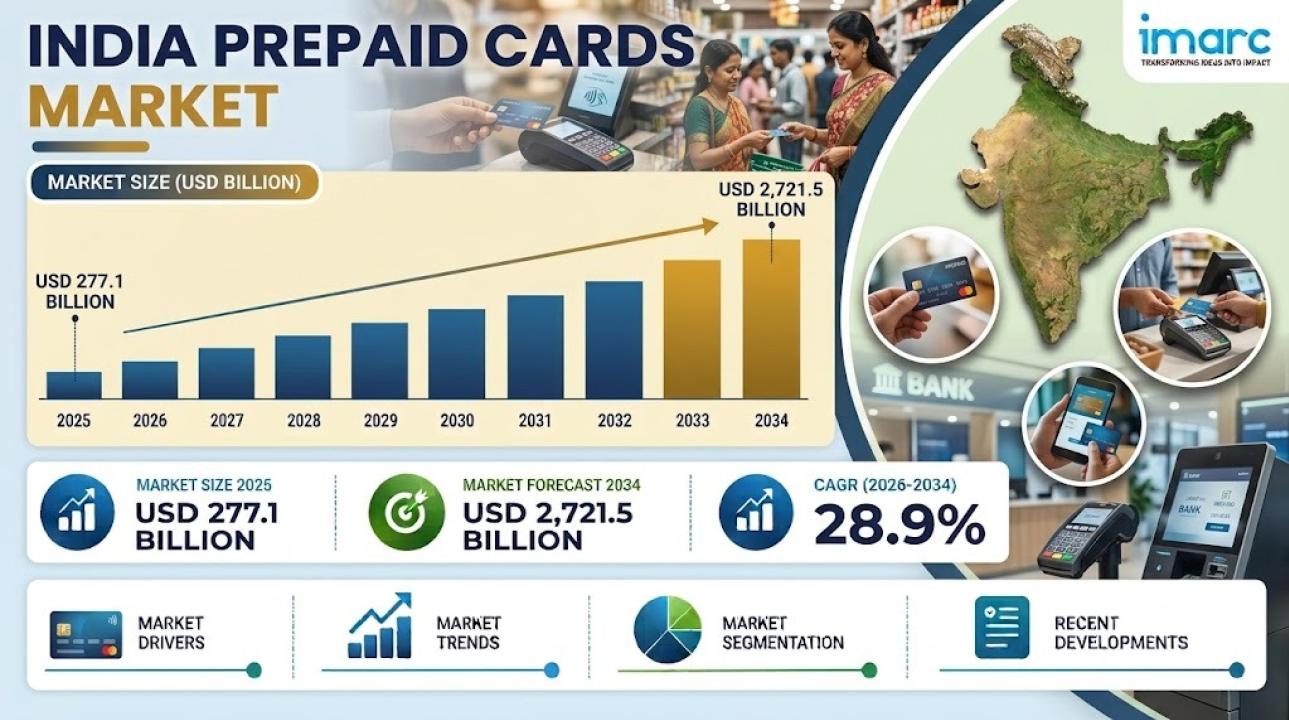
South India, and East India. The India prepaid cards market size reached USD
277.1 Billion in 2025 and is projected to reach USD 2,721.5 Billion
by 2034, exhibiting a compound annual growth rate (CAGR) of 28.9% during
2026-2034.
The market is expanding rapidly due to a powerful confluence
of proactive digital payment adoption, surging e-commerce activities, and
systemic modernization of corporate financial management. Enterprises are
aggressively replacing manual cash reimbursements with API-integrated expense
and payroll cards to ensure transparency and reduce administrative overheads.
Simultaneously, government bodies are scaling up Direct Benefit Transfer (DBT)
programs, utilizing prepaid instruments to securely disburse welfare funds and
scholarships. Supported by the Reserve Bank of India’s push for
interoperability and the booming neobank ecosystem targeting digital-native
demographics, the structural foundation for sustained prepaid card issuance and
volume growth is firmly established nationwide.
Market Snapshot
- Current
Market Size (2025): USD 277.1 Billion
- Projected
Market Size (2034): USD 2,721.5 Billion
- CAGR:
28.9%
- Open
loop cards lead the card type segment with a 72.0% share in 2025, driven
by their universal acceptance on major networks across POS terminals,
e-commerce platforms, and ATMs both domestically and internationally.
- The
corporate/organization vertical commands a 36.0% market share in 2025,
propelled by enterprise payroll cards for contract workers, fleet fuel
cards, and travel and expense management solutions.
- North
India accounts for the largest regional market share at 32.0% in 2025,
anchored by the dense concentration of corporate headquarters and major
government ministries driving both enterprise and state-level card
issuance.
What Growth Factors Are Driving India Prepaid Cards
Market?
- Shift
Toward Digital Payments and Contactless Transactions:
The continuous structural shift from cash to digital
payments serves as a primary growth catalyst for the prepaid cards market
across India. Triggered by historic demonetization and accelerated by the
pandemic, consumers now inherently prefer contactless digital transactions for
everyday retail purchases. Prepaid cards offer an accessible, secure, and
user-friendly digital payment method for the unbanked and underbanked
populations. The widespread deployment of point-of-sale infrastructure and
rapid adoption of digital wallets consistently encourage the widespread
issuance and utilization of general purpose reloadable cards nationwide.
- Expansion
of Corporate Expense and Payroll Programs:
The corporate sector is aggressively adopting prepaid cards
to modernize financial operations, streamline expense management, and optimize
payroll distribution. Businesses increasingly issue dedicated prepaid cards for
employee meal allowances, fuel reimbursements, fleet management, and sales
incentive programs. Furthermore, with the amendment to the Payment of Wages Act
supporting digital disbursements, enterprises are widely utilizing payroll
cards for contract and blue-collar workers. This transition significantly
reduces administrative overheads, ensures transparent financial tracking, and
effectively eliminates the logistical complexities historically associated with
manual cash handling.
- Scaling
of Government Direct Benefit Transfers:
Government initiatives aimed at enhancing financial
inclusion are playing a monumental role in driving India's prepaid card
adoption. The rapid scale-up of the Direct Benefit Transfer system utilizes
prepaid instruments to disburse welfare funds, scholarships, and housing
allowances directly to beneficiaries. By replacing highly inefficient cash
distribution networks with secure digital cards, state and central governments
can eliminate leakages and ensure transparent fund allocation. This systemic
digitalization of welfare disbursements continues to expand the government
vertical's market share while bringing millions into the formal economy.
- Surging
E-commerce and Mobile Commerce Activities:
The exponential growth of the Indian e-commerce landscape is
creating robust demand for highly secure digital payment instruments. Consumers
who lack access to traditional credit cards increasingly rely on open-loop
prepaid cards to participate in online shopping, digital subscriptions, and
mobile gaming. These reloadable cards offer a critical layer of financial
security by limiting potential fraud exposure to the pre-loaded balance, which
strongly appeals to security-conscious digital shoppers. This growing
confidence in online transactions perpetually fuels the issuance of versatile
virtual prepaid cards nationwide.
- Need
for Secure Travel and Forex Solutions:
As international travel and cross-border business
engagements rebound, the demand for multi-currency forex prepaid cards has
surged dramatically. These specialized travel cards provide exceptional
convenience for international travelers, students studying abroad, and
corporate executives by allowing them to lock in exchange rates and avoid
exorbitant international transaction fees. Unlike conventional debit or credit
cards, forex prepaid cards eliminate currency fluctuation risks while offering
superior global acceptance. This functional superiority continues to drive
substantial adoption across both leisure and corporate travel demographics
seamlessly.
➤ Request Sample Report
– TOC, Charts & Key Insights: https://www.imarcgroup.com/india-prepaid-cards-market/requestsample
What Are the Latest Emerging Trends in India Prepaid
Cards Market?
- Integration
of UPI with Prepaid Instruments:
The regulatory mandate enforcing interoperability among
Prepaid Payment Instruments has fundamentally transformed the Indian market. By
enabling prepaid card balances to be seamlessly transacted via Universal
Payments Interface QR codes at any accepting merchant, issuers have drastically
amplified the everyday utility of their products. This deep structural
integration bridges the gap between traditional card networks and instantaneous
mobile payments, allowing users to effortlessly transfer funds across different
digital wallets. Consequently, this unparalleled flexibility accelerates
widespread consumer adoption and boosts overall transaction volumes
significantly.
- Rise
of Virtual and Instant Issuance Cards:
Driven by the demand for immediate gratification and
digital-first experiences, there is a prominent shift toward virtual prepaid
cards. Major banking institutions and fintech startups are heavily promoting
instantly issued, numberless virtual cards that seamlessly reside within mobile
banking applications. These innovative virtual instruments eliminate physical
manufacturing costs, instantly facilitate secure online purchases, and
significantly reduce the environmental footprint associated with traditional
plastic. The enhanced security features, such as dynamic CVVs and rapid card
freezing capabilities, make them exceptionally attractive to modern, tech-savvy
consumers.
- Emergence
of Fintech and Neobank Partnerships:
The dynamic collaboration between agile fintech startups and
traditional banking powerhouses is rapidly reshaping the prepaid ecosystem.
Neobanks are heavily disrupting the market by launching highly customized,
co-branded prepaid cards targeting specialized niche demographics, including
university students, teenagers, and independent gig economy workers. These
modern, software-led prepaid programs offer intuitive financial tracking
dashboards, automated budgeting tools, and highly engaging rewards systems. By
leveraging application programming interfaces, fintechs can instantly deploy
bespoke corporate expense management platforms, effectively capturing
high-growth segments largely underserved by legacy banks.
- Adoption
of Unified Transit and Mobility Cards:
Urban mobility is experiencing a profound transformation
with the widespread rollout of unified transit prepaid cards under the National
Common Mobility Card initiative. Designed to function seamlessly across
extensive metro rail networks, regional bus systems, and designated toll
plazas, these closed-loop and open-loop hybrid cards drastically simplify the
daily commuting experience. Commuters no longer need to carry multiple tickets
or exact change, relying instead on a single reloadable instrument. This unparalleled
convenience actively encourages mass public transit adoption while consistently
increasing localized transaction volumes.
- Customization
of Premium Gift and Reward Cards:
The retail and corporate gifting landscapes are aggressively
moving away from traditional paper vouchers toward sophisticated, highly
customizable prepaid gift cards. Corporations are systematically integrating
these premium reloadable cards into comprehensive employee recognition
frameworks, festive bonus distributions, and diverse client loyalty
initiatives. Furthermore, retail consumers increasingly prefer the unparalleled
flexibility that versatile open-loop gift cards provide, granting recipients ultimate
purchasing freedom across various platforms. The ability to intricately
personalize card designs and seamlessly deliver virtual variants instantly
accelerates their immense popularity across the country.
How will India Prepaid Cards Market Evolve in the Coming
Years?
The India prepaid
cards market outlook remains exceptionally robust through 2034, driven by
the compounding impact of India's structural shift toward a digital-first
economy. The market is projected to expand dramatically from USD 277.1 Billion
in 2025 to USD 2,721.5 Billion by 2034 at a massive CAGR of 28.9%. As fintech
innovation accelerates and regulatory frameworks promote seamless
interoperability, the lines between traditional banking and digital wallets
will blur further. Financial institutions and neobanks that leverage advanced
API integrations to deliver highly customizable corporate expense platforms,
while simultaneously addressing the bespoke needs of the tech-savvy retail
consumer, will successfully capture the highest incremental market share over
the next decade.
How Is India's Prepaid Cards Market Segmented?
➤ By Card Type
- Open
Loop Cards (72.0% market share in 2025)
- Closed
Loop Cards (28.0% market share in 2025)
➤ By Vertical
- Corporate/Organization
(36.0% market share in 2025)
- Retail
(28.5% market share in 2025)
- Government
(21.7% market share in 2025)
- Others
(13.8% market share in 2025)
➤ By Purpose
- General
Purpose Reloadable (GPR) Cards (30.0% market share in 2025)
- Payroll/Incentive
Cards
- Travel
Cards
- Remittance
Cards
- Others
➤ By Region
- North
India (32.0% market share in 2025)
- West
and Central India (27.4% market share in 2025)
- South
India (24.1% market share in 2025)
- East
India (16.5% market share in 2025)
Request Customized Data Tailored to Your Interest
Note: If you require any specific information not covered
within this report's scope, we will provide it as part of the customization.
Competitive Landscape — By IMARC GROUP
The market is moderately concentrated and features a dynamic
interplay between legacy banking institutions, agile fintech startups, and
specialized non-bank PPI issuers. Major private and public sector banks
leverage their vast distribution networks, inherent regulatory trust, and
comprehensive financial ecosystems to maintain dominant market shares.
Concurrently, specialized platforms like EbixCash and Pluxee India are
cementing their leadership in specific corporate niches, such as meal vouchers
and expense management. The competitive landscape is rapidly evolving as
fintech-banking partnerships introduce API-driven, highly programmable prepaid
solutions tailored explicitly for digital-native demographics and modern
enterprises.
Key players covered in the report include:
- HDFC
Bank Ltd.: The market leader boasting the largest private bank prepaid
card issuance, offering a comprehensive suite including GiftPlus,
FlexiBenefit, and robust corporate card management platforms.
- Axis
Bank Limited: A formidable co-leader recognized for its extensive Visa
and RuPay portfolio, offering contactless travel cards, min-KYC meal
cards, and integrated corporate payroll programs.
- ICICI
Bank Limited: A co-leader driving innovation through iMobile
Pay-linked prepaid cards, instant virtual card issuance, and specialized
products like the Student Card and PayDirect.
- State
Bank of India: A strong challenger leveraging the nation's largest
branch network to distribute a vast RuPay portfolio, highly active in
government DBT programs and various transit-linked prepaid solutions
(e.g., Nation First Transit, Nagpur Metro Maha).
- Kotak
Mahindra Bank Limited: A strong challenger focusing on a tech-first
customer experience, offering robust solutions like Kotak FASTag,
multi-currency Forex cards, and digital-centric spend management tools.
- EbixCash:
A prominent non-bank PPI issuer dominating specific corporate niches,
offering extensive solutions for payroll distribution and employee travel
expense management.
- Pluxee
India: A major player leading the corporate employee benefits sector
with its widely accepted meal, reward, and specialized incentive prepaid
cards.
Note: If you need specific information that is not
currently within the scope of the report, we can provide it to you as a part of
the customization.
Frequently Asked Questions (FAQs)
How big is the prepaid cards market in India?
➤ The India prepaid cards market
reached USD 277.1 Billion in 2025, supported by the massive digitization of
corporate payrolls and expanding direct benefit transfer programs.
What is the projected growth rate of the India prepaid
cards market?
➤ The market is projected to
reach USD 2,721.5 Billion by 2034, registering an exceptional compound annual
growth rate (CAGR) of 28.9% between 2026 and 2034.
What are the key factors driving market growth?
➤ Key drivers include the
widespread structural shift from cash to digital payments, the systemic
integration of UPI interoperability, rising e-commerce transactions, and
massive government support for digital welfare disbursements.